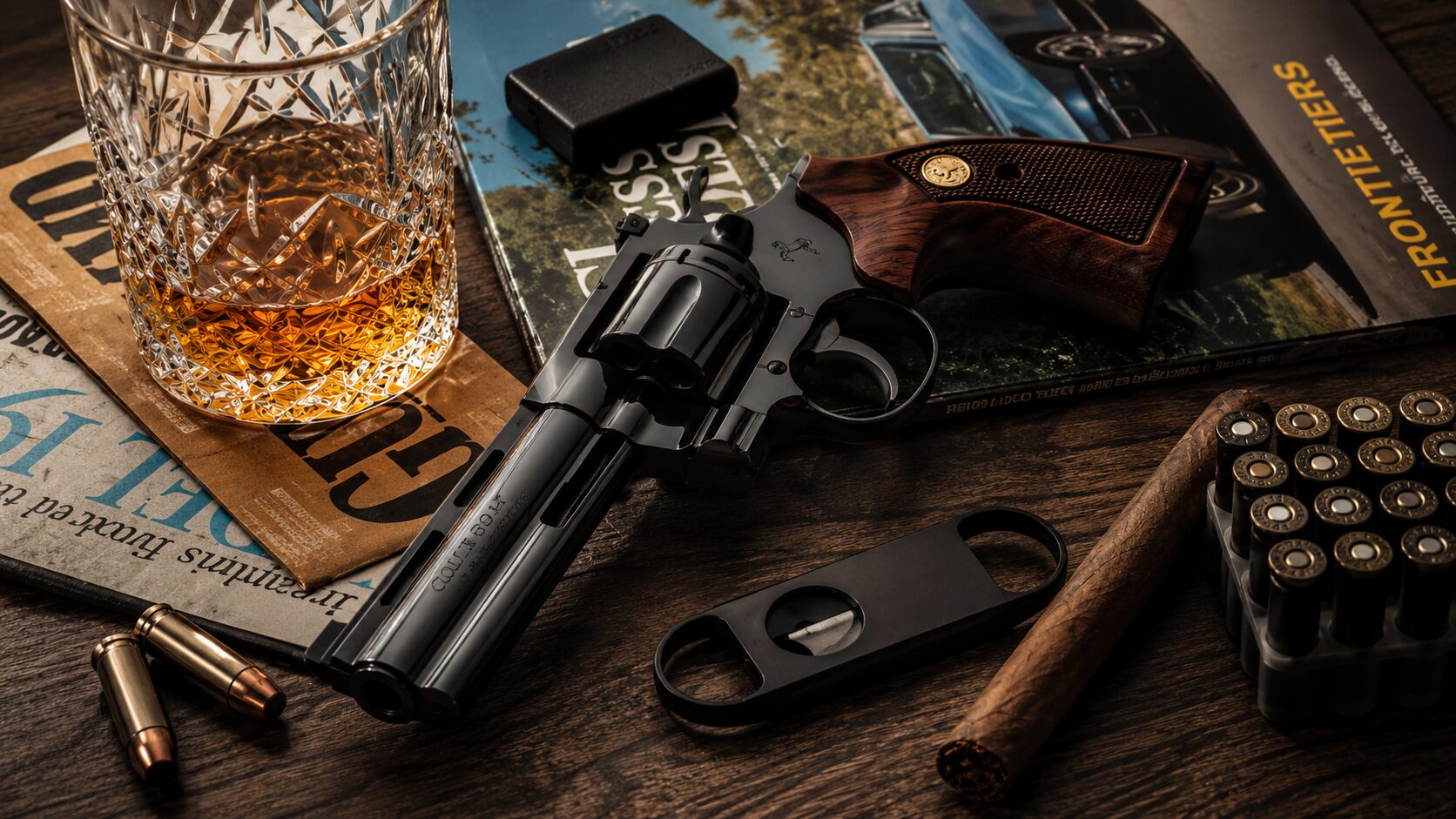
For most firearms enthusiasts, the name Colt Python immediately brings to mind one of the finest revolvers ever built. With its hand-fitted action, elegant profile, and exceptional accuracy, the Python has earned legendary status. Yet within Colt’s famous “Snake Gun” family, there is another revolver that is even rarer—and often far more valuable.
That revolver is the Colt Boa.
Produced only once in an extremely limited run, the Boa was never intended to become a legend. Fewer than 1,200 revolvers were manufactured before the model disappeared from Colt’s lineup for decades. Today, an original Colt Boa is considered one of the most desirable production revolvers ever made, with pristine examples commanding tens of thousands of dollars at auction.
An Experiment That Became a Legend
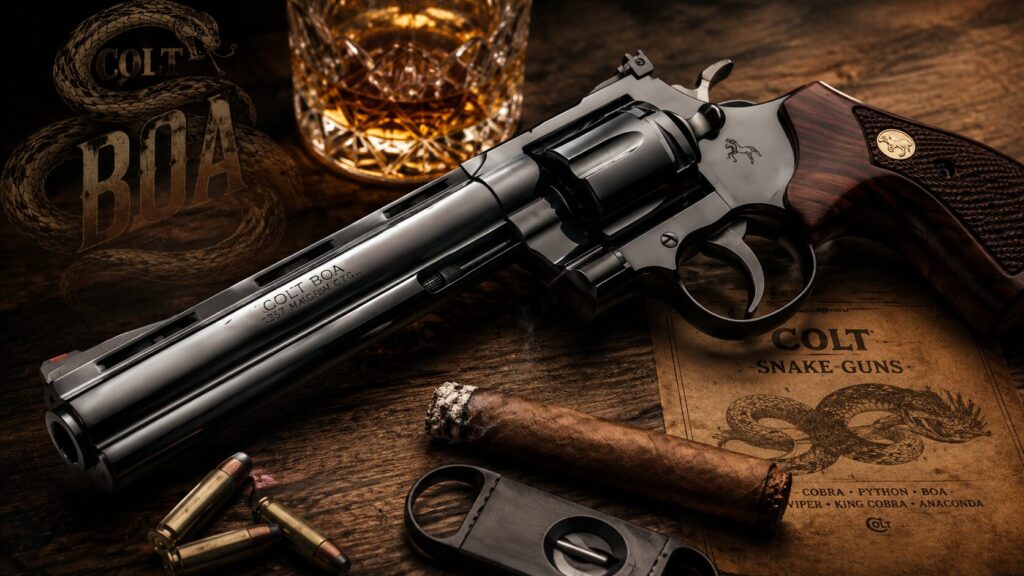
The story of the Colt Boa did not begin in Colt’s engineering department.
Instead, it started in the mid-1980s when American firearms distributor Lew Horton Distributing approached Colt with an unusual proposal: create an exclusive revolver available only through their retail network.
The idea made perfect business sense.
The Colt Python had long been regarded as the company’s flagship revolver, but it was also extremely expensive to manufacture because of the extensive hand fitting required during production.
At the same time, Colt was already producing the more affordable Trooper Mk V, a revolver with a stronger, more modern action that required significantly less labor.
So why not combine the strengths of both models?
That simple question gave birth to the Colt Boa.
A Hybrid of Two Colt Classics
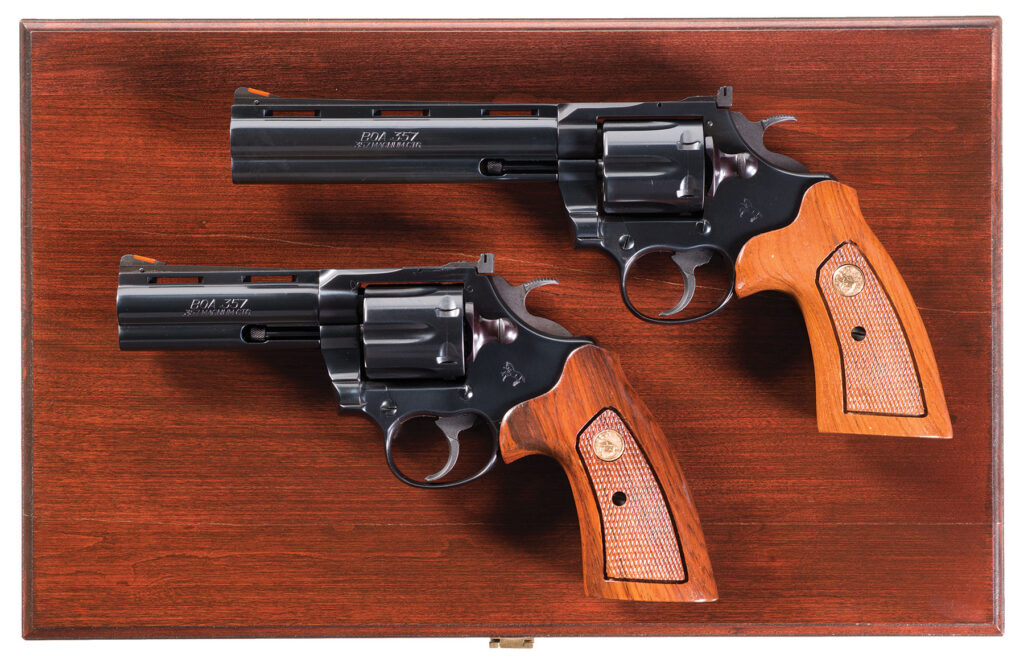
Mechanically, the Boa was something of a hybrid.
It combined:
- the frame and action of the Trooper Mk V;
- the heavy ventilated-rib barrel of the Python;
- a full-length barrel underlug;
- adjustable target sights;
- premium walnut grips with Colt medallions.
The result was a revolver that looked almost identical to the Python while being considerably less expensive to produce.
Because of its appearance, many people mistakenly assume the Boa is simply another version of the Python. In reality, its internal mechanism is entirely different.
Why Were So Few Made?
This is the part of the story that transformed the Boa into one of the most sought-after Colt revolvers in history.
The company never intended to make it a regular production model.
In 1985, Colt fulfilled Lew Horton’s special order and stopped production immediately afterward.
The total production amounted to only 1,200 revolvers:
- 600 with 4-inch barrels
- 600 with 6-inch barrels
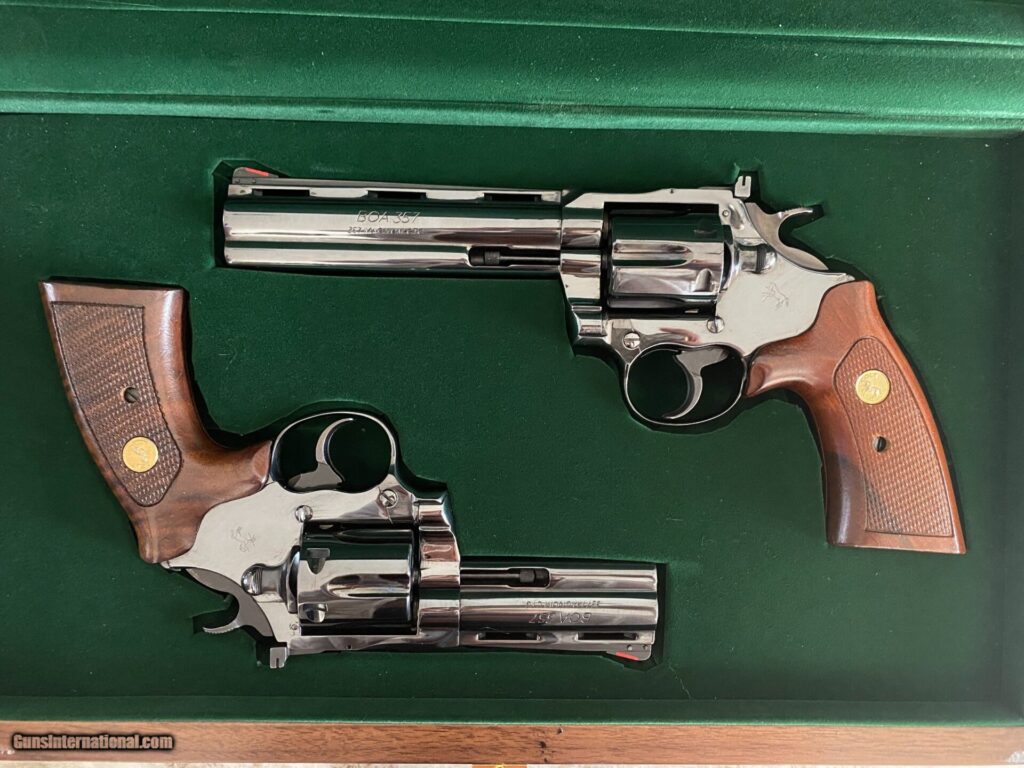
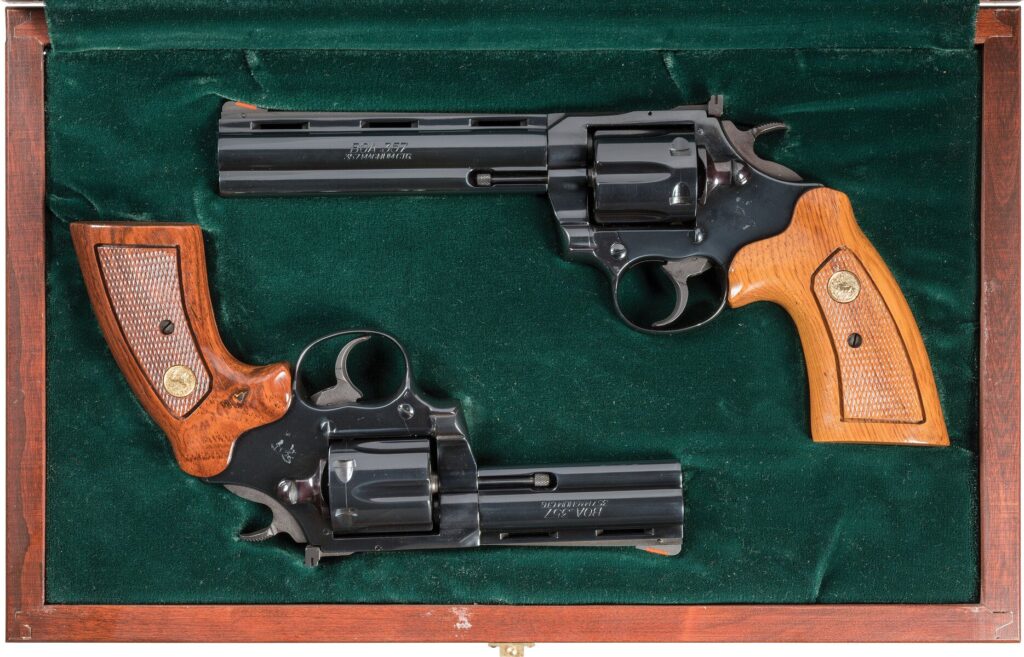
Among these, the first 100 four-inch and 100 six-inch revolvers were sold together as deluxe matched pairs featuring consecutive serial numbers.
Today, these presentation sets are considered the ultimate prize for Colt collectors.
Why Didn’t Colt Continue Production?
The answer lies in the company’s financial situation during the 1980s.
Colt was facing increasing competition, rising manufacturing costs, and significant financial pressure.
The company was already reducing production of labor-intensive revolvers in favor of more profitable firearms.
The Boa was never designed as a permanent addition to Colt’s catalog.
It was simply a limited-edition project created for one distributor.
Once the contract had been fulfilled, the tooling was retired and the revolver quietly disappeared.
How the Boa Differs from the Python
At first glance, distinguishing a Boa from a Python can be surprisingly difficult.
Internally, however, they are very different firearms.
The Python uses Colt’s classic V-spring action, famous for its exceptionally smooth trigger pull but also for its complexity and the extensive hand fitting required during assembly.
The Boa inherited the Trooper Mk V action, which offered several practical advantages:
- fewer moving parts;
- a simpler internal design;
- faster lock time;
- improved durability under heavy use.
Many experienced shooters actually consider the Mk V action more practical than the traditional Python mechanism.
The Holy Grail of Colt Collectors
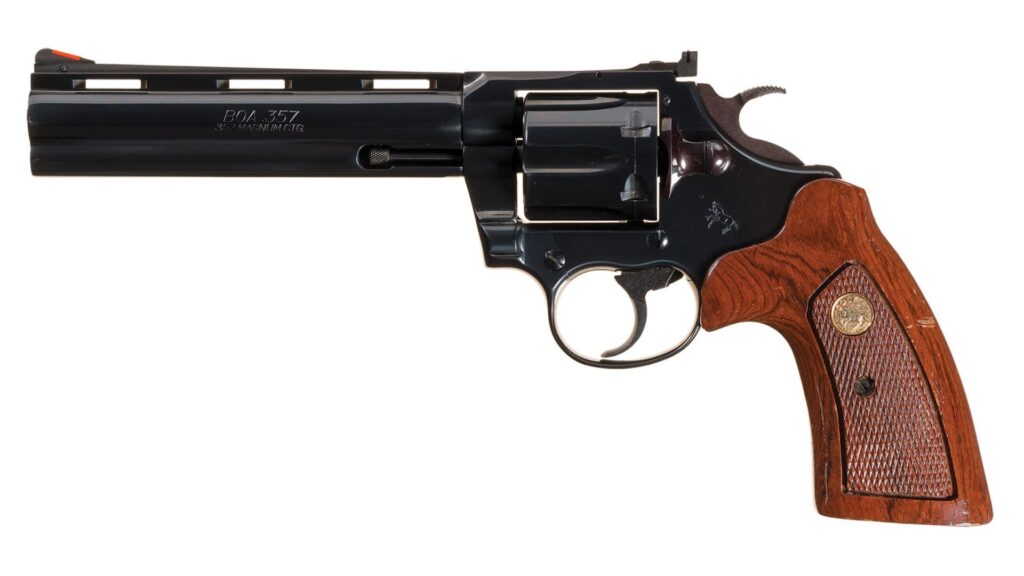
In the world of collectible firearms, rarity often outweighs technical superiority.
The Colt Boa checks every box.
It was:
- produced for only one year;
- manufactured in a single production run;
- sold exclusively through one distributor;
- never included in Colt’s standard catalog.
Those factors have elevated it to near-mythical status among collectors.
Within Colt’s famous Snake Gun family—which includes the Cobra, Python, Diamondback, Viper, King Cobra, and Anaconda—the Boa remains the rarest production model ever offered.
What Is a Colt Boa Worth Today?
When it first appeared in 1985, the Boa was only moderately more expensive than a standard Trooper Mk V.
No one expected it to become an investment-grade collectible.
Today, the situation is entirely different.
Original examples regularly sell for tens of thousands of dollars, while factory-matched presentation sets command even higher prices.
Mint-condition revolvers rarely appear on the market, and when they do, competition among collectors is fierce.
For many Colt enthusiasts, finding an authentic Boa is considerably more difficult than acquiring virtually any other Snake Gun.
The Return of the Boa
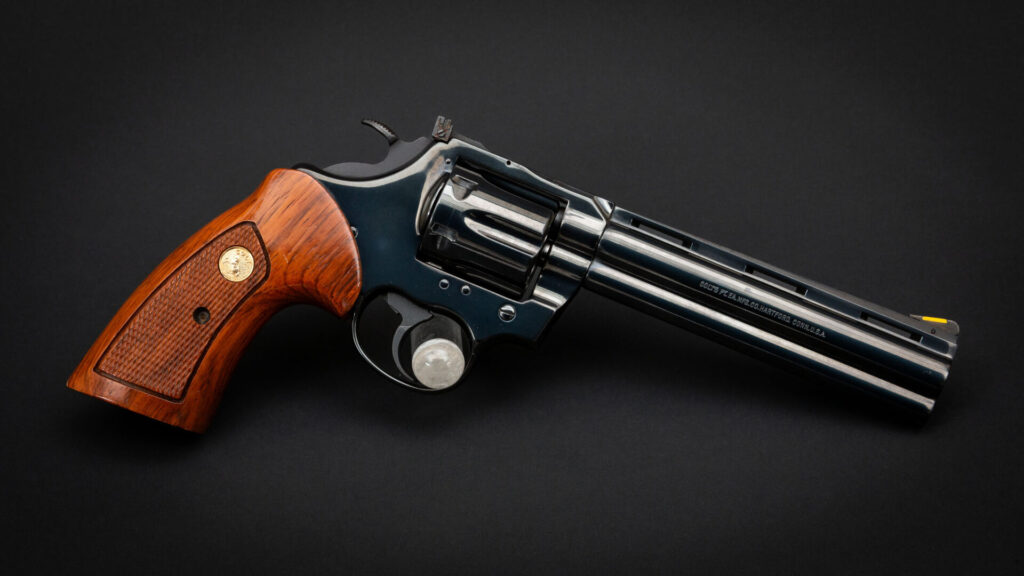
Interest in the revolver remained so strong that Colt announced a modern revival of the Boa decades later.
The new version is built on the current Python platform rather than the original Trooper Mk V action, making it more of a tribute than a faithful recreation.
That decision has only strengthened the value of the original 1985 revolvers, whose historical significance lies not only in their design but also in their extraordinary scarcity.
Conclusion
The story of the Colt Boa perfectly illustrates how firearms legends are born.
It never served as a standard military sidearm, never won famous competitions, and never revolutionized handgun design.
In fact, it was simply a limited-production commercial project created for a single distributor.
Yet its combination of elegant styling, practical engineering, and exceptional rarity transformed it into one of the most coveted revolvers ever produced by Colt.
Sometimes, becoming a legend has little to do with changing history. Sometimes, it is enough to appear at exactly the right moment—and disappear before the world fully realizes what it has lost.