Catapult on Trucks: China Demonstrates a Mobile Electromagnetic UAV Launch System for the First Time

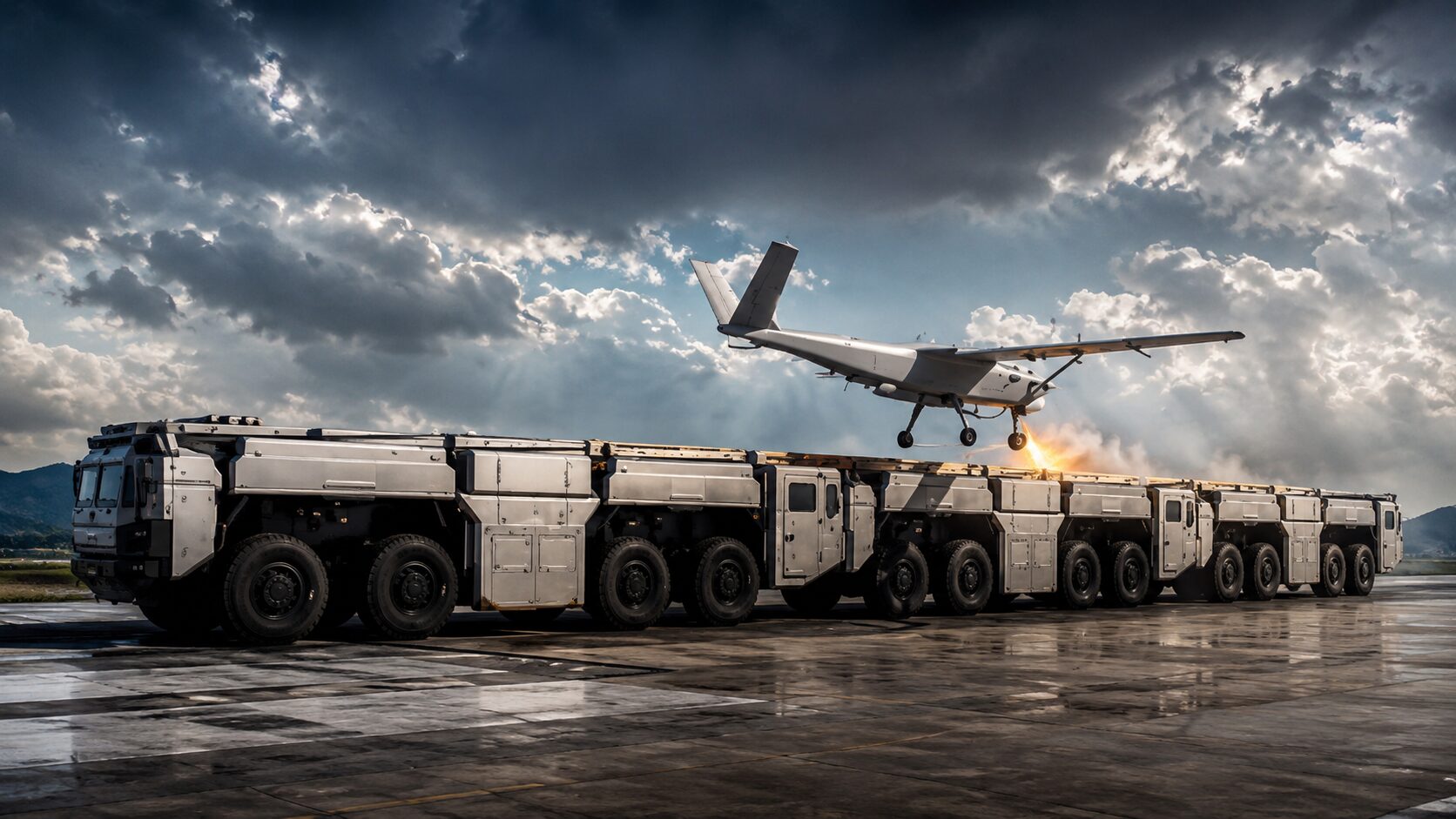
China’s latest military developments often look as if they belong in the realm of speculative engineering or Cold War science fiction. Yet behind their unconventional appearance usually lies a very practical engineering concept. One of the latest examples is a truck-mounted electromagnetic catapult for launching unmanned aerial vehicles, which has now been shown operating publicly for the first time.
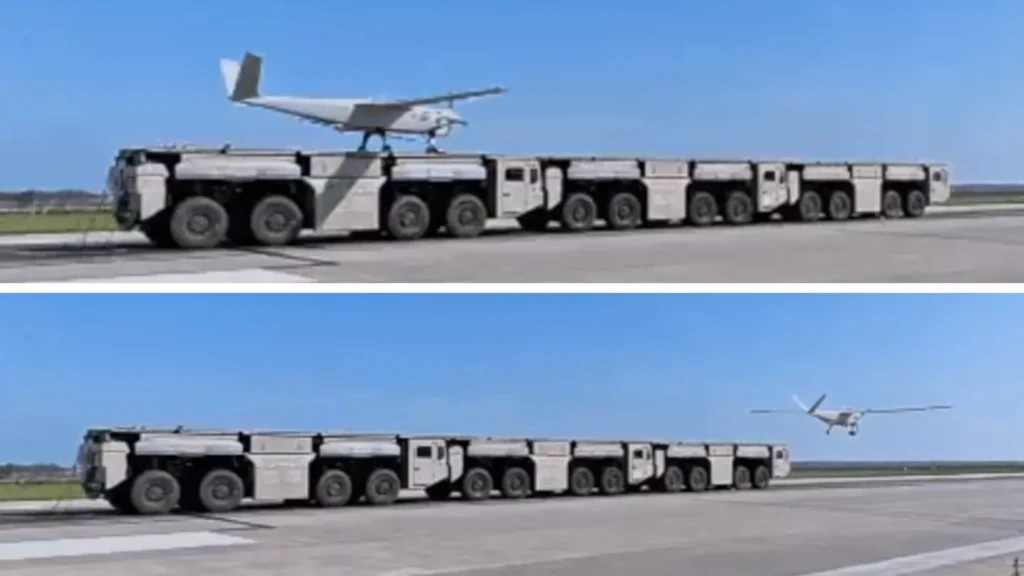
A recently released video shows a fixed-wing UAV being launched from an electromagnetic rail system assembled from several specialized truck modules. While the launcher had appeared in photographs before, this is the first publicly available footage confirming that it is capable of launching an aircraft. The demonstration suggests that the project has moved beyond mock-ups or exhibition prototypes and has reached at least the testing phase.
Not an Aircraft Carrier—But the Same Principle
Electromagnetic catapults are usually associated with aircraft carriers. Their purpose is to accelerate aircraft to takeoff speed within the limited length of a flight deck. Earlier carriers relied on steam catapults, while newer vessels such as the U.S. Navy’s USS Gerald R. Ford and China’s Fujian use electromagnetic launch systems.
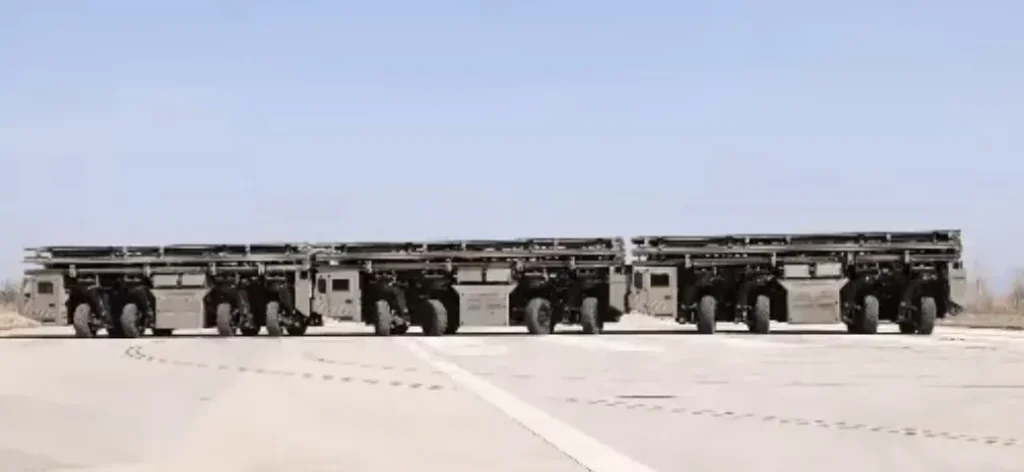
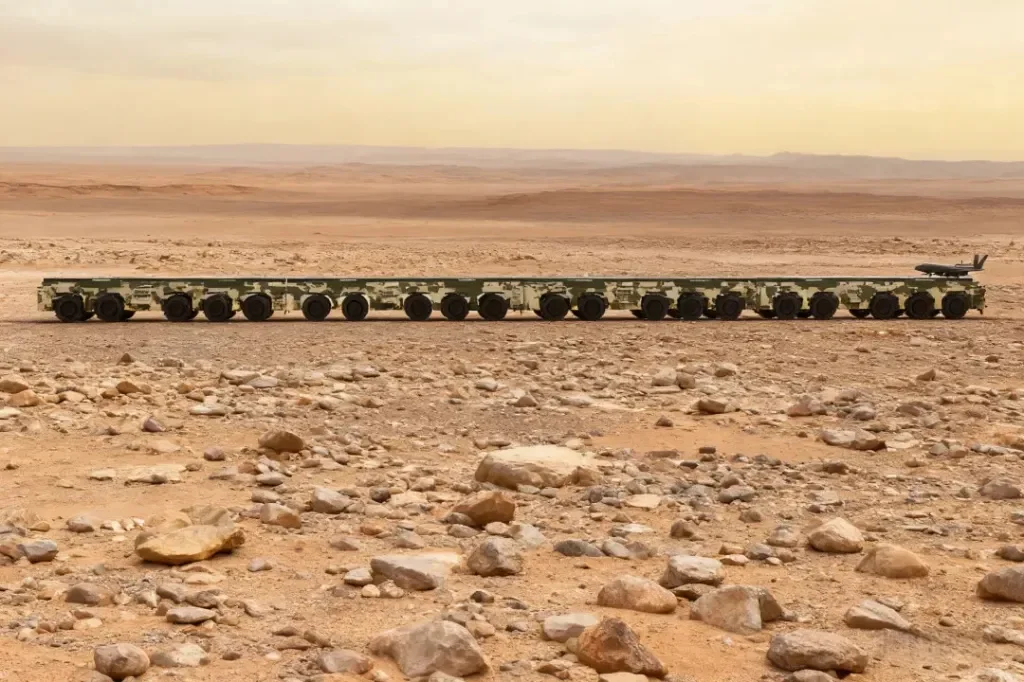
China’s mobile launcher applies the same basic concept in a much more unusual form. Instead of a carrier deck, the launch rail is mounted across several heavy truck modules. Instead of launching carrier-based fighters, it accelerates fixed-wing unmanned aircraft. And instead of requiring permanent infrastructure, the entire system can be transported by road, deployed at temporary sites, or potentially installed aboard suitable vessels.
According to The War Zone, the newly released footage shows a three-module configuration, although earlier photographs featured a four-module version displayed alongside stealthy UAVs resembling future Collaborative Combat Aircraft (CCA). Whether those aircraft were operational prototypes or display mock-ups remains unclear.
Why Would a Drone Need a Catapult?
At first glance, it may seem easier for a UAV to take off conventionally. That assumption, however, is only true for smaller drones.
Larger fixed-wing unmanned aircraft require runways. As payload and aircraft weight increase, so do runway length requirements and dependence on prepared airfields. From a military perspective, this creates a significant vulnerability. Airfields are easily identified, continuously monitored by satellites, and would likely become priority targets during any major conflict.
A launch catapult solves several of these problems at once. It allows aircraft to operate from extremely short launch sites, eliminates dependence on conventional runways, and enables heavier UAVs carrying larger payloads to become operational. The launcher also provides the aircraft with a controlled initial velocity, which is particularly valuable for designs with relatively low thrust-to-weight ratios or unconventional aerodynamics.
For unmanned systems, the advantages are even greater. Without a pilot onboard, drones can tolerate much higher launch accelerations while avoiding the political and human risks associated with manned aviation.
A Mobile Runway for Drone Warfare

Perhaps the most interesting aspect of the Chinese project is its mobility.
If the launcher can indeed be transported by road and deployed rapidly, it effectively becomes a mobile runway for medium and large UAVs. In theory, this would allow reconnaissance drones, strike aircraft, electronic warfare platforms, or decoy drones to be launched from highways, temporary military sites, ports, or even civilian ships.
The maritime application may be especially significant. In late 2025, images emerged showing what appeared to be a similar launcher installed aboard a Chinese cargo vessel, prompting speculation that Beijing could be exploring modular “drone carriers” or improvised auxiliary aviation platforms.
Rather than replacing traditional aircraft carriers, such vessels could provide a much cheaper and more flexible means of launching reconnaissance drones, communication relays, decoys, or strike UAVs in distant operating areas.
Part of China’s Broader Electromagnetic Launch Strategy
The truck-mounted catapult should not be viewed as an isolated experiment.
China has invested heavily in electromagnetic launch technology over the past several years. The country’s newest aircraft carrier, Fujian, is equipped with electromagnetic catapults, and Chinese media have already shown successful launch and recovery operations involving the J-35, J-15T, and the KJ-600 carrier-based airborne early warning aircraft.
The new Type 076 Sichuan amphibious assault ship is also expected to receive electromagnetic catapults and arresting gear, effectively combining the characteristics of a traditional amphibious assault ship with those of a light aircraft carrier optimized for unmanned aviation.
Viewed in this context, the truck-mounted launcher appears to be another branch of China’s broader effort to expand electromagnetic launch technology beyond conventional aircraft carriers and into mobile land-based and maritime applications.
Why Electromagnetic Launch Matters
Compared with pneumatic or rocket-assisted launch systems, electromagnetic catapults offer one major advantage: precise control over acceleration.
Launch forces can be adjusted to match the weight and aerodynamic characteristics of different aircraft, reducing structural stress while allowing multiple UAV types to use the same launcher. This flexibility is particularly valuable for modular drone operations, where reconnaissance platforms, strike drones, decoys, or communication relays may all be launched from a common system.
The technology, however, comes at a cost. Electromagnetic launchers require powerful electrical generators, sophisticated power electronics, cooling systems, and highly accurate control software. In other words, the launcher itself is far more than a simple rail—it is a complex engineering system.
Technical Overview (Open Sources)
Type: Mobile electromagnetic aircraft launch system
Primary mission: Launching fixed-wing unmanned aerial vehicles
Configuration: Multiple specialized heavy truck modules connected into a single launch rail
Known configurations: Three-module and four-module versions
Potential deployment sites: Roads, temporary military bases, ports, and possibly auxiliary ships
Compatible aircraft: Reconnaissance UAVs, strike drones, electronic warfare platforms, and decoy aircraft
Current status: First publicly documented launch of a UAV captured on video
Conclusion
China’s truck-mounted electromagnetic catapult may look unconventional, but the underlying concept is straightforward. It is designed to free larger unmanned aircraft from dependence on traditional airfields and enable launches from dispersed land or maritime locations.
It remains unclear how far the program has progressed or which UAVs will ultimately operate from the system. Nevertheless, the successful public demonstration strongly suggests that China is actively developing a distributed launch infrastructure for its growing fleet of unmanned aircraft.
In future conflicts, that infrastructure could prove just as important as the drones themselves. After all, the more launch options an unmanned aircraft has, the more difficult it becomes for an adversary to destroy it before it ever leaves the ground.