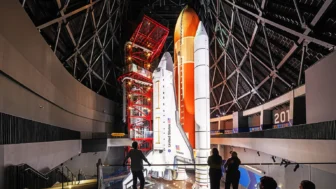
Space Without Rockets? How SpinLaunch Is Trying to Replace Fire and Fuel with a Giant Slingshot

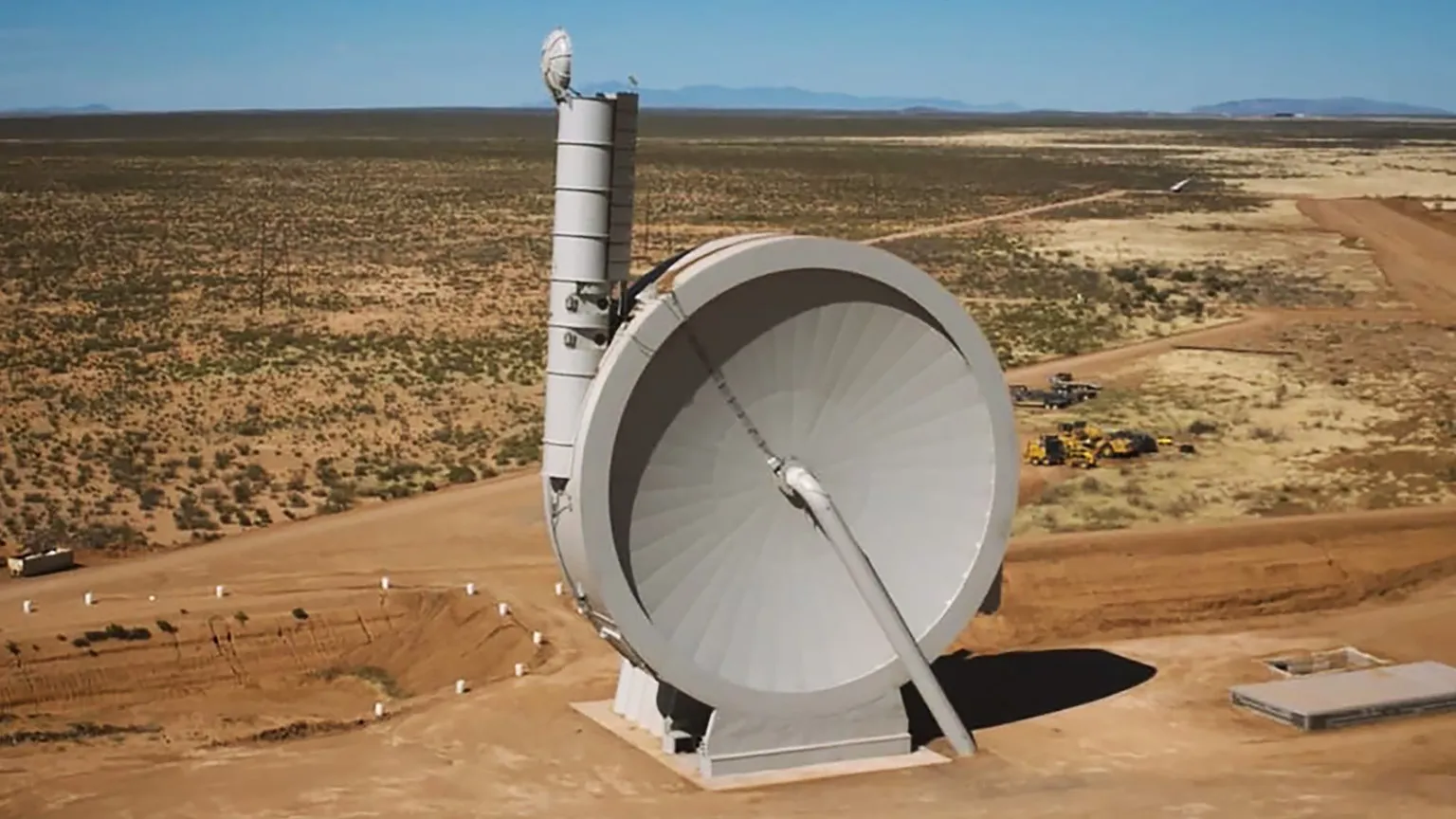
When most people imagine a spacecraft launch, a familiar image comes to mind: a massive rocket, roaring engines, clouds of smoke, and a towering column of flame rising from the launch pad. Since the dawn of the Space Age, that picture has remained largely unchanged. From the rockets of Wernher von Braun to modern SpaceX launch vehicles, the principle has been the same—burn enormous quantities of fuel in a matter of minutes to overcome Earth’s gravity.
But what if that entire approach could be reconsidered?
What if most of the work could be done not by the rocket itself, but by a gigantic mechanical system on the ground?
That is the idea behind SpinLaunch, an American company attempting to challenge one of the most fundamental assumptions of modern spaceflight.
The Most Expensive Problem in Spaceflight
There is a reason why launching satellites remains expensive even in the era of reusable rockets.
The main challenge is that a rocket must carry not only its payload but also a tremendous amount of fuel. To place a single kilogram into orbit, a launch vehicle often needs to carry dozens of kilograms of propellant. But carrying that propellant requires even more propellant.
As a result, most of a rocket’s mass consists of fuel tanks, engines, and fuel itself. The actual payload represents only a small fraction of the total vehicle.
For decades, engineers have tried to solve this problem through various approaches. Multi-stage rockets, air-launch systems, spaceplanes, and even concepts such as the space elevator have all been proposed as ways to reduce launch costs.
SpinLaunch offers a radically different solution.
Instead of accelerating a rocket after liftoff, the company wants to give it tremendous velocity before it ever leaves the ground.
A Giant Slingshot for the 21st Century
At first glance, the concept sounds like science fiction.
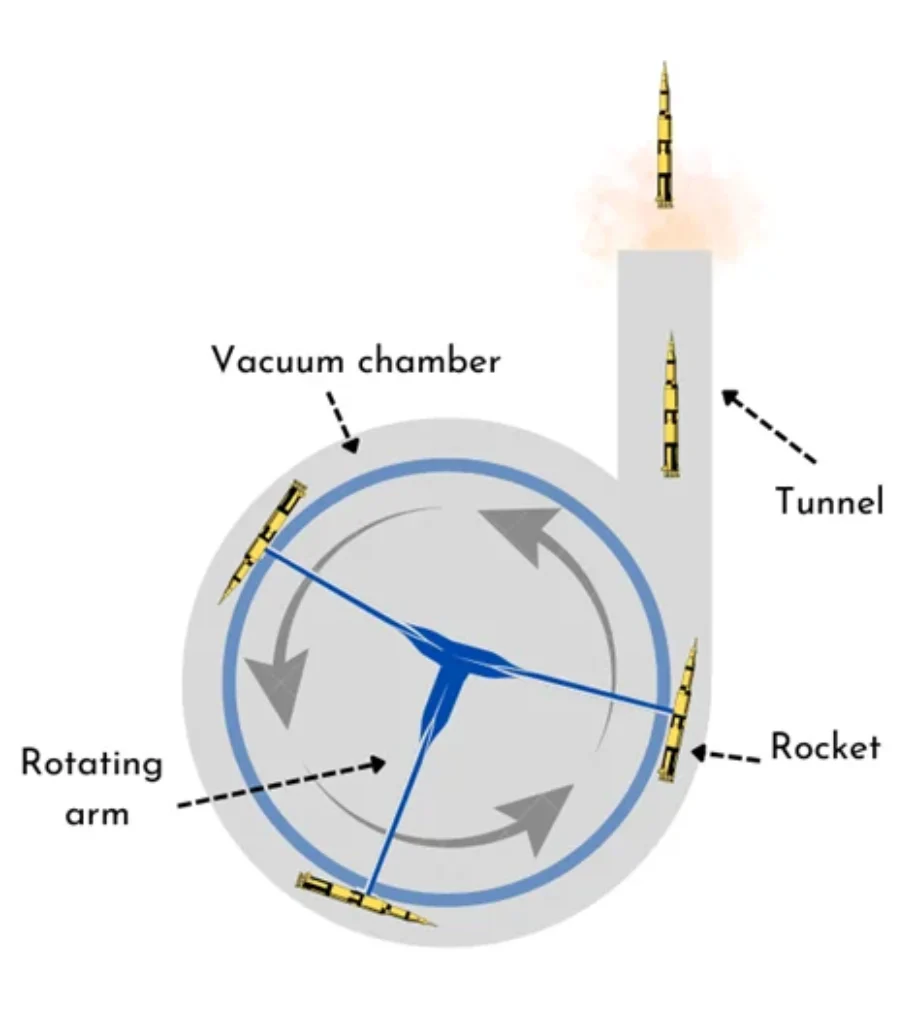
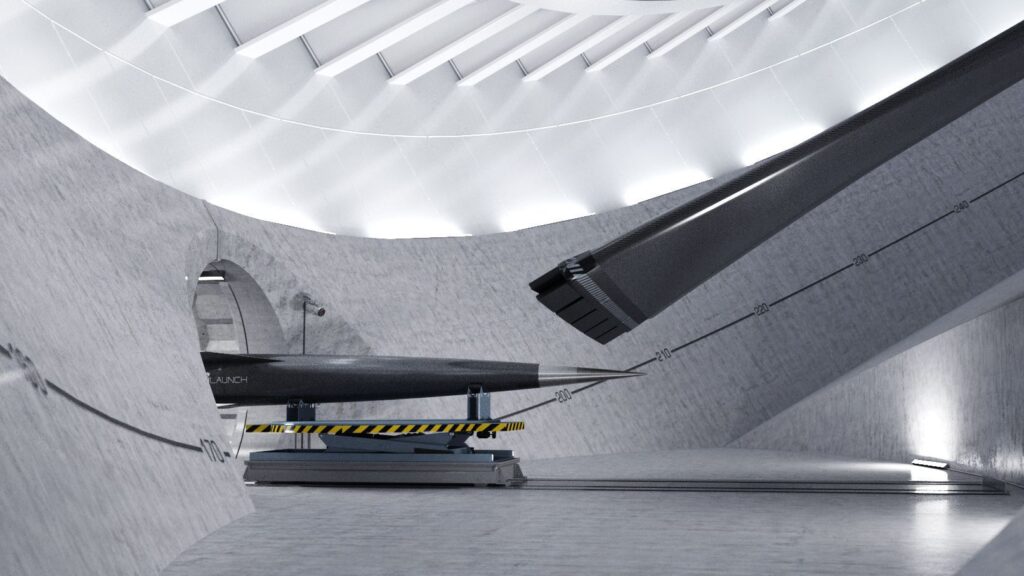
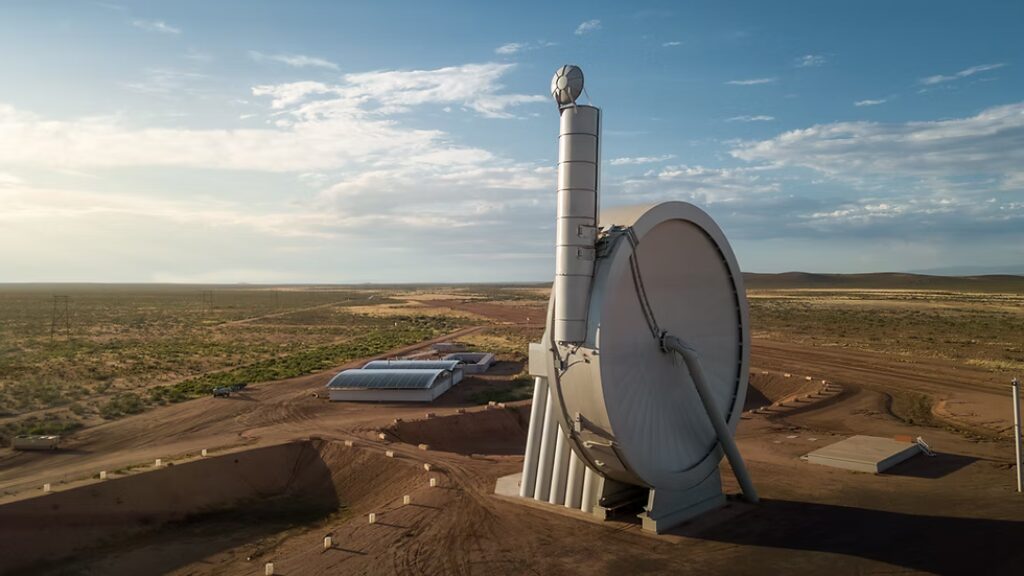
Inside a massive sealed chamber sits a rotating arm tens of meters long. Before launch, the air is pumped out of the chamber, creating an almost complete vacuum.
The system then begins to spin.
As rotational speed increases, the payload experiences extreme acceleration while reaching velocities measured in thousands of kilometers per hour.
At precisely the right moment, the mechanism releases the vehicle.
In a fraction of a second, it exits through a specially designed launch tube and shoots skyward.
From the outside, the process resembles a gigantic slingshot or catapult.
The difference is that instead of launching a stone, it launches a spacecraft.
Why Engineers Became Interested in This Idea
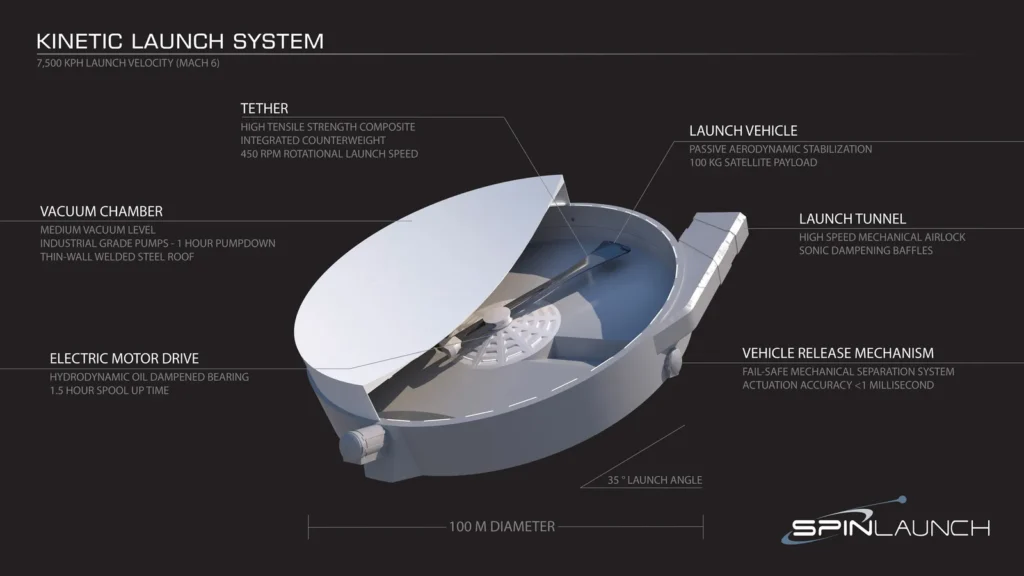
The main advantage of the system is energy efficiency.
A conventional rocket must begin consuming fuel immediately after launch. SpinLaunch proposes performing a significant portion of the acceleration using electric motors and mechanical energy before the vehicle ever leaves the ground.
This allows the rocket portion of the system to be smaller and to require less fuel.
In effect, part of the launch process is shifted from the vehicle itself to ground-based infrastructure.
In theory, this approach could dramatically reduce the cost of placing small satellites into orbit.
The company has repeatedly argued that its technology could lower launch costs by several times compared with traditional rocket systems.
If those projections prove accurate, the impact on the space industry could be profound.
Why It Is Much Harder Than It Sounds
However, such an elegant concept comes with a major challenge.
Acceleration.
During launch, the payload may experience forces thousands of times greater than Earth’s gravity.
For a human being, such conditions would be instantly fatal.
Even many modern satellites are not designed to survive such stresses.
Conventional electronics, solar panels, sensors, and optical equipment could be damaged or destroyed before the vehicle even leaves the launcher.
This is why SpinLaunch is pursuing a fundamentally different approach to spacecraft design.
Instead of building large, highly complex satellites, the company envisions relatively simple, extremely robust spacecraft specifically engineered to survive extraordinary mechanical loads.
In other words, SpinLaunch is not only trying to reinvent launch systems—it is also attempting to change the philosophy of satellite design itself.
From Giant Satellites to Orbital Swarms
Over the last decade, the space industry has undergone a major transformation.
Where satellites once cost hundreds of millions of dollars and weighed several tons, increasingly important roles are now being played by compact spacecraft no larger than a suitcase.
Companies are building constellations consisting of hundreds or even thousands of small satellites.
The most famous example is Starlink, but similar projects are emerging around the world.
SpinLaunch fits naturally into this trend.
The technology is not intended to launch massive interplanetary probes or giant space telescopes. Instead, it focuses on rapidly deploying large numbers of relatively small satellites.
If the future of spaceflight is indeed built around orbital networks of thousands of compact spacecraft, then mechanical launch systems suddenly seem far less unconventional.
Old Ideas with New Technology
Interestingly, the concept itself is not new.
Engineers have been considering the possibility of launching objects into space using giant guns or mechanical systems since the nineteenth century.
During the twentieth century, similar ideas appeared in both the United States and the Soviet Union.
The problem was always the same: the acceleration forces destroyed the payload before it could complete the journey.
What separates SpinLaunch from earlier concepts is the technological environment of the twenty-first century.
Advanced materials, miniaturized electronics, sophisticated guidance systems, and modern engineering tools make it possible to revisit ideas that once seemed completely impractical.
Can It Replace Rockets?
Probably not.
At least not in the foreseeable future.
Human crews will never be able to tolerate such extreme acceleration. Large satellites, space stations, and interplanetary spacecraft will continue to rely on conventional rocket technology.
But replacing rockets is not SpinLaunch’s objective.
The company is targeting a different niche: frequent, low-cost launches of small payloads.
If the technology proves economically viable, it could complement existing launch systems rather than replace them.
In that scenario, future spaceports may include not only traditional launch pads but also enormous centrifuges capable of sending satellites skyward with little or no rocket fuel.
The Future May Be Quieter Than We Expect
Throughout the Space Age, every journey into orbit has begun with fire.
The roar of rocket engines became as symbolic of space exploration as sails once were of ocean travel.
SpinLaunch offers a very different vision.
Instead of a giant rocket, there is a compact launch vehicle.
Instead of a towering flame, there is a vacuum chamber.
Instead of millions of liters of propellant, there is stored mechanical energy.
It is still too early to know whether this technology will truly transform the space industry. History is full of ambitious concepts that never moved beyond the experimental stage.
Yet the willingness to challenge one of the most basic assumptions of spaceflight already makes SpinLaunch one of the most fascinating technology companies of our time.
And if its engineers are right, the spacecraft of the future may reach the stars not aboard giant rockets, but launched from an enormous mechanical slingshot.