
“Citadel” Against Drones: Why Russia Is Bringing Back Anti-Aircraft Artillery To Protect Oil Refineries

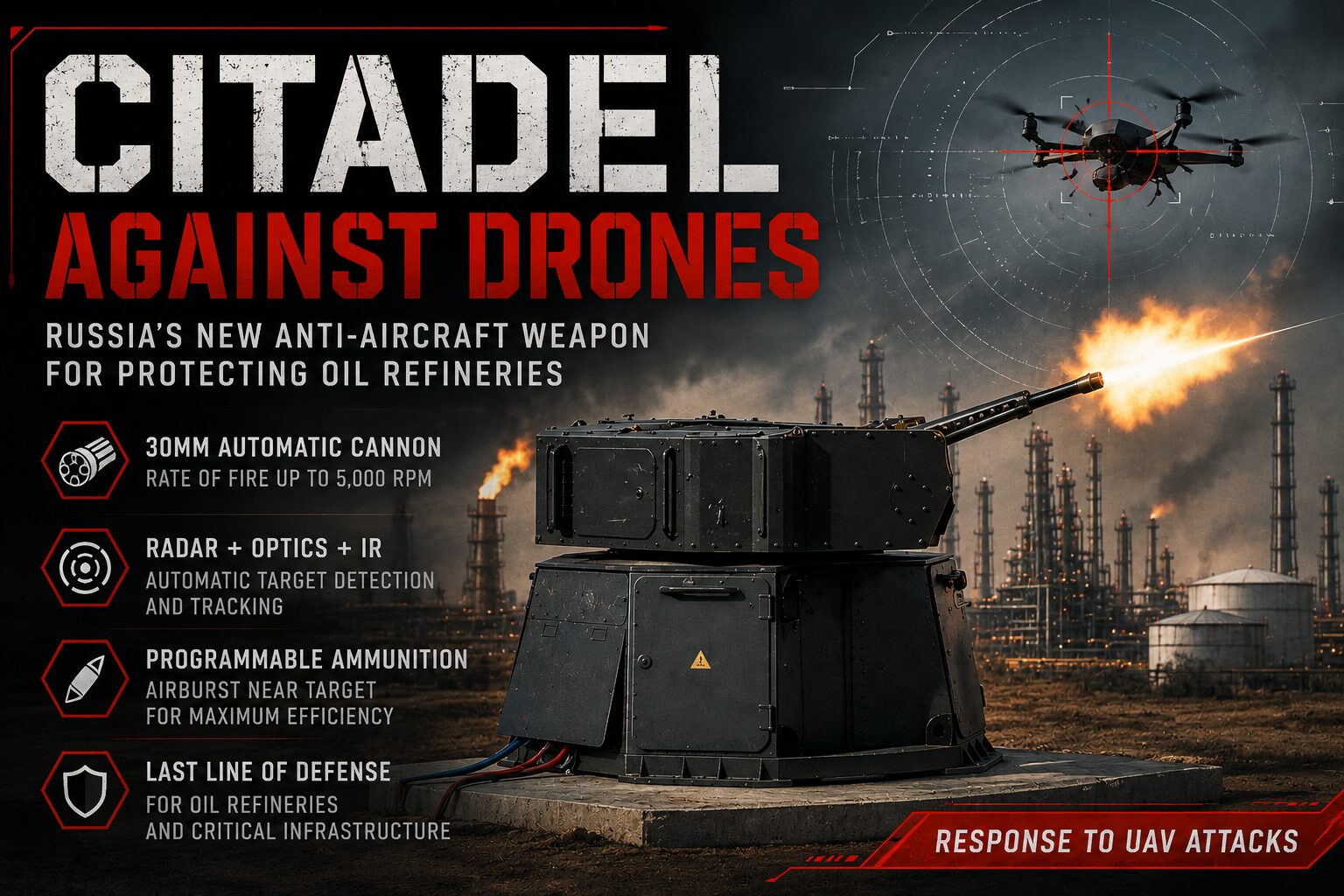
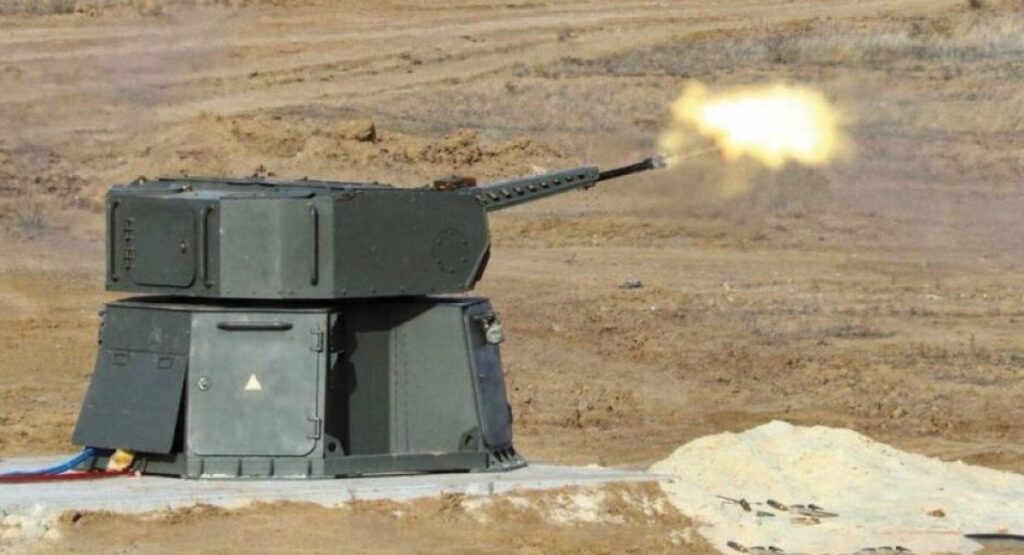
Russia has begun deploying the new ZAK-30 “Citadel” anti-aircraft artillery system designed to protect oil refineries and other stationary infrastructure from drone attacks. At first glance, the news may seem like just another attempt to adapt to the realities of drone warfare. But a closer look reveals something much larger.
Modern warfare has unexpectedly brought an entire class of weapons back to relevance — small-caliber automatic anti-aircraft artillery.
And that is what makes the “Citadel” especially interesting.
In many ways, Russia is not simply building another remotely operated gun turret. The system appears closer to a stationary last-line-of-defense platform — a kind of anti-drone CIWS for industrial infrastructure, strongly reminiscent of naval close-in weapon systems such as the AK-630, Phalanx, or Goalkeeper.
Drone Warfare Has Changed the Entire Philosophy of Air Defense
Only a decade ago, most air-defense systems were primarily designed to fight:
— aircraft,
— helicopters,
— cruise missiles,
— and high-speed targets.
Then came FPV drones, loitering munitions, and long-range unmanned aircraft.
And suddenly, the traditional economics of air defense started to collapse.
Because shooting down relatively cheap drones with missiles costing hundreds of thousands of dollars quickly proved economically unsustainable — especially during mass attacks.
That is why many countries have begun returning to the idea of rapid-fire artillery:
— Germany is developing Skynex,
— the United States is experimenting with C-UAS systems based on the Bushmaster cannon,
— China is actively building small-caliber anti-drone systems,
— and Russia is now deploying the “Citadel.”
In effect, modern warfare has unexpectedly returned to a philosophy reminiscent of World War II:
it is often more efficient to create a dense cloud of fragments in the target’s flight path than to attempt a direct missile intercept against a tiny drone.
The Heir to the Shilka and AK-630
And this is where the story becomes especially interesting.
The philosophy behind the “Citadel” clearly draws heavily from the Soviet tradition of rapid-fire anti-aircraft artillery.
The Soviet Union historically placed enormous emphasis on small-caliber air-defense guns. Soviet engineers were among the first to create fully automated close-range defense systems.
First came:
— the ZSU-23-4 Shilka,
— then the Tunguska,
— later the Pantsir,
— alongside naval systems such as the AK-230 and AK-630.
The logic was simple.
When targets are extremely fast — or when there are simply too many of them — the key factor becomes not the precision of a single shot, but the sheer density of fire. Soviet naval CIWS systems were specifically designed to create a literal “wall of metal” in front of incoming threats.
Today, the world is returning to that same philosophy — only now the primary targets are drones rather than anti-ship missiles.
What makes the “Citadel” especially notable is that it appears designed not as a traditional battlefield SPAAG, but as a stationary anti-drone turret complex for defending specific infrastructure:
— oil refineries,
— warehouses,
— factories,
— energy facilities,
— and large industrial sites.
Small Caliber, But Extremely Dangerous Mathematics
Technically, the “Citadel” appears relatively straightforward.
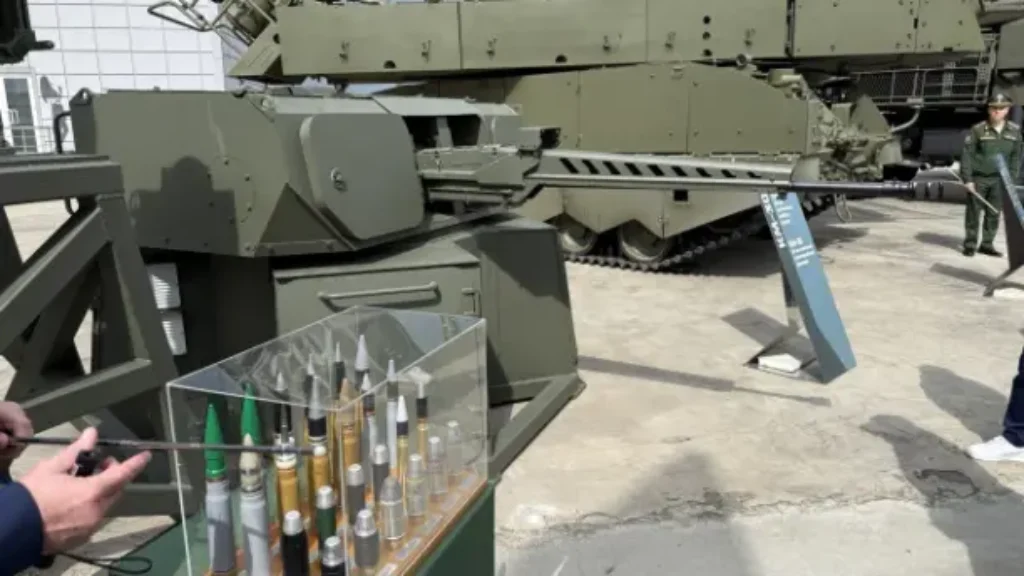
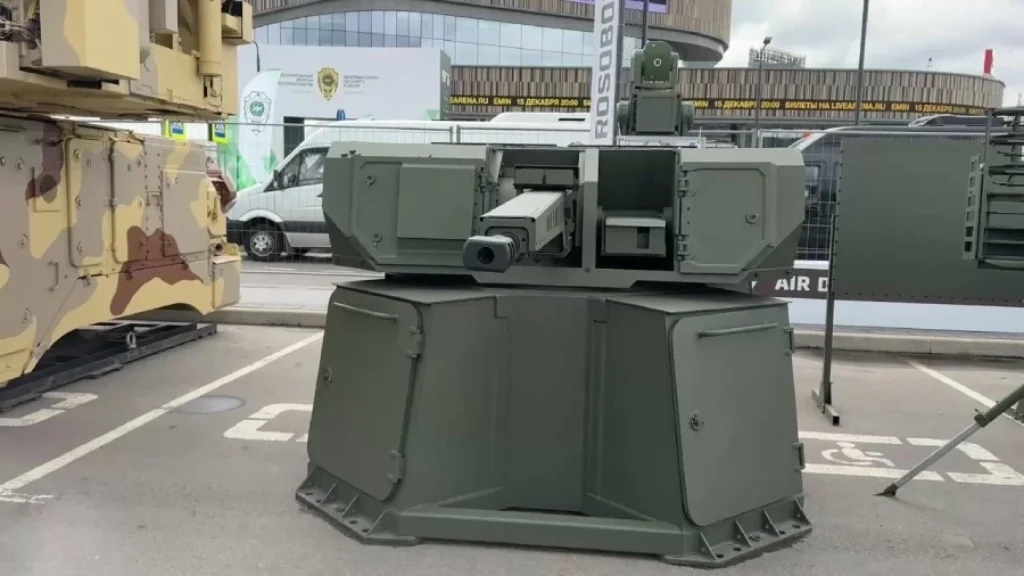
At its core is a remotely operated 30mm automatic cannon mounted in an autonomous turret. According to some reports, the system may be connected to the BM-30-D “Spitsa” combat module.
The emphasis is not on armor penetration or extreme range, but on:
— rate of fire,
— automation,
— and programmable ammunition.
That last point is especially important.
One of the main problems with conventional anti-aircraft guns against drones is that a small UAV often requires a near-direct hit. But if the shell can detonate near the target and release a cloud of fragments, the probability of destruction increases dramatically.
In many ways, modern anti-drone artillery is becoming a high-tech evolution of World War II anti-aircraft guns — now combined with:
— radar systems,
— electro-optical sensors,
— infrared tracking,
— automatic target acquisition,
— and computerized airburst calculations.
According to available information, the “Citadel” integrates:
— radar-based target detection,
— optical tracking,
— infrared observation,
— and a high level of automation from detection to engagement.
In other words, the operator increasingly becomes more of a supervisor than a gunner.
Why Oil Refineries Have Become the New “Front Line”
Perhaps the most revealing aspect of the “Citadel” is that it was designed specifically for protecting oil refineries.
Only recently, air defense was associated primarily with armies, airbases, and military installations. But drone warfare has dramatically changed the geography of modern threats.
Today, the most vulnerable and strategically important targets increasingly include:
— oil depots,
— energy infrastructure,
— chemical plants,
— logistics hubs,
— and industrial facilities in general.
And that creates a major problem.
Most of these facilities are enormous in size. They cannot realistically be covered entirely by traditional missile-based air-defense systems. That means layered defense becomes essential:
— long-range SAM systems,
— electronic warfare,
— mobile interception teams,
— and finally, automated gun systems as the last defensive layer.
That lower defensive tier is precisely where the “Citadel” appears intended to operate.
The Return of the Anti-Aircraft Gun Era
Perhaps the most fascinating part of this entire story is something larger.
Not long ago, the future of air defense seemed to belong exclusively to:
— missiles,
— lasers,
— hypersonic interceptors,
— and advanced networked systems.
But modern warfare has unexpectedly revived a very old idea:
sometimes the most effective way to destroy a target is simply to throw an enormous amount of metal into its path.
The difference today is that this concept is now being combined with:
— radar systems,
— artificial intelligence,
— automated tracking,
— programmable ammunition,
— and network-centric architecture.
In that sense, the “Citadel” is not merely another Russian anti-aircraft gun.
It is an attempt to adapt the philosophy of naval CIWS systems and the Soviet school of rapid-fire artillery to the age of mass drone warfare.
And systems like it will likely begin appearing around factories, ports, refineries, and critical infrastructure all over the world in the coming years.
Because the era of cheap drones is gradually making cheap automatic anti-aircraft artillery relevant once again.






