Spring, 1525. Germany is collapsing into chaos. Across the roads of Franconia march thousands of armed peasants — ragged, hungry, furious men carrying improvised weapons: reforged scythes, flails, clubs, and crude arquebuses. This is not an army in the traditional sense. It is more like a storm suddenly rising against the entire old order of Europe.
The Holy Roman Empire had never seen a rebellion on such a scale.
History would later call it the German Peasants’ War — the greatest popular uprising in Europe before the French Revolution. Yet amid the chaos of rebellion, among the poorly organized peasant bands, there existed one force that even its enemies spoke of with grim respect.
Der Schwarze Haufen.
The Black Company.
And its commander was a man who should never have stood on that side of the battlefield at all — the knight Florian Geyer.
Germany Before the Explosion
To understand why Florian Geyer’s story became so extraordinary, one must first imagine Germany at the beginning of the sixteenth century.
This was not a unified nation. The Holy Roman Empire resembled an enormous patchwork of duchies, bishoprics, free cities, and knightly territories. Formally, all were subordinate to the emperor, but in reality each region lived according to its own laws and interests.
For peasants, such a system increasingly became unbearable.
Feudal lords expanded labor obligations, seized common lands, imposed new taxes, and stripped villages of ancient rights. Peasants were forbidden to hunt, fish, gather wood, or use forests that their communities had relied upon for generations.
At the same time, the ideas of the Reformation were spreading rapidly across Germany.
The sermons of Martin Luther about the “freedom of the Christian” were interpreted by peasants in ways Luther himself never intended. If all Christians were equal before God, then why did some live in castles while others starved in mud huts?
Out of this atmosphere emerged the famous “Twelve Articles” — arguably the first mass political program of popular demands in European history. The peasants demanded the abolition of serfdom, the restoration of communal rights, and limits on feudal oppression.
But there was one enormous problem.
The rebels barely knew how to wage war.
The Knight Who Betrayed His Own Class
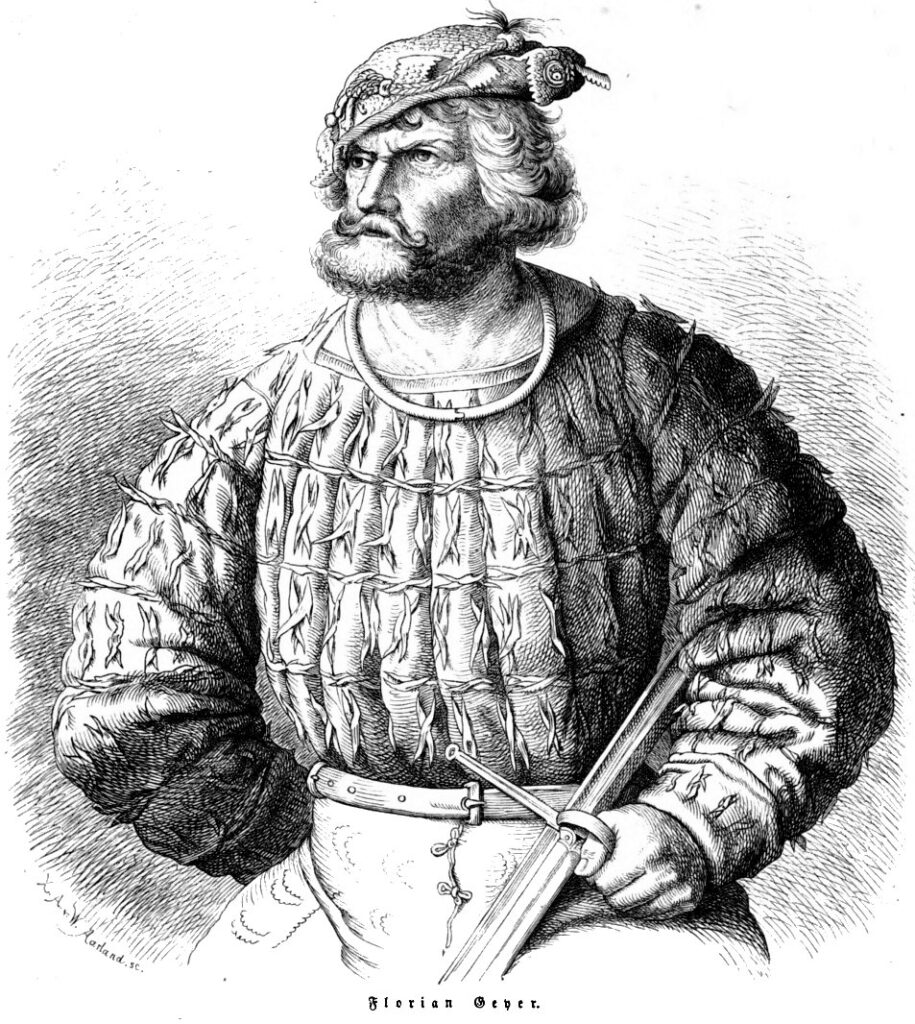
Against this background, Florian Geyer appeared almost unbelievable.
He came from an old Franconian knightly family. His life was supposed to revolve around tournaments, diplomacy, and service to princes. As a young man, Geyer had even visited the court of Henry VIII and later served the Margrave of Brandenburg-Ansbach.
This was not some desperate adventurer or wandering fanatic.
He was an educated, experienced, and successful nobleman.
Which made his decision to join the peasants profoundly shocking to contemporaries.
Why he did so remains debated to this day.
Perhaps Geyer genuinely sympathized with peasant grievances. Perhaps he despised the growing power of princes and church authorities. Or perhaps he saw in the rebellion an opportunity to reshape the political structure of the empire itself.
What mattered was that he committed himself completely.
Geyer did not merely support the rebellion.
He invested his own fortune into it, armed men at his own expense, and began transforming an angry crowd into a real army.
The Birth of the Black Company
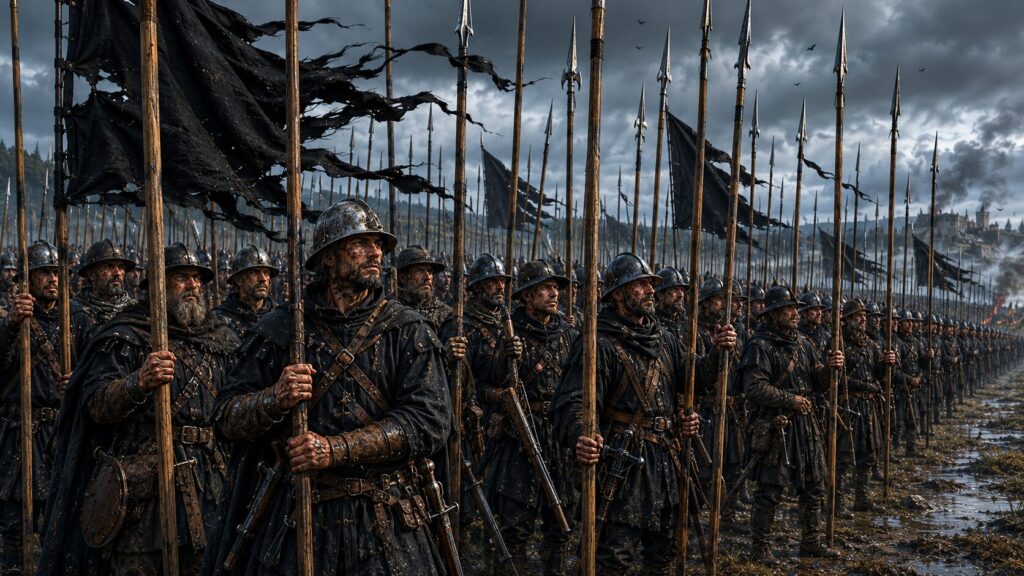
Most peasant formations during the war were called Haufen — literally “bands” or “mobs.”
The word perfectly reflected their chaotic nature: loud, emotional masses driven more by rage than discipline.
But Geyer wanted something different.
Thus emerged Der Schwarze Haufen — the Black Company.
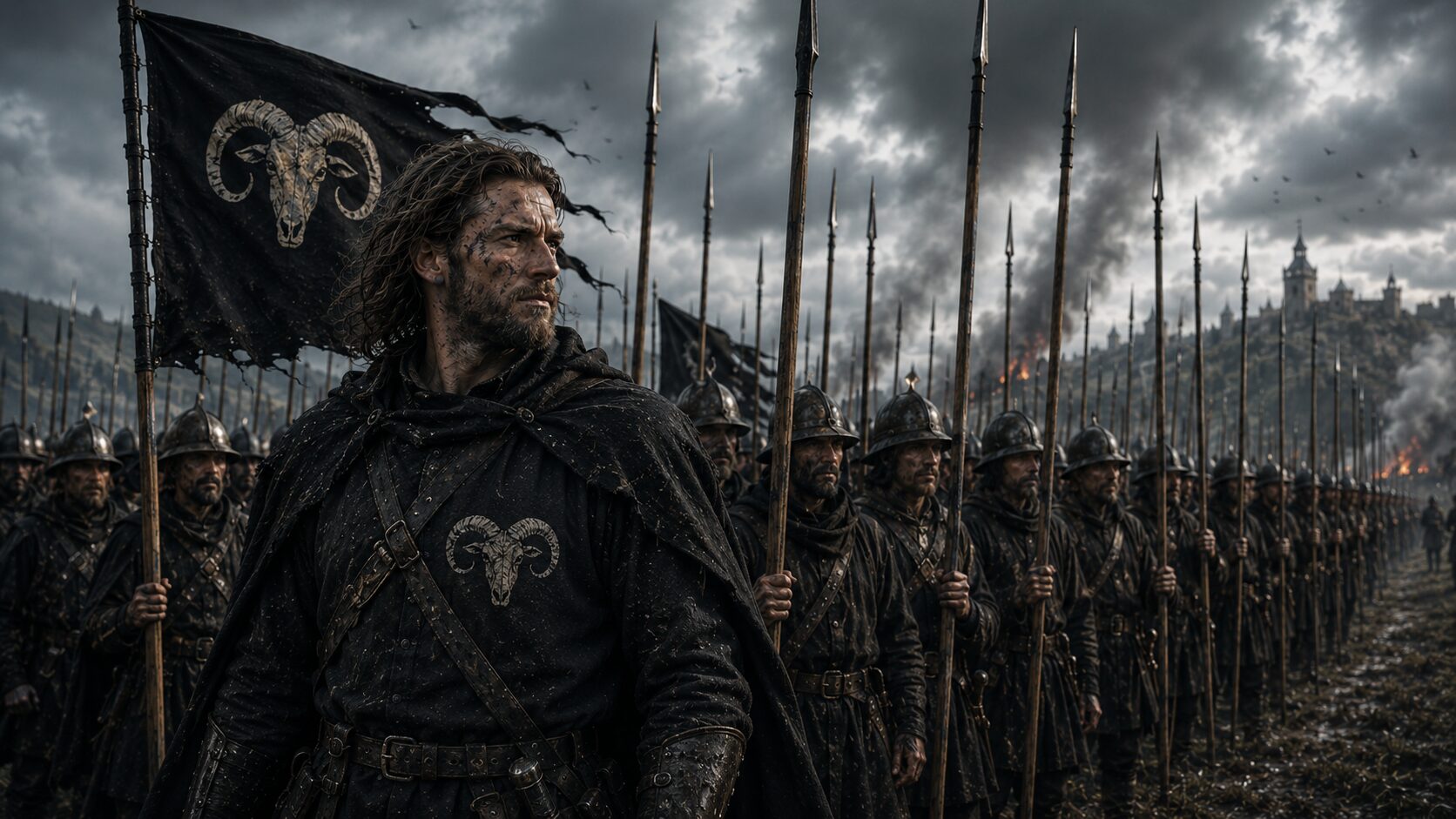
Even the name set them apart. While many rebels wore ordinary peasant clothing, Geyer’s men reportedly dressed in dark coats and armor, making them instantly recognizable and deeply intimidating.
Yet the true difference was not appearance.
It was discipline.
Geyer trained his soldiers like professionals.
He taught them:
— to maintain formation;
— to fight on command;
— to use pikes and arquebuses effectively;
— to hold discipline under pressure.
Alongside peasants, the Black Company also included experienced mercenaries and a number of mounted knights connected to Geyer himself.
The result was extraordinary.
The Black Company became perhaps the only peasant force in the entire war capable of confronting professional armies on relatively equal terms.
The Army That Burned Castles
In the spring of 1525, the Black Company began campaigning through Franconia and Swabia.
Unlike many peasant bands that dissolved into looting and chaos, Geyer operated almost like a conventional military commander. His primary goal was the destruction of castles and monasteries that could serve as strongholds for princely armies.
Near Würzburg alone, Geyer’s men destroyed dozens of fortresses.
Among them was even a castle belonging to Geyer’s own family.
To contemporaries, the symbolism was unmistakable.
The knight had literally burned his own past.
Weinsberg — The Moment Everything Changed
Then came disaster.
Another rebel leader, the radical Jacob Rohrbach, carried out a massacre at Weinsberg. Captured nobles and knights were forced to run through rows of pikes and were brutally slaughtered.
For Geyer, this was a turning point.
He was a man of war, but also a knight shaped by older concepts of military honor. The pointless massacre of prisoners disgusted him.
Geyer publicly condemned the killings and withdrew his Black Company from Swabia.
But by then, it was too late.
After Weinsberg, the princes resolved to crush the uprising without mercy.
The Last Battle of the Black Company
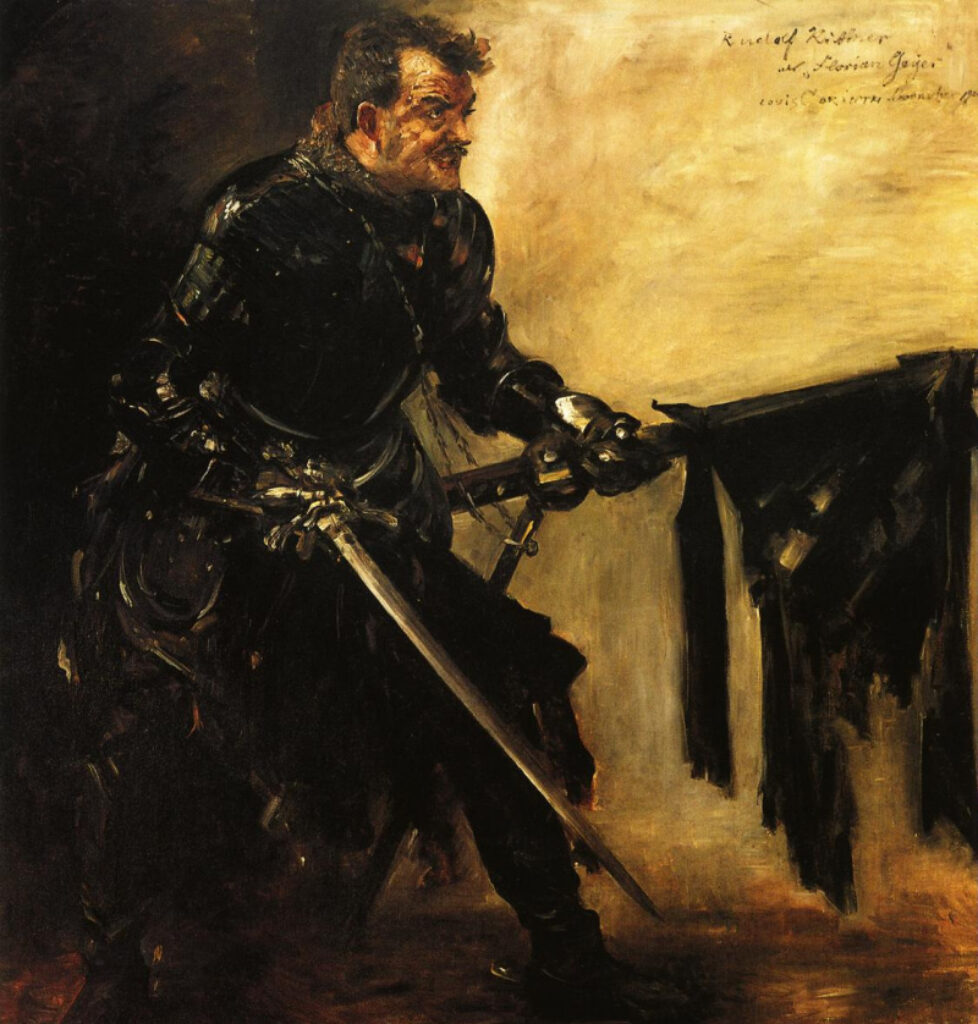
By the summer of 1525, the peasant cause was collapsing.
The armies of Georg Truchsess von Waldburg systematically destroyed one rebel force after another. Most peasants could not withstand professional landsknechts and heavy cavalry.
Only the Black Company continued to fight in disciplined formation.
Its final stand came near Ingolstadt.
Geyer’s men retreated into the ruins of a castle they themselves had previously destroyed. There they resisted the overwhelming forces of the Swabian League.
The Black Company repelled several assaults.
Then artillery was brought forward.
When the defenses were breached, the final slaughter began. Nearly the entire company died where it stood.
But they did not die as a fleeing mob.
They died as an army.
The Death of Florian Geyer
Geyer himself was not present during the final battle.
He had traveled in search of reinforcements, trying desperately to convince nearby cities to continue resisting. One after another, former allies abandoned him. The burghers preferred survival over loyalty once it became clear the rebellion was doomed.
In June 1525, Geyer was ambushed near Würzburg.
Ironically, the attack was organized by one of his own relatives, who had sided with the princes.
The details of his death remain unclear.
History records only the simple fact:
Florian Geyer was killed.
How a Defeated Knight Became a Legend
One might think the story would end there.
The Peasants’ War was crushed with horrifying brutality. Tens of thousands died.
Yet Geyer’s memory survived long after the rebellion itself vanished.
Over time, he became an almost mythical figure. Songs, poems, and legends were written about him. The most famous was “Wir sind des Geyers schwarzer Haufen” — “We Are Geyer’s Black Company.”
Then history took an almost absurd turn.
Geyer’s image would later be claimed by:
— revolutionaries;
— socialists;
— nationalists;
— Nazis;
— and even the army of East Germany.
Every era attempted to make him its own symbol.
But perhaps the reason his legend endured is simpler than politics.
Florian Geyer’s story is ultimately the story of a man who consciously turned against his own world.
A knight who refused to see peasants as mere dirt beneath noble boots.
A nobleman who tried to transform rebellion into an army.
And a man who lost his war — but won immortality in memory.