In the history of engineering, there are machines that impress with their specifications. There are machines that amaze with the boldness of their design. And then there are projects so extraordinary that, even decades later, they seem like artifacts from an alternate reality. The Soviet MAZ-7907 belongs firmly in that last category.
Nearly 30 meters long. Twenty-four driven wheels. A gas-turbine engine borrowed from a main battle tank. An electric transmission. The ability to move sideways like a crab while carrying a payload weighing more than 150 tons. It sounds like something from a science-fiction novel, yet this vehicle was very real.
The MAZ-7907 became the pinnacle of Soviet heavy wheeled transporter development and one of the last truly grand projects of the Cold War. It was not created to set records or showcase industrial capabilities. Its purpose was far more serious: to ensure the mobility of the most destructive weapons ever built.
When the Missile Became More Important Than the Tank
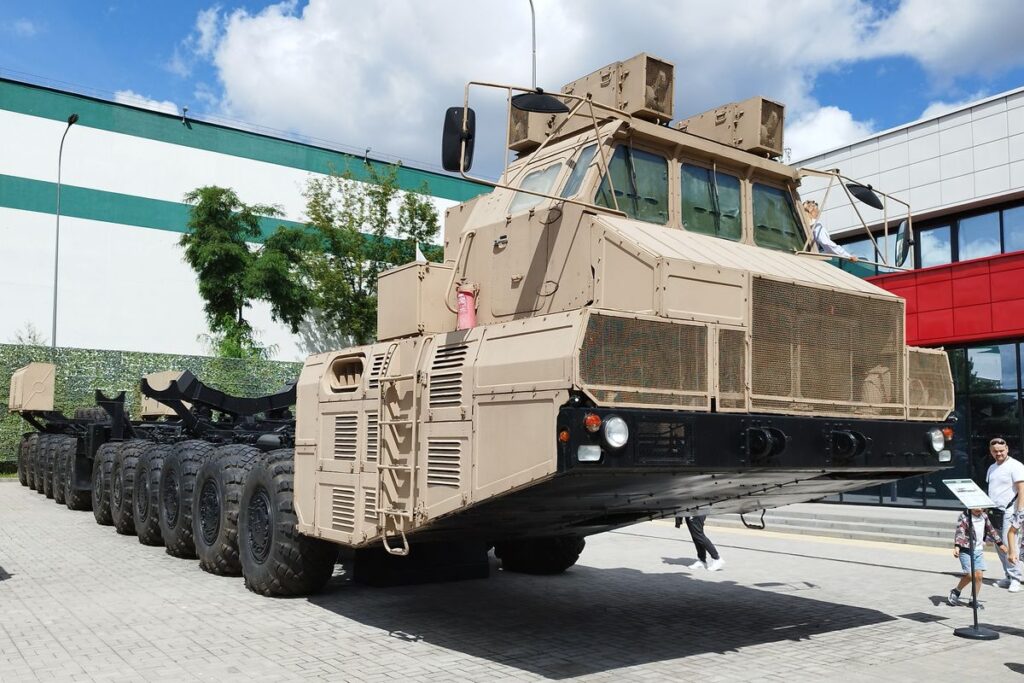
The early 1980s marked one of the most tense periods of the Cold War. Both superpowers continued to modernize their strategic nuclear forces, seeking to guarantee a retaliatory strike even in the event of a surprise attack.
Moscow paid close attention when the United States introduced the LGM-118 Peacekeeper intercontinental ballistic missile. Equipped with multiple independently targetable warheads and remarkable accuracy, it represented a significant leap in strategic capability. The Soviet response came in the form of the RT-23 missile program.
But building the missile was only part of the challenge. Ensuring its survivability was equally important.
Fixed silo launchers were known targets for enemy reconnaissance. Railway-based missile systems could potentially be tracked by satellites. Soviet planners therefore sought a mobile platform capable of carrying a massive missile across ordinary roads and remote routes while remaining difficult to detect.
To achieve this, they needed a vehicle unlike anything the world had ever seen.
From Failure to an Engineering Masterpiece
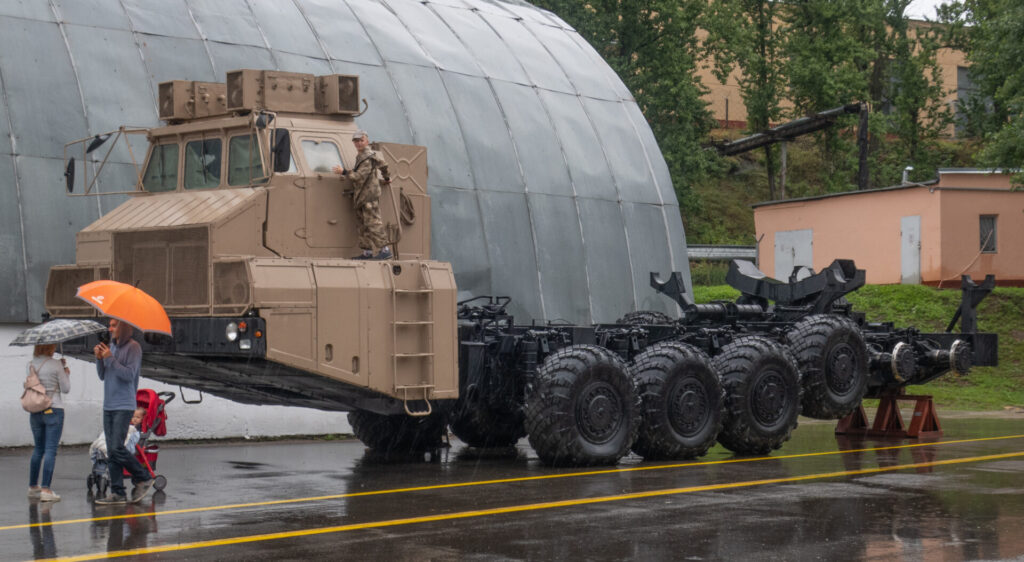
The first attempt to solve the problem was the MAZ-7904. The transporter was so enormous that it still appears almost unreal today.
Stretching over 32 meters in length and weighing hundreds of tons, it relied on a powerful marine diesel engine. However, testing quickly exposed a fatal flaw: excessive ground pressure.
The giant vehicle sank into soft terrain and left deep tracks wherever it traveled. Those tracks were easily visible from the air, making the transporter highly vulnerable to satellite observation. For a machine designed to remain hidden, that was unacceptable.
Yet the project was not abandoned. Engineers at the Minsk Automobile Plant carefully studied the results and decided to pursue an entirely different approach.
The result was the MAZ-7907.
A Vehicle from the Twenty-First Century Built in the Soviet Union
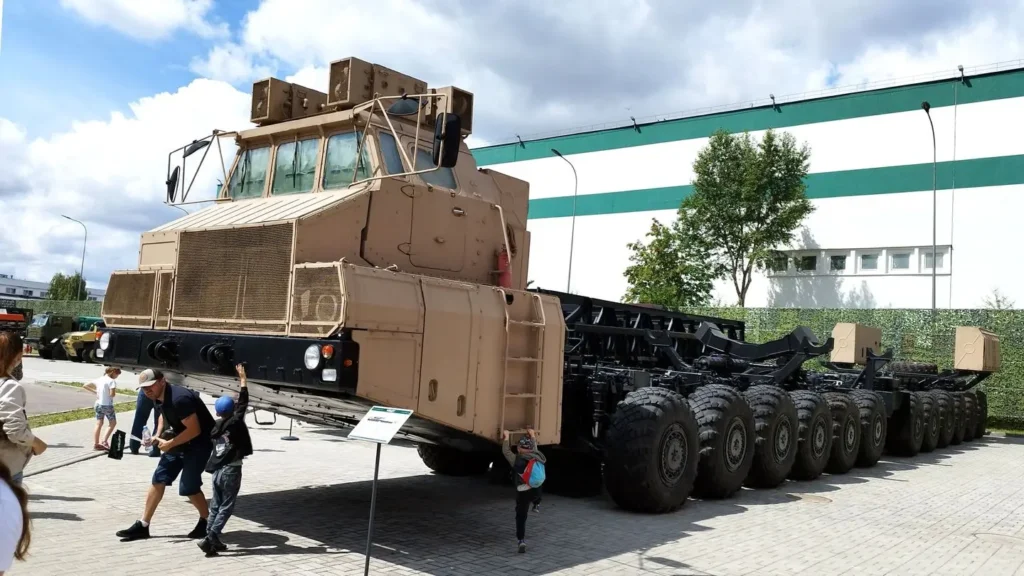
When the new transporter rolled onto the test grounds in 1985, even experienced engineers were astonished.
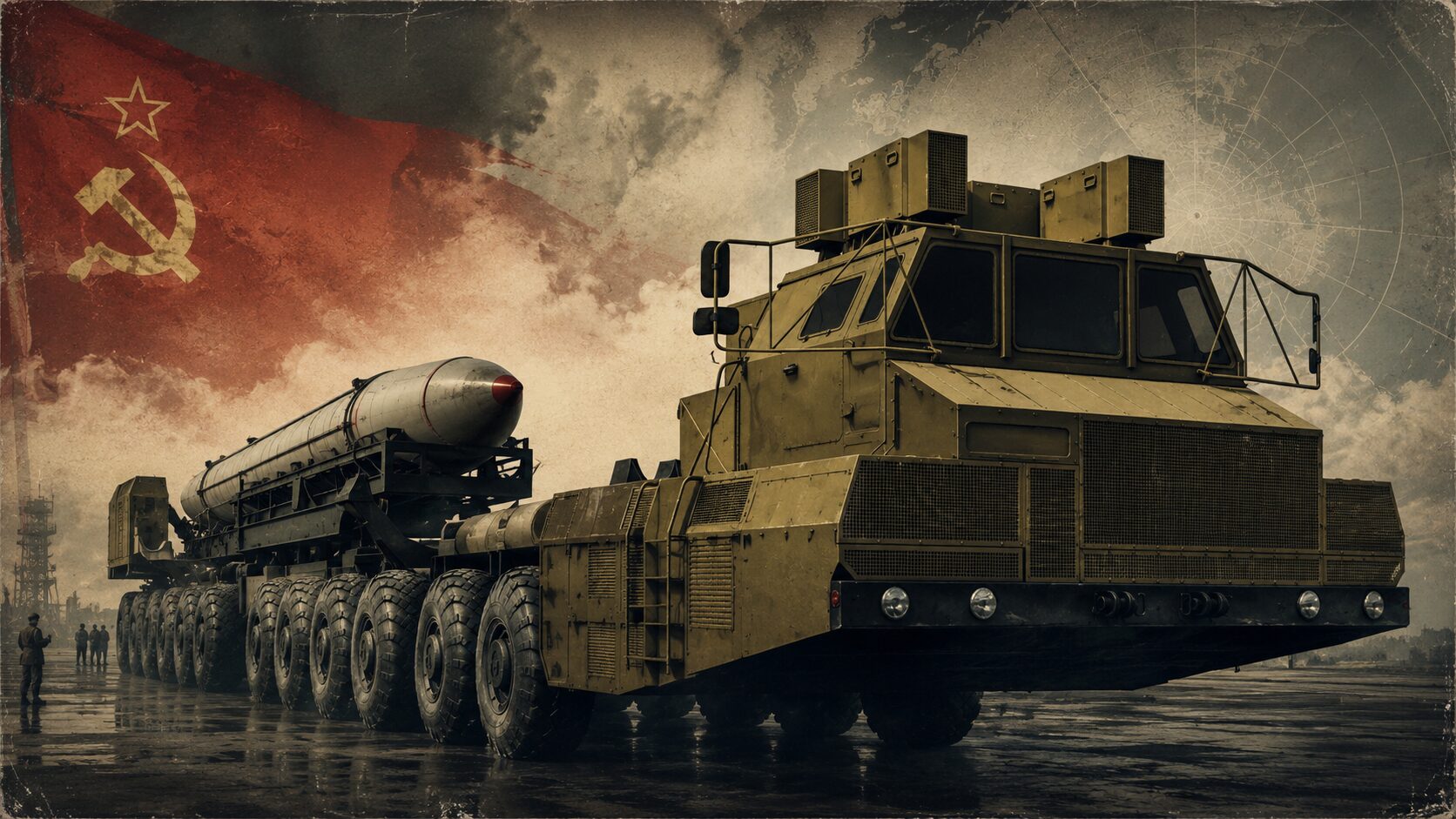
Before them stood a twelve-axle giant riding on twenty-four wheels.
But the most remarkable features were hidden beneath its massive body.
Instead of a conventional diesel engine, the designers installed a GTD-1000TF gas turbine derived from the powerplant used in the T-80 main battle tank. Producing approximately 1,250 horsepower, the turbine did not drive the wheels directly. Instead, it powered an electrical generator.
In effect, the MAZ-7907 was a series hybrid decades before hybrid vehicles became fashionable.
The electricity generated by the turbine was distributed to twenty-four individual traction motors—one for each wheel.
For the mid-1980s, this was an astonishingly advanced solution.
Today, hybrid propulsion is regarded as a hallmark of modern engineering. Soviet designers implemented a similar concept on a vehicle weighing well over one hundred tons nearly forty years ago.
A Landship on Wheels
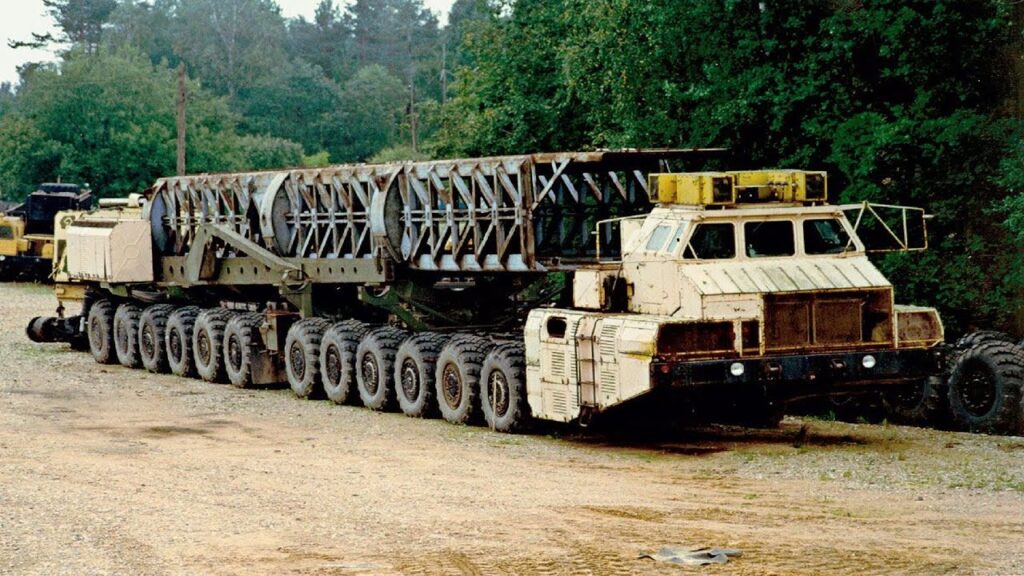
The chassis was just as impressive as the drivetrain.
To ensure mobility across uneven terrain, the vehicle featured an articulated frame. Essentially, the transporter consisted of two massive sections connected by a heavy-duty joint.
This arrangement allowed the vehicle to flex and adapt to rough ground while maintaining wheel contact and traction.
Several front and rear axles were steerable, giving the nearly thirty-meter-long machine a surprisingly tight turning radius.
During testing, the MAZ-7907 demonstrated the ability to move sideways, shifting laterally while maintaining orientation. This unusual maneuver became known as “crab steering.”
Even today, such a capability remains rare among specialized heavy vehicles.
One of the Soviet Union’s Most Secret Machines
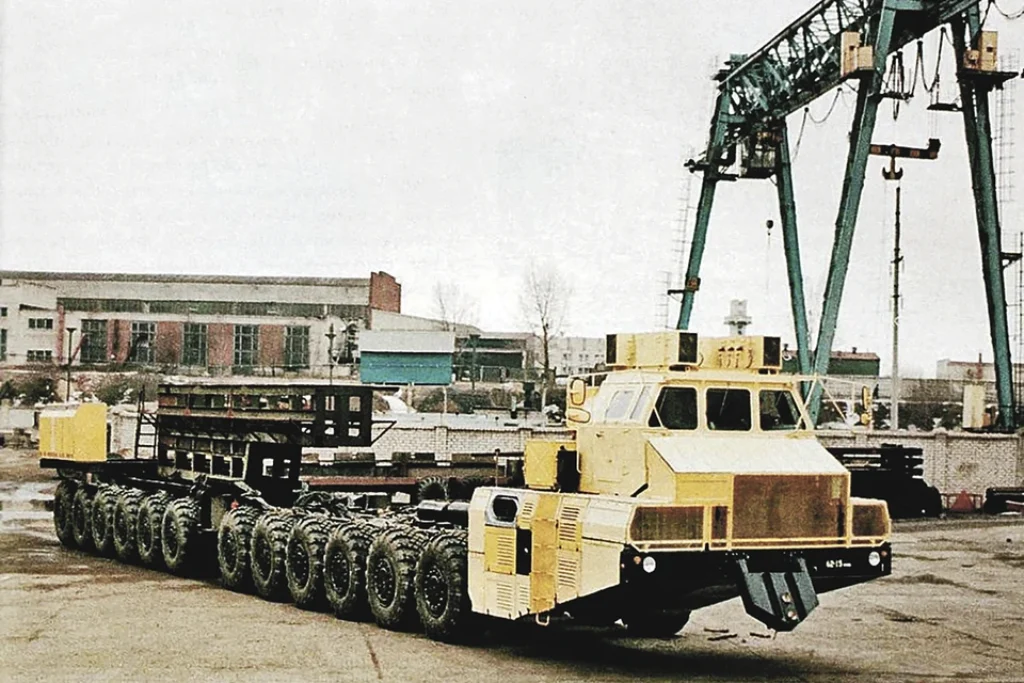
Testing of the transporter was conducted under extraordinary secrecy.
Convoys were escorted by military authorities and traffic police. Routes were prepared in advance, and many test runs took place exclusively at night.
For local residents, the experience was almost surreal. The enormous machine would emerge from the darkness, crawl silently along the road accompanied only by the whistle of its turbine, and disappear again into the night.
The MAZ-7907 was not merely a vehicle. It was a critical component of the Soviet nuclear deterrent, a machine whose very existence was intended to remain hidden from potential adversaries.
In many cases, Western intelligence agencies were unaware of the full extent of such projects.
The End of the Cold War—and the End of the Project
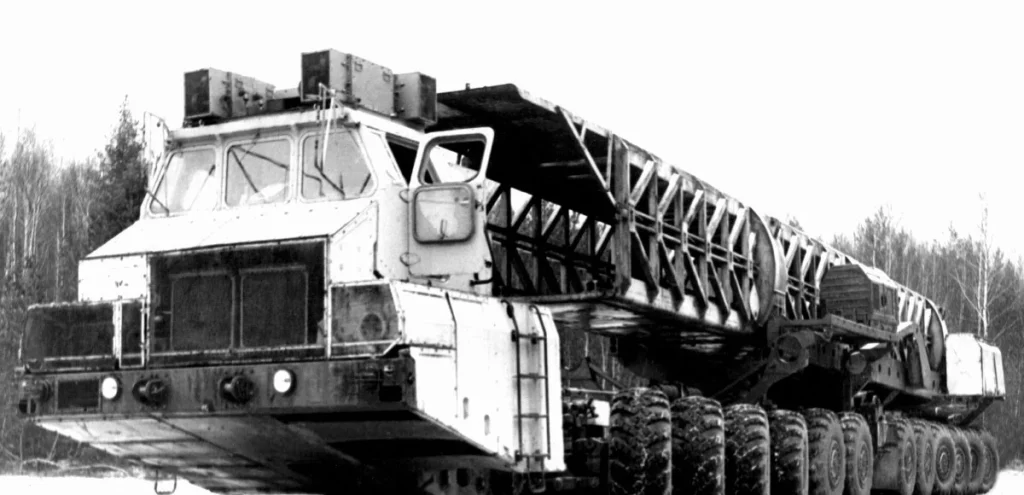
Unfortunately for its creators, history took a different turn.
While the two prototype vehicles were still undergoing trials, the geopolitical landscape began to shift dramatically. The Cold War entered its final phase, and the Soviet Union soon found itself facing profound political and economic upheaval.
Large strategic weapons programs were scaled back or canceled entirely.
The colossal transporter designed to carry intercontinental ballistic missiles suddenly had no mission.
The project was terminated.
Both prototypes were placed into storage, where they spent years slowly deteriorating, becoming monuments to an unrealized future.
The Leviathan’s Final Journey
The most famous chapter in the MAZ-7907’s story came after the collapse of the Soviet Union.
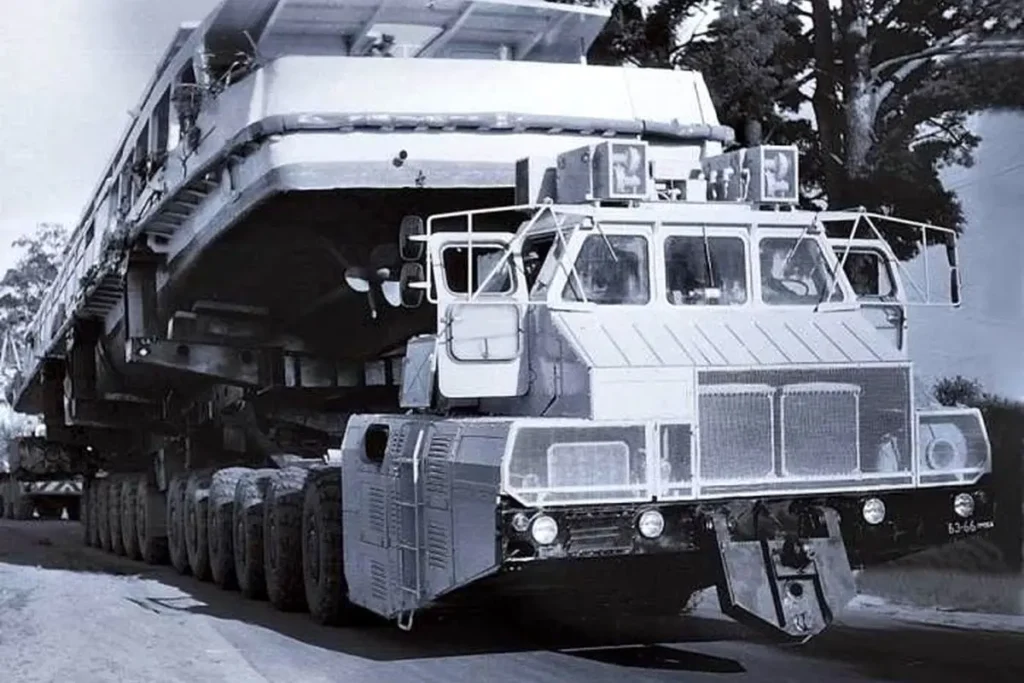
In the early 1990s, one of the transporters was unexpectedly assigned a civilian task: carrying an 88-ton riverboat to its new destination.
The sight was almost absurd.
A machine designed to transport the instruments of nuclear Armageddon slowly crawled along Belarusian roads carrying a pleasure boat on its back.
The mission was completed successfully, but during unloading the transporter had to enter shallow water. Moisture severely damaged its unique electric transmission system, effectively ending its operational life.
For one of the most sophisticated transport vehicles ever built, it was a strangely humble finale.
The Legacy of Soviet Engineering Ambition
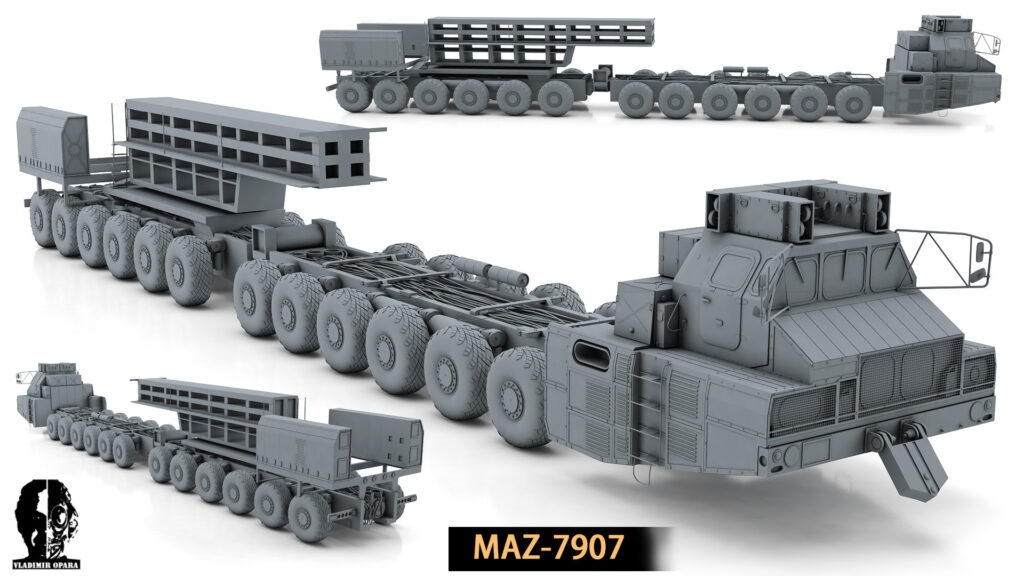
Today, the MAZ-7907 remains one of the most remarkable vehicles ever created.
It never carried operational missiles on active deployment. It never entered military service. It never reached serial production.
Yet machines like the MAZ-7907 reveal the scale of engineering ambition that defined the Cold War.
Soviet designers created a vehicle that still appears technologically daring today. Electric transmission, individual wheel motors, gas-turbine propulsion, multiple steering axles, and an articulated frame were all solutions that remain impressive even by modern standards.
The MAZ-7907 never fulfilled the mission for which it was built. Nevertheless, it endures as a symbol of an era when engineers were given seemingly impossible challenges—and somehow found a way to solve them.