How the Empire of Charlemagne Died: The Fall of the Most Powerful Dynasty of the Middle Ages

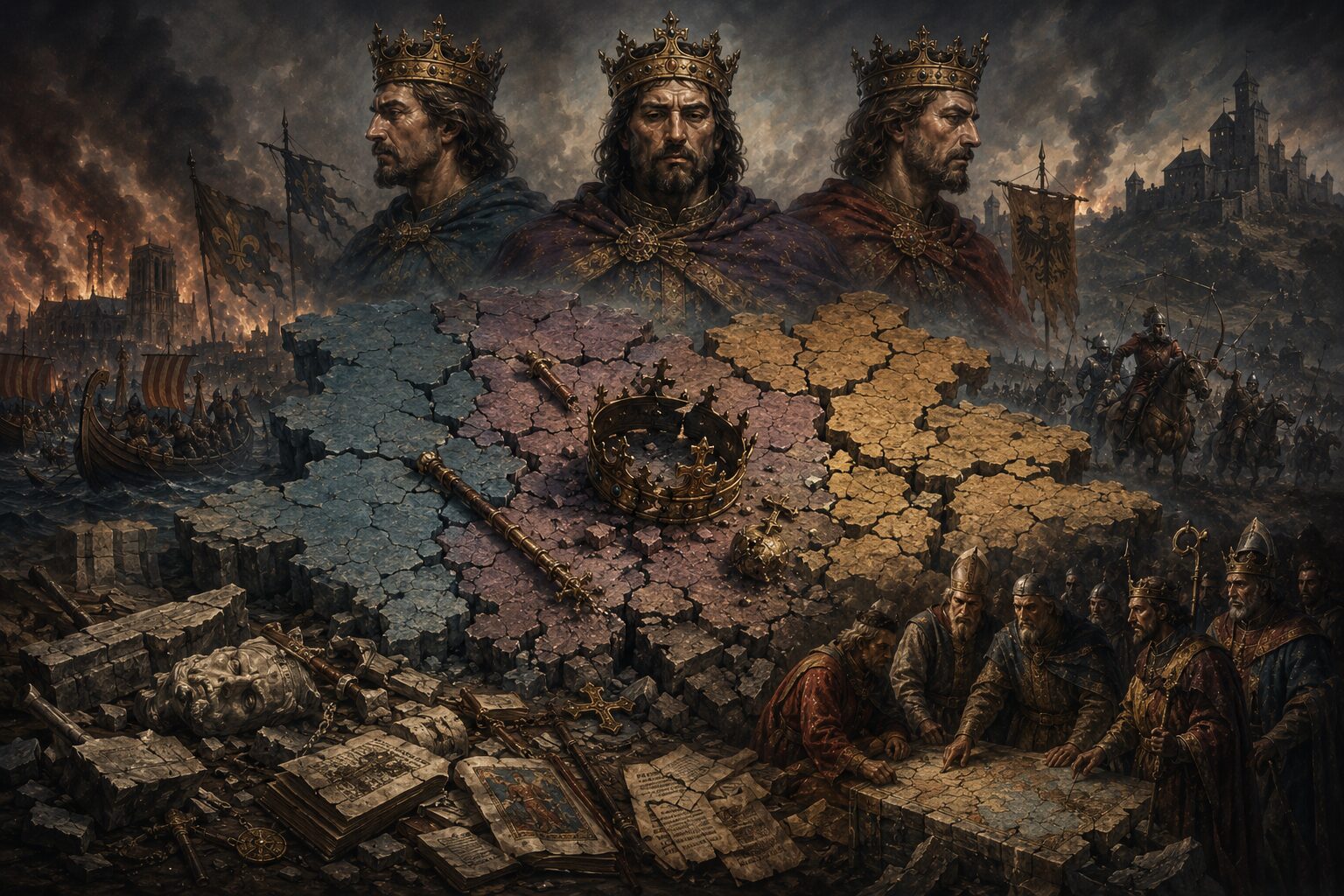
On Christmas Day in the year 800, an event took place in Rome that many contemporaries saw as the rebirth of antiquity. Inside St. Peter’s Basilica, Pope Leo III placed an imperial crown upon the head of the Frankish king Charlemagne. According to legend, Charlemagne himself was surprised by the gesture, although historians still debate how genuine that surprise really was.
Whatever the truth, a new empire was born that day.
Under Charlemagne’s authority stretched lands from the Atlantic Ocean to the Danube, from the North Sea to the Pyrenees and northern Italy. His armies had defeated the Lombards, subdued the Saxons, brought Bavaria to heel, and forced neighboring powers to recognize Frankish supremacy. After three centuries of turmoil following the fall of the Western Roman Empire, Europe once again had a ruler whom many regarded not merely as a king, but as the sovereign of Christendom itself.
It seemed that the dynasty he founded had secured an eternal future.
History, however, had other plans.
In less than two centuries, Charlemagne’s descendants would lose everything. The vast empire would fragment, royal authority would become little more than a symbol, and the last Carolingian king would die young and largely forgotten. The collapse was so complete that the new rulers of France and Germany would build their kingdoms without the Carolingians.
How did the most powerful family in Europe disappear so quickly?
An Empire Held Together by One Man
The greatest problem facing Charlemagne’s empire was, paradoxically, Charlemagne himself.
His extraordinary success became the source of future disaster.
The Carolingian Empire was not a modern state. It possessed no large bureaucratic apparatus capable of governing millions of subjects. It had no permanent standing army independent of local nobles. There was no clear and universally accepted system of succession.
Everything depended on the emperor.
Charlemagne constantly traveled throughout his domains, personally settling disputes, receiving ambassadors, appointing counts and bishops, leading military campaigns, and suppressing revolts. He served simultaneously as monarch, judge, commander, and symbol of unity.
As long as he lived, the system functioned.
But empires rarely survive their founders.
When Charlemagne died in January 814 at Aachen, it became clear that his successors had inherited a state that was excellent at conquering enemies but far less capable of surviving a change of ruler.
Louis the Pious and an Impossible Inheritance
The only surviving legitimate son of Charlemagne was Louis the Pious.
History has often treated him unfairly.
Many chroniclers portrayed Louis as weak and indecisive, incapable of preserving his father’s achievements. The reality was considerably more complicated.
Louis inherited not simply a kingdom, but the largest state in Western Europe since the age of Rome.
Any ruler would have struggled with such a burden.
There was another problem as well.
Frankish tradition did not recognize strict primogeniture. Lands were considered family property and were expected to be divided among heirs.
For a small kingdom this system could function.
For a continental empire it was potentially fatal.
Louis understood the danger and attempted to organize the succession before his death. Yet every effort only intensified rivalries among his sons.
Gradually, they ceased to see one another as brothers.
Instead, they became competitors.
The War That Destroyed an Empire
When Louis the Pious died in 840, the nightmare Charlemagne had feared finally arrived.
Civil war.
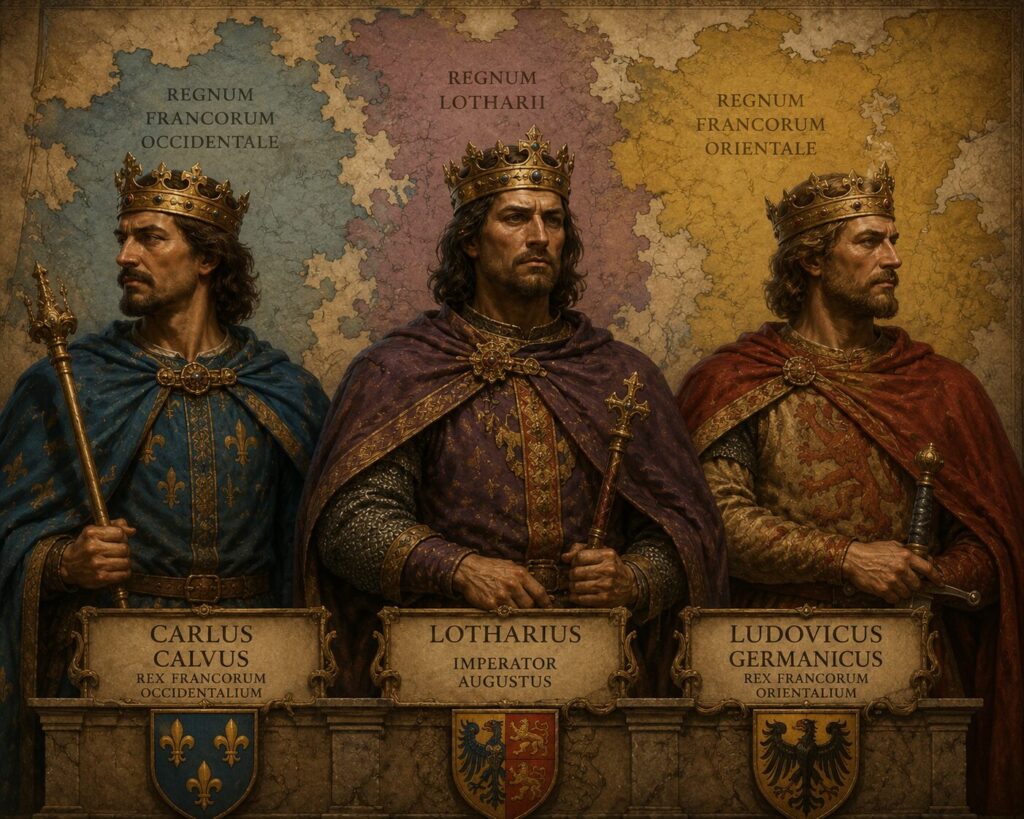
On one side stood Lothair, the eldest son, who believed himself the rightful heir to the entire empire.
Opposing him were Louis the German and Charles the Bald.
What followed resembled not a family dispute but a struggle for control of Europe itself.
Frankish armies fought Frankish armies.
Counts changed sides.
Bishops joined political intrigues.
Entire regions passed from one faction to another.
The bloodiest confrontation came at the Battle of Fontenoy in 841.
Contemporaries were horrified by its scale.
Chroniclers described thousands of deaths and openly referred to the battle as a fratricidal catastrophe.
For many observers, it seemed as though the empire created by Charlemagne was destroying itself.
What makes the story remarkable is that external enemies played only a minor role in its downfall.
The Carolingians dismantled their own inheritance with their own hands.
Verdun: The Day Europe Was Divided
In 843, the exhausted rivals finally agreed to make peace.
The result was the famous Treaty of Verdun.
At first glance, it appeared to be a straightforward political settlement.
In reality, it became one of the most important turning points in European history.
The empire was divided into three parts.
Charles the Bald received the western territories.
Louis the German gained the eastern lands.
Lothair retained the imperial title along with a long central corridor stretching from the North Sea to Italy.
Most contemporaries viewed the arrangement as temporary.
History proved otherwise.
West Francia gradually evolved into France.
East Francia became the foundation of Germany.
The lands of Lothair became a perpetual zone of conflict between the two.
Lorraine, Burgundy, the Low Countries, and northern Italy would remain contested for centuries.
In many respects, the political map of modern Europe began to emerge at Verdun.
While the Brothers Fought, the Vikings Arrived
Charlemagne had built his empire through military power.
Yet even he could not foresee the threat approaching from the north.
The Vikings.
While the Carolingians fought among themselves, longships began penetrating deeper into Europe’s river systems.
Monasteries were looted.
Cities burned.
Coastal regions were devastated.
Viking fleets sailed up the Seine, Loire, Rhine, and Elbe.
One of the most shocking events was the sack of Paris.
To the Franks, it was a humiliation.
Only a generation earlier, the descendants of Charlemagne had been regarded as masters of Europe. Now they struggled to defend their own capitals.
The Vikings were not the only danger.
Saracen raiders threatened the south.
The Magyars increasingly appeared from the east.
Slavic tribes continued resisting Frankish expansion along the frontier.
Already weakened by internal conflict, the Carolingian world found itself under pressure from every direction.
Kings Without Power
By the tenth century, the Carolingians still wore crowns.
But real authority was slipping away.
The true rulers of Europe were increasingly the dukes, counts, and bishops.
In France, the Robertians rose to prominence.
In Germany, powerful Saxon dynasties gained influence.
Local nobles no longer needed a strong king.
In fact, a weak monarch often suited them better.
Carolingian rulers continued to issue charters and preside over ceremonies, but major decisions were increasingly made by others.
The imperial title still carried prestige.
Actual power did not.
In many ways, the descendants of Charlemagne had become prisoners of the system they inherited. Their ancestors had built a mighty empire, but they had never created institutions capable of sustaining it without extraordinary leadership.
The Last Carolingian
The end came quietly.
The last Carolingian king of France was Louis V.
When he ascended the throne in 986, little remained of the glory of Charlemagne’s age.
The young king ruled for less than two years.
In 987 he died after falling from his horse during a hunt.
He was barely in his twenties.
He left no heirs.
After his death, the nobility elected Hugh Capet as king.
A new dynasty was born.
The Carolingians vanished from power.
There was no great battle.
No dramatic revolution.
No grand tragedy worthy of an ancient epic.
The most powerful family in Europe simply ceased to rule.
Why Did the Carolingians Fail?
It is tempting to blame the dynasty’s collapse on weak rulers.
But that explanation is too simple.
The Carolingians were ultimately victims of their founder’s success.
Charlemagne created an empire whose size exceeded the administrative capabilities of his age.
To survive, it required bureaucrats, roads, taxation systems, permanent armies, and durable institutions.
Early medieval Europe possessed none of these in sufficient quantity.
After the death of a powerful ruler, fragmentation became almost inevitable.
Add the tradition of dividing inheritances, the ambitions of local nobles, and constant external threats, and it becomes clear why even talented successors would have struggled to preserve the empire.
Charlemagne united Europe.
His descendants failed to create a system capable of preserving that achievement.
A Legacy That Outlived the Dynasty
When the last Carolingian died in 987, few contemporaries realized the significance of the moment.
It seemed as though only a king had changed.
In reality, an entire era had come to an end.
The dynasty that once ruled most of Western Europe had disappeared.
Yet its legacy proved stronger than the family itself.
From the shattered empire emerged France and Germany.
The Carolingian Renaissance preserved much of the classical learning that might otherwise have been lost.
The political vision created by Charlemagne continued to inspire rulers for centuries.
The Carolingians lost their throne.
But the world they helped create endured.
And that is the great paradox of their history: the dynasty vanished, yet the Europe it shaped survived long after its rulers were gone.