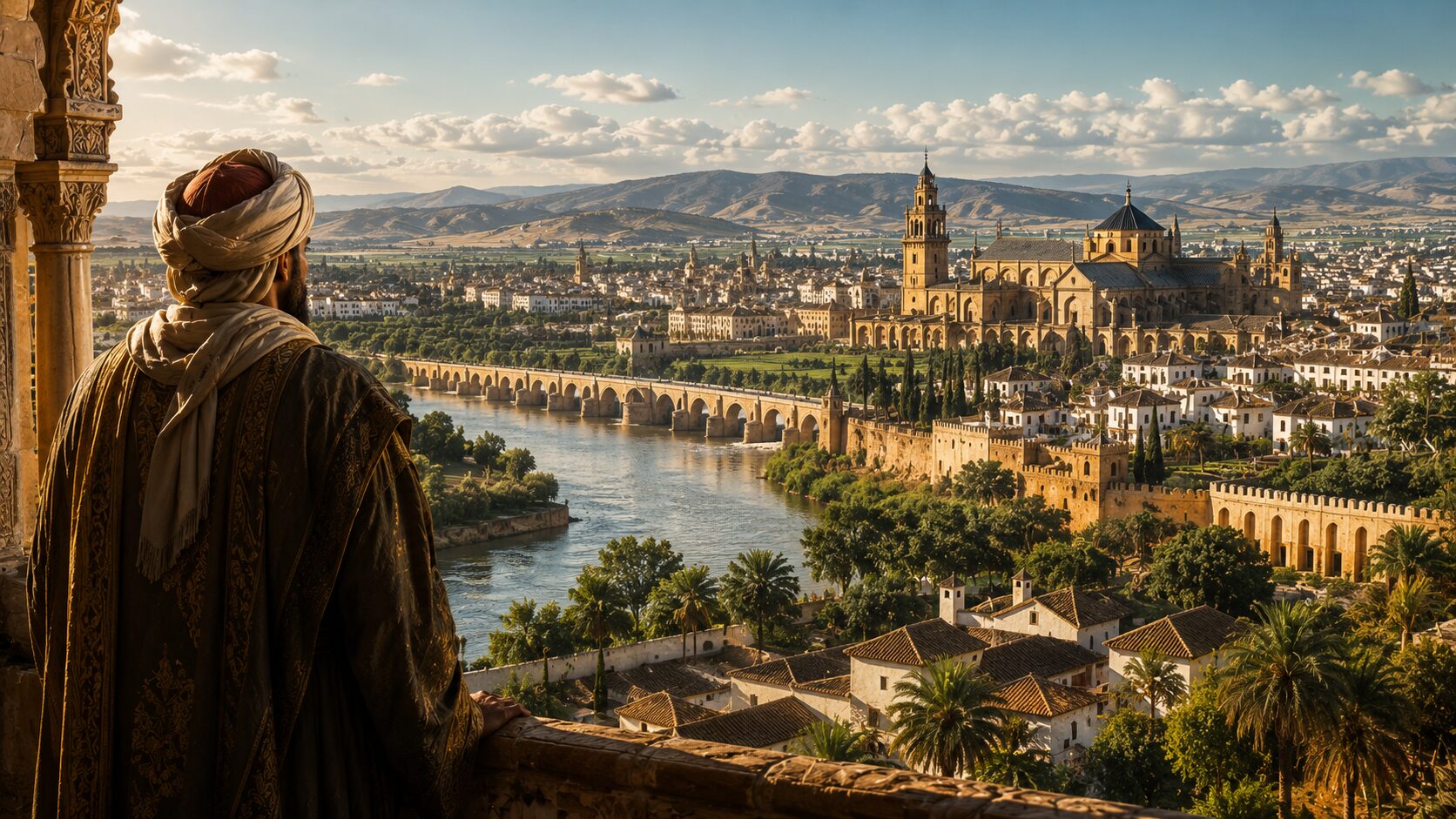
At the beginning of the eleventh century, an embassy arriving in Córdoba from Christian Europe entered a different world. Beyond the city walls stretched a vast urban landscape surrounded by gardens, mills, fields, and country estates. Ships moved along the Guadalquivir, while the markets offered silk fabrics, metalwork, ceramics, paper, spices, and books. In the workshops, skilled artisans produced goods that were traded throughout the Mediterranean.
Above the city rose the Great Mosque, a stone forest of columns and red-and-white arches. A few miles from Córdoba stood the palaces of Madinat al-Zahra, the caliph’s new residence, built as a physical demonstration of the power of the western Umayyads. From the capital, the rulers governed a state with a professional army, a developed taxation system, a stable gold currency, and an educated bureaucracy.
Around the year 1000, the Caliphate of Córdoba was almost certainly the wealthiest and most powerful state in Western Europe. Its prosperity did not rest on a single legendary library or on a romantic vision of peaceful coexistence between three religions. It was built on productive agriculture, cities, trade, taxation, and the ability of the central government to gather resources from across the country.
Yet Al-Andalus did not emerge as a fully formed civilization. It grew out of military conquest, civil wars, ethnic tensions, and almost three centuries of gradual transformation, during which Roman and Visigothic Spain became part of the Islamic world.
A Country That Did Not Yet Exist
The name Al-Andalus did not always refer to the same territory. Early Arabic authors used it to describe the lands of the Iberian Peninsula under Muslim rule. As the Christian kingdoms advanced southward, the borders of Al-Andalus steadily contracted. In the eighth century, it covered almost all of Iberia. By the end of the Middle Ages, only the Emirate of Granada remained.
For this reason, it is not entirely accurate to speak of a single “Empire of Al-Andalus” lasting from 711 to 1492. During those centuries, several political systems succeeded one another: a province dependent on the Damascus Caliphate, the independent Emirate of Córdoba, the Caliphate of Córdoba, the fragmented taifa kingdoms, the states of the Almoravids and Almohads, and finally Nasrid Granada.
The history of the wealthiest Al-Andalus is above all the history of the Umayyad state centered on Córdoba, which reached its height in the tenth century.
It began in 711, when an army led by Tariq ibn Ziyad crossed from North Africa through the strait that would later be called Gibraltar, from the Arabic Jabal Tariq, “the Mountain of Tariq.” Most of his troops were not Arabs, but recently Islamized Berbers from the Maghreb.
They faced the Visigothic Kingdom, which controlled most of Iberia. On a map, it appeared to be a powerful state. In reality, it was suffering from a dynastic crisis. The Visigothic monarchy lacked a stable system of succession, and the death of a king often led to coups, conspiracies, and struggles among aristocratic factions.
King Roderic had probably come to power through such a conflict. When the Muslim army landed in the south, part of the local elite either refused to support him or decided to wait and see who would win. At the battle traditionally known as Guadalete, Roderic’s army was defeated, and the king himself disappeared, most likely killed in the fighting.
The collapse of central authority opened the road to the major cities. Córdoba, Toledo, Seville, and other centers fell one after another. In some places there was fighting, but many cities negotiated surrender agreements, recognizing the new authority in exchange for the preservation of property, religion, and local administration.
Spain was not conquered by a massive horde capable of occupying every village. The conquerors were far too few. They seized the capitals, fortresses, roads, and tax system, negotiated with local elites, and gradually incorporated the peninsula into the Umayyad state.
By the 720s, Muslim armies had already crossed the Pyrenees. They occupied Narbonne and raided deep into Gaul. However, their defeat by Charles Martel in 732 and the later strengthening of the Franks limited further expansion to the north. Al-Andalus consolidated its position on the Iberian Peninsula, although its northern frontier remained unstable for a long time.
The Conquerors Who Nearly Destroyed Their Own State
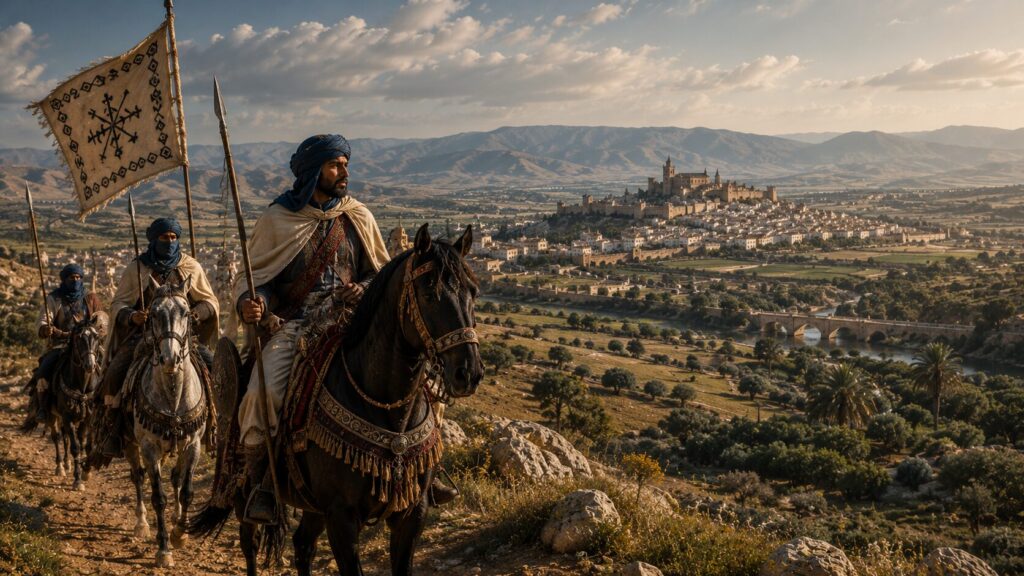
The conquest of Iberia did not bring peace to the new state.
From the beginning, Muslim society in Al-Andalus was deeply divided. The Arab elite took pride in its lineage and claimed the best lands and offices. The Berbers, who had formed a large part of the invading army, were often settled in poorer regions and believed they had been treated unfairly.
The Arabs themselves were also divided. Rivalries between tribal coalitions, imported from Syria and Arabia, continued in Iberia. These tensions overlapped with conflicts among governors, Berber dissatisfaction, and resistance from the local population.
In the 740s, a major Berber uprising spread across North Africa and reached Iberia. The central government in Damascus sent Syrian troops westward, but after their defeat in the Maghreb, some of them crossed into Al-Andalus. Their settlement temporarily strengthened the military system, while also adding yet another competing faction.
The situation changed after 750, when the Abbasid Revolution destroyed Umayyad power in the East. Most members of the ruling family were hunted down. One of the few survivors was the young Abd al-Rahman ibn Muawiya, a grandson of Caliph Hisham.
He fled through Egypt and North Africa before turning toward distant Al-Andalus. In 755, the Umayyad prince landed in Spain, gathered supporters, and defeated the ruler of Córdoba the following year.
Thus, an independent state of the western Umayyads appeared at the edge of the Islamic world.
Abd al-Rahman I did not proclaim himself caliph. Formally, he used the title of emir, but he rejected Abbasid political authority. His state was not a province of Baghdad. It had its own dynasty, army, treasury, and foreign policy.
For the Abbasids, Córdoba was a dangerous reminder of the dynasty they had overthrown. For the Umayyads, Spain became a second homeland, a place where a destroyed house could begin again.
How Iberia Became Part of the Islamic World
The early decades of the Emirate of Córdoba were marked by rebellions and a difficult struggle for centralization. Outside the capital, the emir’s authority was constantly challenged by Arab clans, Berber leaders, local aristocrats, and rulers of frontier regions.
Yet during this period, a much deeper transformation was taking place.
The conquest did not replace the population of the peninsula. Most inhabitants descended from local Hispano-Romans and Visigoths. They continued to farm the land, live in the same cities and villages, practice Christianity, and speak Romance dialects. Large Jewish communities also remained.
Gradually, increasing numbers of local people adopted the Arabic language and the cultural habits of the new ruling elite. Some converted to Islam, while others remained Christian but entered the Arabic-speaking urban world.
From this process emerged two of the most important groups in Al-Andalus.
The Mozarabs were Christians living under Muslim rule who adopted Arabic language and culture to varying degrees. They preserved their churches, liturgy, and communal institutions, but they might use Arabic names, read Arabic poetry, and conduct business in the language of the Muslim state.
The Muwallads were local converts to Islam and their descendants. Over time, they came to form a large share of the Muslim population. Al-Andalus gradually ceased to be a country in which a small group of conquerors ruled a Christian majority. It became an increasingly Islamized and Arabized society.
This was not an immediate or entirely voluntary fusion. Conversion could open the way to a career and remove certain legal restrictions, but it did not automatically bring social equality. Old Arab families continued to take pride in their ancestry, and Muwallads repeatedly rebelled against Córdoba.
Even so, after several generations the boundaries became less distinct. A descendant of a Visigothic landowner could become a Muslim judge, official, or military commander, speak and write in Arabic, and consider Al-Andalus his only homeland.
A Land Where Wealth Grew from Water
The power of Córdoba began not with libraries, but with agriculture.
Southern and eastern Iberia had fertile river valleys and a long agricultural tradition dating back to Roman times. The Muslim conquest did not create farming from nothing, but it connected the peninsula to a wider network of technologies, crops, and knowledge linking the Mediterranean, North Africa, the Middle East, and parts of Asia.
Irrigation systems, water-lifting devices, canals, and water distribution networks were expanded and improved. Norias, water mills, reservoirs, and irrigation channels were widely used. The results were especially visible in the dry regions of Valencia, Murcia, Andalusia, and the Ebro Valley.
Alongside traditional Iberian crops such as wheat, grapes, and olives, rice, citrus fruits, sugar cane, eggplants, saffron, cotton, and mulberry trees became more common or more economically important. Historians continue to debate the scale of the so-called Islamic Agricultural Revolution, and it would be wrong to credit Muslims with introducing every new plant. However, by the end of the tenth century, Al-Andalus possessed a diverse and technologically sophisticated agricultural economy with a strong reputation throughout the Mediterranean.
More important than any individual crop was the combination of irrigation, urban markets, monetary circulation, and a large craft-producing population. Farmers produced not only for their own consumption. Fruit, oil, wine, grain, dyes, flax, and raw materials for textile production flowed into the markets and became taxes, commercial profit, and urban demand.
Land remained the foundation of the economy, but the wealth of the caliphate came from the link between the countryside and the cities.
A Country of Cities
Early medieval Western Europe was not a cityless wasteland, as popular accounts sometimes suggest. Rome, Paris, Pavia, Milan, Toledo, and other centers continued to exist and develop. Yet the level of urbanization in Al-Andalus was unusually high for the western part of the continent.
Seville controlled the lower Guadalquivir. Toledo remained a major center of central Iberia. Zaragoza guarded the Ebro Valley and the northeastern frontier. Almería became an important Mediterranean port and textile center. Málaga, Valencia, Badajoz, and many other cities linked agricultural regions to regional and international trade.
These cities were more than administrative centers. They contained markets, mosques, baths, caravanserais, workshops, warehouses, and courts. Metal was worked, leather was tanned, and ceramics, weapons, glass, paper, and textiles were produced.
Silk was especially important. Its production required a complex chain of activities: growing mulberry trees, breeding silkworms, spinning thread, dyeing it, and employing highly skilled weavers. Fine textiles became exports, court luxuries, and diplomatic gifts.
Al-Andalus also possessed deposits of iron, copper, lead, silver, and mercury. Iberian metals had been mined since antiquity, but under Muslim rule mining became part of a wider Mediterranean economy.
Money connected these industries. The Umayyads of Córdoba minted silver dirhams and gold dinars. A stable currency facilitated taxation, military payments, and long-distance trade. The continued importance of gold coinage and a developed monetary economy distinguished Al-Andalus from many of its western neighbors.
Córdoba, Capital of the West
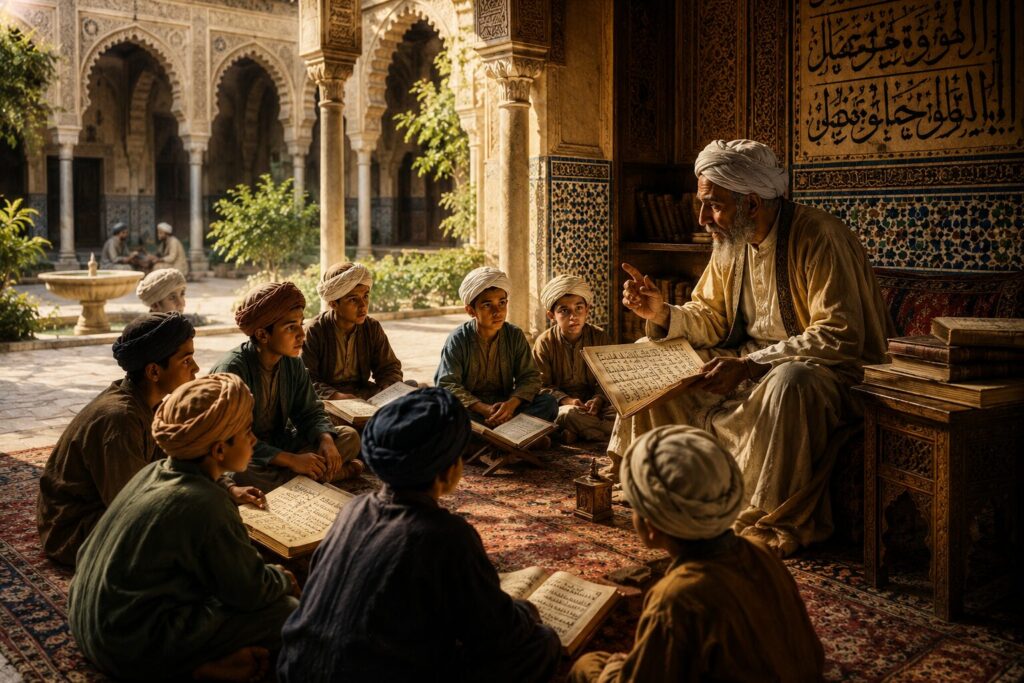
The true heart of the state was Córdoba.
The city had existed long before the Muslim conquest. Under Rome, Corduba had been the capital of the province of Baetica, and it remained important under the Visigoths. The Umayyads did not build their capital on an empty site, but they transformed it into the center of a new political system.
By the tenth century, Córdoba was probably the largest city in Western Europe. Exact population figures remain disputed. Medieval chronicles often exaggerated, and popular claims of “one million inhabitants” or thousands of illuminated streets cannot be accepted without serious qualification. Yet archaeology and written evidence leave no doubt that the metropolitan area was enormous by the standards of the age.
It consisted not only of the old fortified center. Suburbs, palatial complexes, gardens, cemeteries, artisan quarters, and country estates spread far beyond the walls. The Guadalquivir supplied water, powered mills, and connected the capital to Seville and the Atlantic.
The Great Mosque of Córdoba embodied the history of the dynasty. Abd al-Rahman I began its construction on the site of an earlier religious complex. Every powerful ruler after him expanded the building, adding a new architectural layer.
Inside, repeating columns and double-tiered arches created the impression of an endless space. Under al-Hakam II, the richly decorated mihrab and domes became masterpieces of western Umayyad art.
Yet the mosque was not only a religious monument. Friday prayer displayed the unity of the community around the ruler, while the caliph’s name, spoken from the pulpit, affirmed his legitimacy.
The Caliph Who No Longer Hid Behind the Title of Emir
At the beginning of the tenth century, the Umayyad state nearly collapsed.
Entire regions ceased to obey the capital. The most dangerous enemy of Córdoba was Umar ibn Hafsun, the leader of a long rebellion in the south, supported by mountain fortresses, Muwallads, and dissatisfied local communities. At the same time, the Christian kingdoms were growing stronger, while the Fatimid Caliphate emerged in North Africa and openly claimed leadership of the Islamic world.
In 912, Abd al-Rahman III became emir. He was around twenty years old, and Córdoba’s authority appeared almost nominal. Yet the new ruler systematically recovered fortresses, subdued rebellious regions, and rebuilt centralized government.
By 929, his position was strong enough for him to adopt the title of caliph.
This was a carefully calculated political act. The Abbasid caliph still ruled in Baghdad, while the Shia Fatimids controlled North Africa. Abd al-Rahman III declared that the western Umayyads were equal to either rival dynasty.
The Emirate of Córdoba became a caliphate.
The title was supported by material resources. The state collected land, commercial, and other taxes, and drew revenue from mints, customs, markets, and royal estates. Much of this income supported a professional army, navy, court, and bureaucracy. The centralized government possessed the ability to extract surplus wealth from the economy and concentrate it in the capital.
This concentration of resources made possible the construction of Madinat al-Zahra.
A City Built as Proof of Power
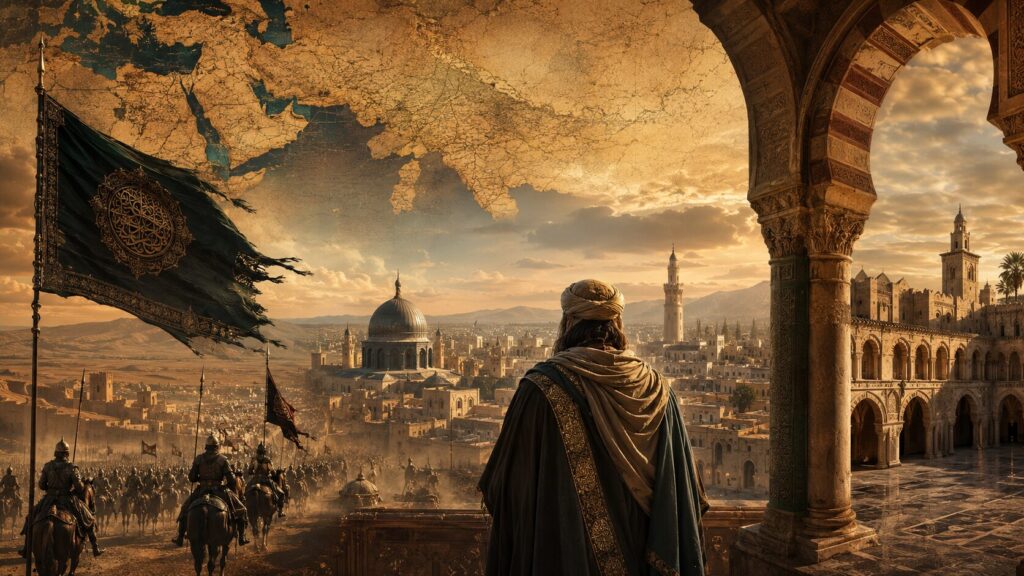
About eight kilometers from Córdoba, Abd al-Rahman III ordered the construction of a new palatial capital: Madinat al-Zahra, the “Radiant City.”
A later legend claimed that the caliph built it for a favorite woman. The real reason was more practical and far more ambitious. The ruler needed a residence capable of housing the court, officials, guards, workshops, and diplomatic ceremonies, while demonstrating the legitimacy of the new caliphate.
The city was built on the slopes of the Sierra Morena. Its terraces reflected the hierarchy of power. At the top stood the caliph’s residence and palace buildings. Below were administrative offices, gardens, residential quarters, and service areas.
An ambassador approaching the ruler passed through a space deliberately designed to create psychological impact. Water, marble, carved stone, gardens, textiles, and ceremonial order were intended to show that the Caliph of Córdoba possessed no less grandeur than the emperors of Constantinople or the rulers of Baghdad.
Madinat al-Zahra was a complete urban complex with roads, bridges, water systems, palaces, houses, and workshops.
The irony was that this magnificent project was short-lived. It took decades to build, yet in the early eleventh century it was looted and destroyed during civil war. The brilliant capital, intended as an eternal symbol of the Umayyads, survived their political greatness only briefly.
Libraries, Translators, and Men of Learning
The wealth of Al-Andalus is often associated primarily with science, but it is important not to confuse cause and effect.
Large libraries, schools, and manuscript workshops could exist because they were supported by a wealthy court, educated officials, an urban elite, and a developed market. The production of knowledge required money. Books had to be purchased, copyists had to be paid, parchment or paper had to be prepared, teachers had to be maintained, and scholars needed the freedom to work.
Caliph al-Hakam II, who ruled from 961 to 976, became especially famous as a collector of manuscripts. He ordered books from the East and supported scholars. Later writers credited his library with hundreds of thousands of volumes, although such figures cannot be verified and were probably exaggerated.
The existence of a major collection, however, is beyond doubt. Córdoba became part of an intellectual world stretching from Iberia to Egypt, Syria, Iraq, and Central Asia. Books, ideas, and specialists traveled along the same routes as textiles, coins, and spices.
In Al-Andalus, scholars studied law, theology, grammar, medicine, mathematics, and astronomy. They were not merely custodians of classical knowledge. They commented on, corrected, organized, and expanded the ideas they inherited.
The intellectual flowering of Al-Andalus was not limited to the tenth century. Its greatest thinkers, including the philosopher Ibn Rushd, the physician and philosopher Ibn Tufayl, and the Jewish scholar Maimonides, lived later, after the fall of the Caliphate of Córdoba. Their achievements grew from the urban and educational traditions established under the Umayyads.
Al-Andalus also became one of the bridges through which Arabic philosophy and science reached Latin Europe. Yet the great translation movement developed especially in twelfth-century Christian Toledo, not in the Umayyad capital. The transmission of knowledge was more complex than the popular formula that “the Arabs preserved antiquity and returned it to Europe.”
Was Al-Andalus a Land of Universal Tolerance?
The romantic image of Al-Andalus often presents it as a society of perfect coexistence between Muslims, Christians, and Jews. The opposite myth depicts it only as a place of conquest and religious oppression.
Both versions are too simple.
Christians and Jews could preserve their faith, communities, clergy, and legal institutions while recognizing Muslim authority and paying special taxes. They participated in economic life, served at court, and worked in medicine, translation, crafts, and trade.
Some Jewish figures reached very high positions. The most famous was Hasdai ibn Shaprut, a physician and diplomat under Abd al-Rahman III. He took part in negotiations with foreign embassies and became a patron of Jewish scholarship.
Yet legal equality in the modern sense did not exist. Islam held the dominant position, while non-Muslims belonged to protected but subordinate communities. Their treatment varied according to the ruler, the period, the city, and the political situation.
There were eras of cooperation and cultural exchange, but also rebellions, repression, and religious conflict. In ninth-century Córdoba, a movement of Christian martyrs emerged, whose members publicly denounced Islam. In later centuries, especially under the Almohads, pressure on Christian and Jewish communities intensified.
Al-Andalus was neither a modern secular society nor a permanent religious prison. It was a hierarchical medieval system whose uniqueness lay in the intensity of contact between different languages, religions, and cultural traditions.
African Gold and Trade Across Two Seas
The geography of Al-Andalus allowed it to participate in several commercial worlds at once.
To the east lay the Mediterranean routes to North Africa, Egypt, Sicily, and the Islamic East. To the west lay the Atlantic. Across the Pyrenees came trade with Christian lands, while routes through the Maghreb connected Iberia to trans-Saharan commerce.
African gold was especially important. It traveled north from regions beyond the Sahara through the trade centers of the Maghreb and allowed the Umayyads to mint dinars. Control of maritime routes and North African politics was therefore not only a matter of prestige or security, but also part of the struggle over money and trade.
Al-Andalus exported textiles, leather, metal goods, ceramics, agricultural produce, and, during certain periods, slaves. It imported luxury goods, spices, books, raw materials, and gold.
This should not be imagined as a modern free market. Medieval transport was slow, dangerous, and expensive. War, piracy, crop failures, and political crises could disrupt trade routes almost immediately.
Even so, a monetized economy and a developed urban network set Al-Andalus apart from many western European states. The combination of agricultural surplus, trade, craft production, and taxation allowed Córdoba to support an expensive court and a permanent army.
The Army That Consumed the Country’s Wealth
The wealthiest state in Western Europe was also a military power.
The northern frontier of Al-Andalus was never completely peaceful. Asturias, León, Navarre, Castile, and the Christian counties of the northeast gradually strengthened. Raids occurred in both directions. Muslim armies devastated northern lands, while Christian forces attacked the south.
The army of Córdoba changed over time. Early rulers depended on Arab and Berber military groups tied to tribal interests. The Umayyads tried to create forces loyal directly to the ruler by employing mercenaries, slave soldiers, and foreign contingents.
Under al-Mansur, the effective ruler at the end of the tenth century, the military system reached its highest level of activity. He led dozens of campaigns against the Christian kingdoms and captured Santiago de Compostela in 997, although he failed to alter the long-term strategic balance of the peninsula.
Victory brought loot and strengthened the regime, but the army consumed enormous resources. To maintain it, the state had to collect taxes, control trade, and preserve political unity.
As long as the central government functioned, the system appeared invincible. Once a struggle for control of the court began, the same professional troops and palace factions became participants in civil war.
How the Wealthiest Country Disappeared in a Single Generation
After the death of al-Mansur in 1002, the system he had created began to collapse.
The Umayyad caliphs formally continued to rule, but real power shifted among courtiers, military commanders, and ethnic factions. Berber troops, Slavic military slaves, Arab nobles, and the citizens of Córdoba supported rival candidates.
In 1009, the fitna, or civil war, began. It lasted for more than twenty years. Caliphs were deposed, restored, and overthrown again. The capital endured sieges and looting. Madinat al-Zahra was destroyed. Provincial governors stopped sending taxes to Córdoba and declared independence.
In 1031, the leading families of Córdoba formally abolished the caliphate.
The unified state broke into dozens of principalities known as taifas. Among the most important were Seville, Toledo, Zaragoza, Badajoz, Valencia, and Granada.
Economic and cultural life did not disappear overnight. Some taifas remained wealthy, and rivalry between their courts even encouraged poetry, science, and the arts. Yet political fragmentation carried a high price.
The rulers of the taifas fought one another and paid tribute, known as parias, to Christian kings. Large quantities of silver and gold flowed northward, strengthening León, Castile, Navarre, and Aragon.
In 1085, King Alfonso VI of Castile captured Toledo. Alarmed taifa rulers called for help from the Almoravids of North Africa. They halted the Christian advance, but soon absorbed the divided principalities themselves.
From that point onward, Al-Andalus experienced further political and cultural revivals, but no unified state ever again matched the Caliphate of Córdoba in the tenth century.
Was It Really the Wealthiest State in Europe?
The claim requires qualification.
It was not necessarily true for the eighth or twelfth centuries. Al-Andalus changed together with its borders and political system. Nor can historians calculate the “GDP” of the Caliphate of Córdoba and compare it precisely with Byzantium, England, or the Holy Roman Empire. Reliable medieval statistics simply do not exist.
The Byzantine Empire also remained an extremely sophisticated state, with a vast capital, a stable monetary system, and international trade. If Byzantium is counted as a European state, the claim that Córdoba was unquestionably the richest becomes more debatable.
Yet for Western Europe around the year 1000, the description is highly plausible. At that time, the Caliphate of Córdoba combined productive and diversified agriculture, numerous cities, developed craft industries, gold and silver coinage, long-distance trade, a professional army, an educated bureaucracy, and strong central government.
Its wealth, however, did not make it eternal.
The Caliphate of Córdoba did not fall because of economic backwardness or a single devastating invasion. It was destroyed by a struggle among elites for control of resources that had become too valuable to remain outside political rivalry.
A Civilization That Outlived Its State
The Caliphate of Córdoba lasted little more than a century, but Al-Andalus survived it for almost five hundred years.
After the fall of Córdoba, cities, markets, craft traditions, irrigation systems, libraries, and educated communities continued to exist. Political borders changed, but the cultural world did not vanish with each dynasty.
Al-Andalus developed into a society that cannot be reduced to a simple conflict between “Arabs” and “Spaniards.” Most of its Muslims eventually descended from local people. Many Christians spoke Arabic. Berbers, Arabs, Muwallads, Mozarabs, Jews, and Saqaliba did not live in isolated worlds. They traded, argued, formed alliances, translated books, and struggled for power.
For this reason, Al-Andalus was not merely an eastern state accidentally transplanted into Europe. It became a distinct Iberian civilization, born from the fusion of local traditions with the Islamic Mediterranean.
Its wealth was created not only by caliphs, palaces, and caravans. It grew in the irrigated gardens of Valencia, the workshops of Almería, the ports of Seville, the markets of Toledo, and the crowded suburbs of Córdoba.
In 711, a relatively small army of conquerors entered the peninsula. Three centuries later, the region possessed the largest urban and economic system in Western Europe, with a culture of its own and a population that could no longer be neatly divided into conquerors and conquered.
Yet one central question remained: who were the people of Al-Andalus?
Were they Christians who had adopted the Arabic language? Descendants of Visigoths who had converted to Islam? Arabs born in Spain who had never seen Damascus? Or had they already become an entirely new people?
The answer lies with the Mozarabs and the Muwallads, the central figures of the next part of this series.