Twelve Rockets Instead of Six: Why Poland Is Betting on Homar-K Over HIMARS

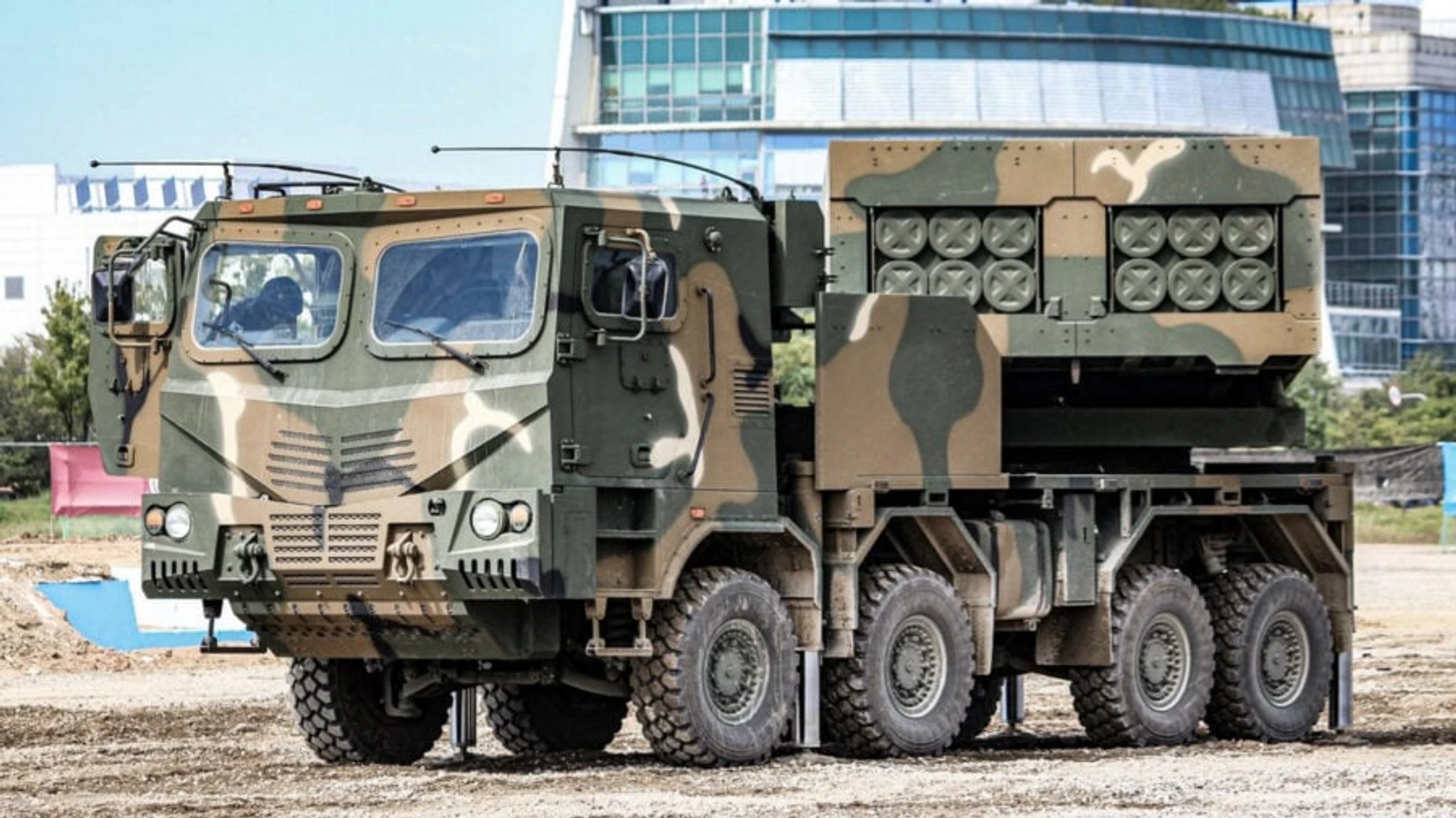
The American M142 HIMARS has practically become synonymous with modern precision rocket artillery. The compact wheeled launcher can fire both guided rockets of the GMLRS family and much longer-range ATACMS missiles, with the new PrSM now expanding its capabilities even further. Poland’s decision to acquire HIMARS therefore seemed entirely logical. The country ordered its first twenty systems in 2019, received them in 2023, and at one point planned to purchase hundreds of additional launchers.
Now, however, an unexpected idea is being discussed in Poland: sell the twenty existing M142s and concentrate on another system.
That system is Homar-K, the Polish version of South Korea’s K239 Chunmoo.
For now, this remains a proposal discussed by Polish defense analysts rather than an official decision by the Ministry of National Defence. According to Defence Express, the discussion followed a Defence24 article suggesting that Poland could dispose of its small fleet of twenty HIMARS launchers and redirect resources toward further development of Homar-K.
But the idea did not appear out of nowhere.
Poland has already ordered 290 Homar-K launchers, is preparing domestic rocket production, and is gradually building its own industrial infrastructure around the system.
And that raises an interesting technical question.
If HIMARS is considered one of the most advanced rocket artillery systems in its class, why does Poland need Homar-K?
The answer becomes clearer when three systems are placed side by side: the American HIMARS, the Polish-South Korean Homar-K, and the Russian Tornado-S.
They represent three quite different answers to the same question: how many rockets, of what range and power, should a modern rocket artillery system carry?
HIMARS: One Launcher, One Pod
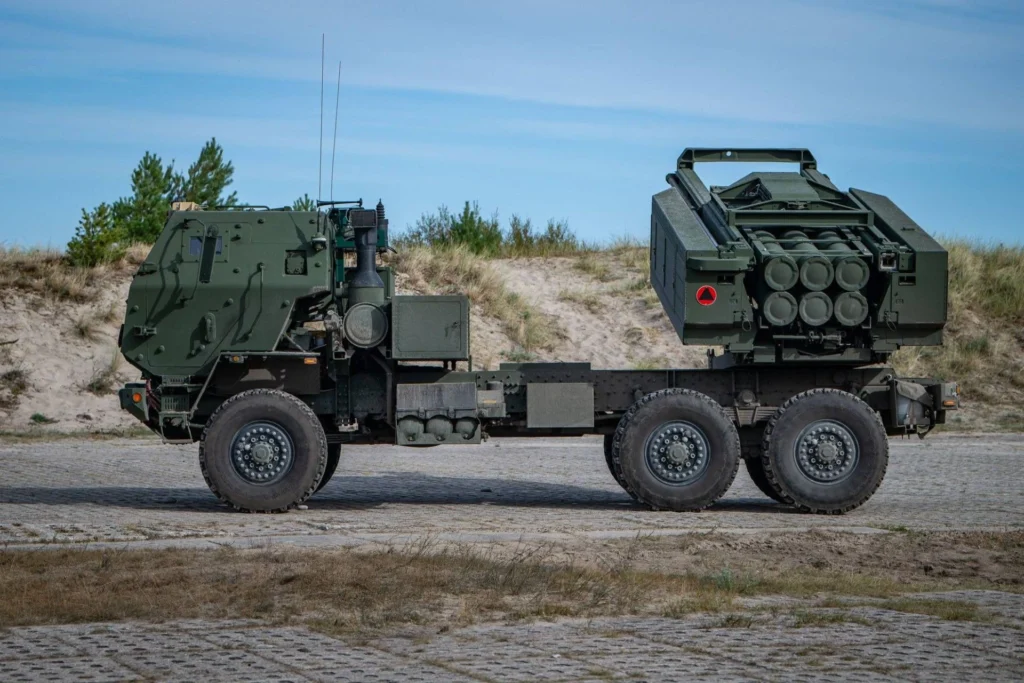
The main advantage of the M142 is also its main limitation.
HIMARS was developed as a lighter wheeled relative of the tracked M270 MLRS. Instead of the M270’s two launch pods, it carries only one. This made the vehicle comparatively compact, easier to deploy, and easier to conceal.
But the number of ready-to-fire munitions was cut in half.
A standard MLRS pod carries six 227 mm rockets. These can include various GMLRS guided rockets with ranges of roughly 70–90 km, while newer ER GMLRS ammunition extends the range to around 150 km. Instead of six rockets, the launcher can carry one much larger ATACMS missile, while the newer PrSM uses a different container configuration.
This modular concept has proved extremely successful. The crew does not have to load individual rockets manually: the empty pod is removed as a complete unit and replaced with another.
But physics cannot be avoided.
One pod remains one pod.
After firing six GMLRS rockets, a HIMARS must either leave the position or reload.
And this is where the main difference between HIMARS and Homar-K begins.
Homar-K Carries Two Pods
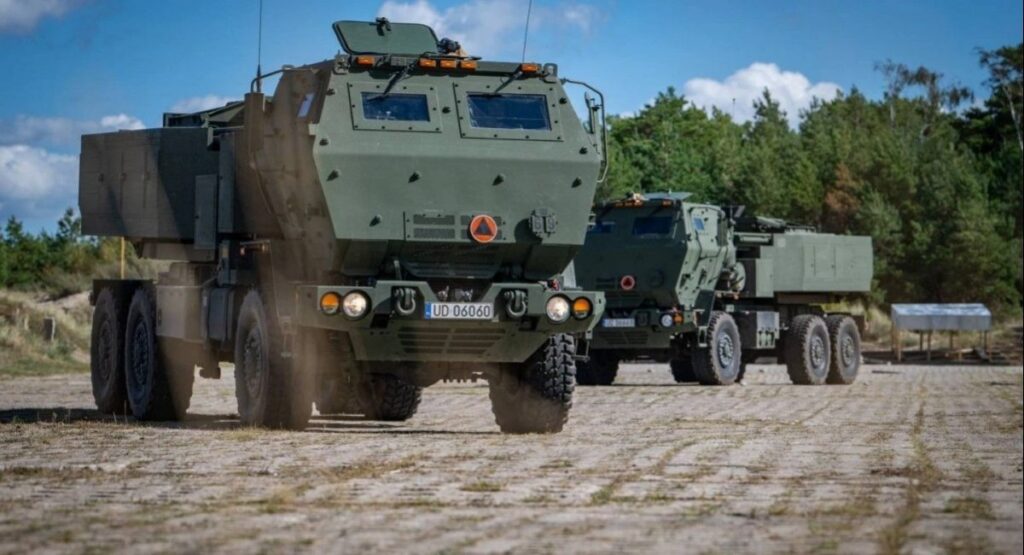
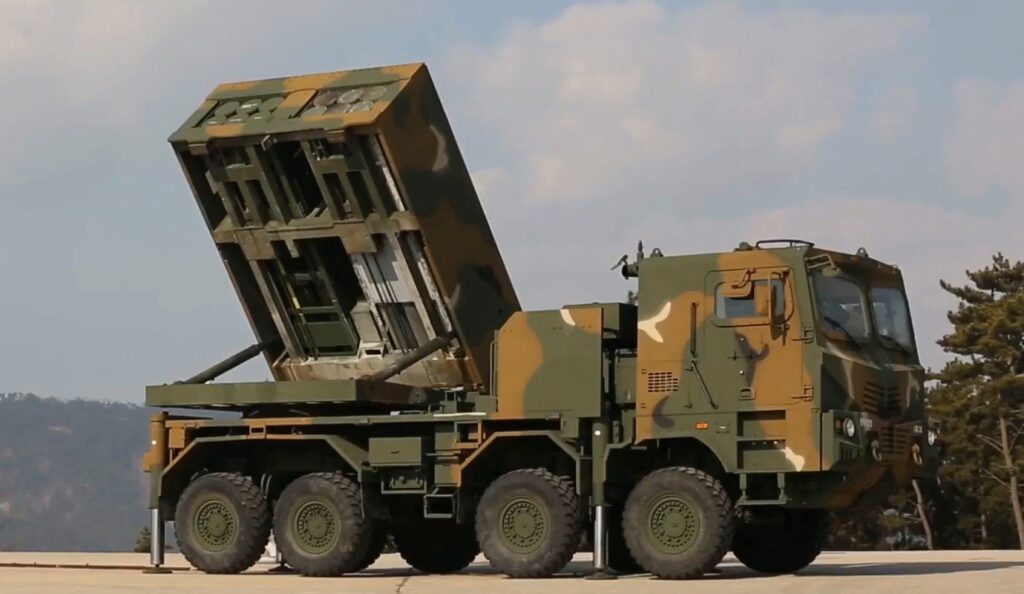
South Korea’s K239 Chunmoo is conceptually closer to the heavier M270 than to HIMARS: its launcher carries two independent rocket pods.
Poland, however, did not simply purchase the complete South Korean system.
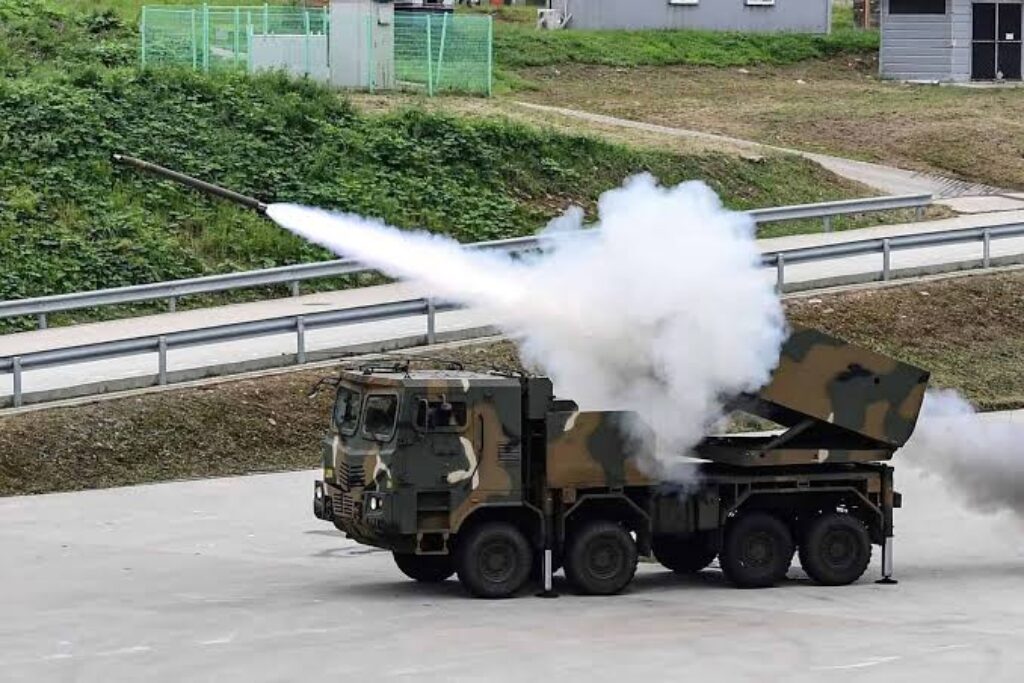
Homar-K uses a Polish Jelcz 8×8 truck chassis, integrates the Polish TOPAZ battle management and fire-control system developed by WB Group, and incorporates other locally produced components. Polish companies are also gradually becoming involved in system integration, maintenance, and ammunition production.
The two-pod configuration immediately gives the system an important advantage.
Each pod can carry six 239 mm guided rockets. A single launcher can therefore carry 12 ready-to-fire guided rockets.
HIMARS carries six.
The difference becomes especially apparent when comparing units rather than individual launchers.
Four HIMARS launchers carry 24 GMLRS rockets.
Four Homar-K launchers can carry 48 comparable guided rockets.
This does not mean that Homar-K is automatically “twice as good.” HIMARS is smaller and lighter, while mobility and logistics are also extremely important. But in terms of ready-to-fire ammunition, the larger two-pod architecture gives Chunmoo a significant advantage.
Moreover, the two pods can be configured independently.
And this is where the South Korean system becomes particularly interesting.
One Vehicle Can Carry Different Missiles
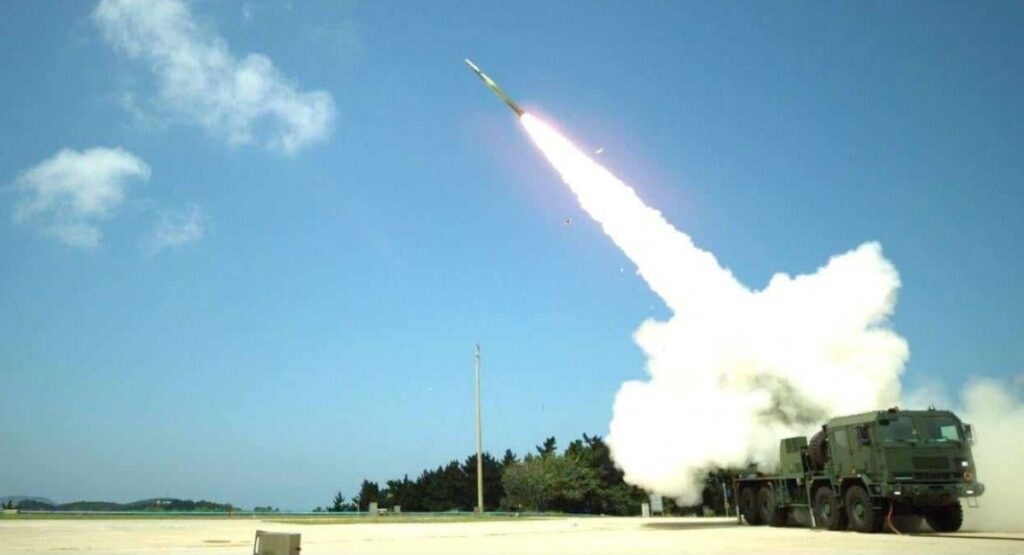
The K239 was designed from the beginning as a multi-caliber system.
The Polish Ministry of National Defence has listed several possible Chunmoo ammunition configurations. A pod can accommodate twenty 131 mm unguided rockets, six 230 mm rockets, six 239 mm guided rockets, two larger missiles of approximately 400 mm caliber, or one long-range missile of approximately 600 mm caliber.
The two pods do not necessarily have to carry the same type of ammunition.
This is a fundamentally important feature.
In theory, a Homar-K could enter a firing position with six medium-range guided rockets in one pod and a heavier long-range weapon in the other.
A single launcher can therefore serve as a carrier for several different classes of weapon.
For Poland, two types of guided ammunition are currently particularly important.
The first is the 239 mm CGR-080. Its range is around 80 km. The rocket uses inertial and satellite navigation, while the manufacturer claims a circular error probable of approximately 15 meters. In December 2025, Poland signed a contract worth roughly $4 billion covering the supply and localization of these rockets.
The second is the much larger CTM-290.
It has a diameter of approximately 600 mm and a maximum range of around 290 km. A test launch of this missile from the Polish Chunmoo configuration has already been conducted in South Korea.
Homar-K can therefore cover two quite different missions.
At ranges of around 80 km, it functions as a precision multiple-launch rocket system.
At distances approaching 300 km, it becomes an operational deep-strike weapon.
And both roles can be performed by the same launcher.
But HIMARS Has an Answer
At this point, it would be easy to conclude that Poland simply found a “better HIMARS.”
That would be a mistake.
The American system possesses an extremely important advantage of its own: the enormous and constantly expanding MLRS ammunition ecosystem.
GMLRS has become one of the most widespread Western guided artillery rockets. ER GMLRS is extending its reach. HIMARS can fire ATACMS, while the Precision Strike Missile is becoming the system’s new long-range weapon.
In other words, the future potential of HIMARS is not defined solely by today’s GMLRS.
HIMARS is also considerably more compact than the heavier Homar-K. The M142 was specifically developed as a highly mobile system that could be rapidly redeployed, including by military transport aircraft. Homar-K’s heavier eight-wheel chassis pays for its larger ammunition capacity with greater size and weight.
This creates a very clear engineering trade-off.
HIMARS sacrifices ready-to-fire ammunition capacity for compactness.
Homar-K sacrifices compactness for two launch pods and a larger salvo.
But for Poland, another factor is gradually becoming more important than a few additional rockets.
Poland Is Not Simply Buying a South Korean MLRS
The first major agreement signed in 2022 covered 288 K239 Chunmoo systems. Subsequent contracts brought the planned fleet to 290 Homar-K launchers. The second executive contract signed in 2024 alone covered 72 launcher modules, several thousand rockets with ranges of 80 and 290 km, and was valued at approximately $1.6 billion before taxes.
But the number of launchers is less important than what is being built around them.
The launcher is installed on a Jelcz chassis.
Fire control is integrated with the Polish TOPAZ system.
Maintenance is being localized.
Polish companies are receiving technology.
And production of the main 239 mm CGR-080 guided rockets is now expected to take place in Poland.
Hanwha Aerospace and WB Group have established a joint venture to localize production. Serial manufacturing is expected to expand progressively through the end of 2028. In the longer term, the companies also plan to develop additional missile variants for Polish requirements and potentially for other European customers.
This creates a fundamental difference.
Poland buys HIMARS.
Poland is gradually trying to co-produce Homar-K with South Korea.
And if the Polish Army ultimately operates around 290 Homar-K launchers alongside only twenty American M142s, maintaining separate infrastructure for such a small HIMARS fleet begins to look less attractive.
That is where the idea of selling the American systems comes from.
Not because HIMARS has suddenly become a bad weapon.
But because twenty HIMARS launchers risk becoming a small separate fleet inside a much larger Homar-K ecosystem.
What Happens If We Add Russia’s Tornado-S?
To better understand the Homar-K concept, it is useful to introduce another system: Russia’s 9K515 Tornado-S.
An important caveat is necessary here. Tornado-S is not a direct equivalent of either HIMARS or Chunmoo. It evolved from the heavy 300 mm Smerch multiple-launch rocket system and retains a different design philosophy.
Nevertheless, the comparison is revealing.
Tornado-S has 12 launch tubes for 300 mm rockets. Modern guided ammunition has been credited with ranges of up to approximately 120 km. Individual guided rockets can receive separate flight assignments and use inertial and satellite navigation.
A single Russian launcher can therefore also fire twelve heavy rockets.
But it achieves this in a completely different way.
Tornado-S remains fundamentally a heavy 300 mm multiple-launch rocket system.
HIMARS is a modular single-pod system.
Homar-K is a modular two-pod, multi-caliber system.
That is why simply comparing the number of rockets tells us very little.
Tornado-S has twelve 300 mm launch tubes.
Homar-K can carry twelve 239 mm guided rockets in its standard configuration, but those can be replaced by much larger long-range missiles.
HIMARS carries only six standard GMLRS rockets, but the vehicle is smaller and lighter, while its ammunition family includes American operational-level strike weapons.
All three systems represent different engineering compromises.
Twelve Rockets Do Not Necessarily Mean One Target
There is another point without which comparisons of modern rocket artillery become misleading.
When guided ammunition is used, the size of the salvo no longer means that every rocket must be fired into the same target area.
Modern fire-control systems can distribute individual rockets among separate coordinates.
Therefore, twelve ready-to-fire guided rockets on a Homar-K are not simply twice the “salvo weight” of six GMLRS rockets on a HIMARS.
They potentially represent twice as many individual precision engagements before reloading.
That can be particularly important in modern counter-battery operations.
A launcher attempts to spend as little time as possible at a firing position. It receives target coordinates, launches the required number of rockets, and immediately relocates.
The more ammunition carried by the launcher, the more missions it can theoretically complete before it needs to meet a resupply vehicle.
But once again, there is a price.
More ammunition requires a heavier chassis.
A heavier chassis consumes more fuel.
Dimensions increase.
Concealment becomes more difficult.
That is why HIMARS and Homar-K cannot be judged by a single number.
They are optimized around different priorities.
Why Poland Chose This Path
It now becomes easier to understand why a relatively small story about the possible sale of twenty HIMARS launchers actually points to a much larger development.
Poland initially followed the American route and acquired the M142. Warsaw then decided to expand its rocket artillery dramatically, with plans now involving hundreds of launchers.
That was when South Korea entered the picture.
The K239 offered a way to obtain a large number of systems relatively quickly.
But Poland went further and began transforming Chunmoo into Homar-K.
A South Korean launcher module.
A Polish Jelcz chassis.
A Polish TOPAZ system.
Increasingly localized maintenance.
Future domestic production of guided rockets.
Even the supporting infrastructure is now being built around Homar-K. In May 2026, additional major agreements were signed for equipment supporting twelve divisional modules of the system, while Poland’s SAFE program is providing additional financing for its deployment.
The question has therefore gradually changed.
In 2019, it was:
Does Poland need HIMARS?
Now it is:
Does Poland need twenty HIMARS launchers when it is building a fleet of almost three hundred Homar-K systems alongside them?
And the answer is no longer determined solely by range or even by the number of rockets.
It is increasingly determined by industry and scale.
HIMARS vs Homar-K: Which Is Actually Better?
There is no universal winner.
HIMARS is a more compact system with access to the enormous American family of MLRS munitions and the advantages of compatibility with one of the world’s largest precision-strike ecosystems.
Homar-K is considerably heavier, but it carries two pods, can field twelve medium-range guided rockets instead of six, and can combine different types of ammunition on a single launcher. The Polish version is also integrated with national chassis and command-and-control systems.
Tornado-S, meanwhile, represents a third approach: twelve heavy 300 mm rockets in a system developed directly from the classic Smerch heavy MLRS.
But for Poland specifically, Homar-K has acquired an advantage that cannot be seen in a simple specifications table.
Poland is gradually gaining control over the system itself.
Not complete control — key technologies and some munitions remain South Korean in origin. But significantly more control than would be possible through the simple purchase of complete American launchers.
That is why the discussion about potentially selling twenty HIMARS launchers does not necessarily indicate disappointment with the American system. At this point, it is not even an adopted government decision.
It illustrates something else.
When Poland bought its first M142s, it needed modern rocket artillery.
When Poland launched the Homar-K program, it was looking for hundreds of launchers, its own fire-control system, a national truck chassis, and the ability to manufacture thousands of rockets domestically.
At that scale, the question “Which launcher is better?” gradually becomes secondary.
A much more important question takes its place:
Which one can Poland manufacture, supply with ammunition, and continue developing itself?