The MQ-9 Became Too Expensive to Lose: Why the U.S. Is Building the Wildfire, Which Looks Like a Reaper All Over Again

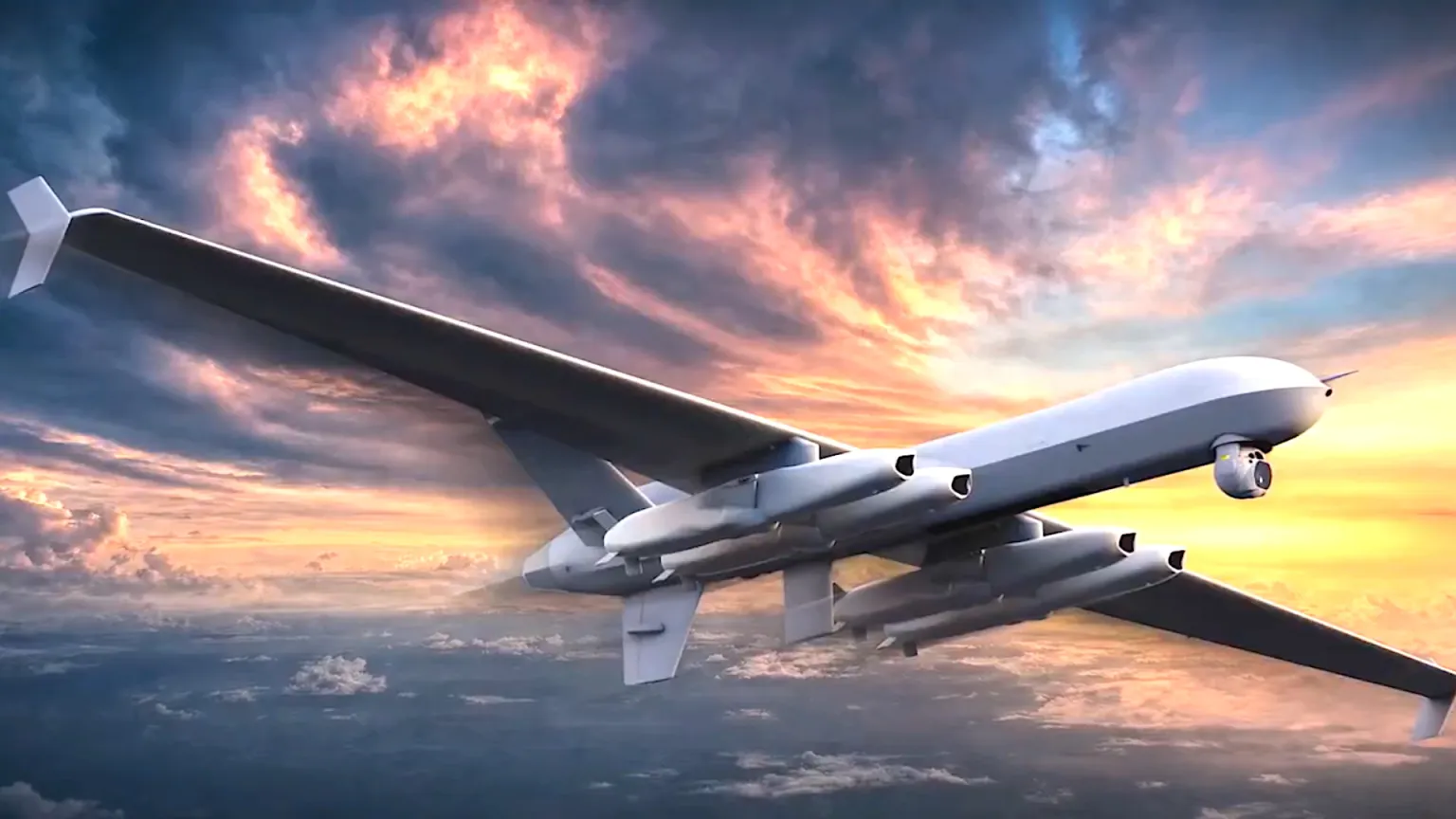
General Atomics has unveiled the Wildfire, a new medium-altitude, long-endurance drone with which the company hopes to compete for the role of successor to the famous MQ-9A Reaper. At first glance, the newly released image looks rather strange. After two decades of unmanned aviation development, the emergence of stealthy flying wings, jet-powered Collaborative Combat Aircraft, and increasingly ambitious autonomous combat aircraft, the Reaper’s proposed successor looks… almost like another Reaper. A long straight wing, V-tail, pusher propeller, electro-optical turret beneath the nose, and externally carried weapons make its lineage immediately obvious.
But that may be the most interesting thing about the Wildfire. General Atomics is not trying to build another futuristic technology demonstrator. It is trying to solve the central problem the U.S. Air Force has discovered with the MQ-9: the Reaper has become simultaneously too useful to abandon and too expensive to lose on a regular basis. Production of the MQ-9A has already ended, while combat losses have become a growing concern for the Air Force. Now the service wants an aircraft capable of performing many of the same missions, flying enormous distances, and carrying heavy weapons, but with a target unit cost of roughly $10 million excluding sensors and certain other systems. By comparison, fully equipped Reapers are widely reported to cost roughly $30–50 million, and the Air Force itself has used the $50 million figure as a reference point.
That creates an unusual requirement. Normally, a successor is expected to fly faster, higher, farther, and with greater stealth and technological sophistication than its predecessor. Here, one of the defining requirements is very different: the new drone must be cheap enough that American commanders are not afraid to lose it.
The Reaper Was Built for a War in Which the Enemy Could Barely Reach It
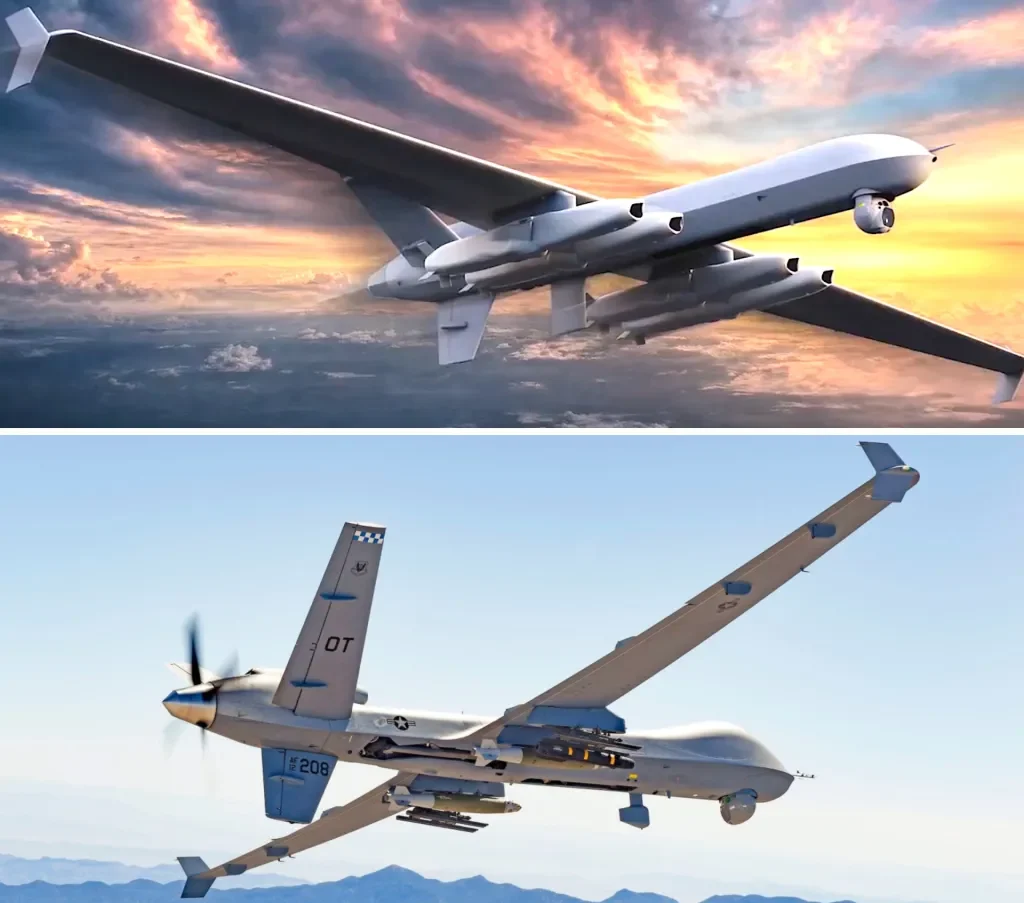
The MQ-9 became one of the symbols of American warfare in the early 21st century for good reason. Its design was almost perfectly suited to operations in which the United States enjoyed overwhelming air superiority. A large propeller-driven drone could remain over an operational area for hours, watch a target, transmit video to operators thousands of miles away, and strike when necessary. In such an environment, speed and stealth were far from the most important characteristics. Endurance, satellite communications, high-quality sensors, and the ability to remain continuously on station mattered much more.
That was what made the Reaper so successful. It could perform missions for which using a fighter would often have been wasteful: monitoring a road, escorting a convoy, searching for a particular vehicle, observing a specific area, and then employing a Hellfire missile or guided bomb when required. An entire model of air warfare emerged in which the drone served simultaneously as a reconnaissance platform, strike aircraft, and persistent camera hanging over the battlefield.
But that model contained a condition that for years was easy to overlook: the enemy could not possess serious air defenses. A large, slow aircraft with an enormous straight wing and no major low-observable features is an attractive target for modern surface-to-air missile systems. As long as the Reaper hunted opponents that had little ability to fight back in the air, this was not a critical problem. Once the threat environment changed, the famous hunter could itself become very expensive prey. The Air Force now openly says it is consuming MQ-9s at a concerning rate and lacks good options for immediately replacing them.
That experience is now embedded directly in the requirements for the Reaper’s successor. The Air Force and the Defense Innovation Unit call the program Massed Modular Aircraft, or MMA. The key word is not merely modular, but massed. The United States wants a platform that can be deployed in numbers while remaining operationally useful even when losses are inevitable. Instead of building a small number of extremely expensive aircraft that must be protected at almost any cost, the idea is to create a larger fleet in which attrition becomes part of the wartime calculation.
Wildfire Looks Like a Reaper for a Reason
In the first released rendering, the Wildfire is unmistakably similar to its predecessor. It retains the classic pusher-propeller arrangement, long wing, and familiar tail configuration. This might look like excessive conservatism on the part of General Atomics, but this aerodynamic layout is actually well suited to the requirement. If the aircraft does not need to penetrate directly through dense integrated air defenses, it does not necessarily need to be jet-powered or stealthy. A large wing and efficient propeller-driven powerplant provide exactly what made the Reaper valuable in the first place: exceptional endurance and range with relatively low fuel consumption.
The MMA requirements reveal just how ambitious the concept actually is. The Air Force wants a speed of at least 200 knots, a combined weapons and sensor payload of at least 2,800 pounds, or about 1,270 kilograms, an unrefueled combat radius of at least 2,300 nautical miles — roughly 4,260 kilometers — while carrying payload, and the ability to self-deploy at least 8,000 nautical miles, or approximately 14,800 kilometers. The aircraft must also operate from runways no longer than 6,000 feet and use highly modular, open-architecture mission systems that allow new capabilities to be integrated quickly. General Atomics says the Wildfire will exceed the ferry-range requirement.
This helps explain why the company has little reason to reinvent the aircraft aerodynamically. General Atomics has been refining variations of this basic configuration for decades, from the Gnat and Predator through the MQ-9 and its derivatives. Its characteristics, manufacturing methods, operational behavior, and shortcomings are already well understood. If the main challenge is to reduce cost while accelerating production, proven aerodynamics can become an advantage rather than a sign of technological stagnation. The Wildfire is not supposed to be a revolutionary aircraft in the conventional sense. It is supposed to be an industrially optimized next-generation Reaper.
But One of the MQ-9’s Most Recognizable Features Has Disappeared
The difference is particularly noticeable around the nose. The Reaper carries a distinctive hump on top of the forward fuselage that houses its satellite communications antenna. The Wildfire does not. General Atomics has confirmed that this is linked to the use of proliferated low-Earth-orbit, or pLEO, satellite communications. The company already has experience integrating such connectivity into existing unmanned aircraft and intends to bring that architecture into the Wildfire.
It looks like a small change, but it reflects an enormous difference between the Predator era and modern warfare. Early MALE drones were essentially aircraft continuously connected to their operators through expensive satellite links. Today, large constellations of low-orbit satellites make much more distributed communications architectures possible. At the same time, autonomy is advancing rapidly, reducing the need for an aircraft to continuously transmit everything it sees and receive direct instructions for every routine action.
In the longer term, this changes what we mean by the word “drone.” The original Predator was, to a large extent, a remotely piloted aircraft — the pilot simply sat somewhere other than the cockpit. The Wildfire is intended to move closer to an autonomous platform in which humans assign missions, operating areas, and rules, while the aircraft handles a growing share of routine flight and cooperation with other drones itself. General Atomics says it envisions networking dozens of Wildfires to generate genuine combat mass and has pointed to autonomy work conducted through its other programs. These claims still need to be demonstrated on the Wildfire itself, but the direction is clear.
This also explains why affordability and mass are inseparable from autonomy. If every one of a hundred drones requires its own crew to operate it almost like a Reaper, a true massed force becomes extremely manpower-intensive. Scaling the number of aircraft therefore requires scaling autonomy at the same time.
And Then General Atomics Hung Cruise Missiles Under It
The first Wildfire rendering depicts the drone carrying four Joint Strike Missiles, with two weapons under each wing. The JSM is a stand-off weapon capable of attacking both ships and land targets. General Atomics subsequently revealed something even more interesting: it is also examining a Wildfire configuration carrying two AGM-158C LRASMs, the heavy long-range anti-ship missile derived from the JASSM family. The company openly describes the Wildfire as a “flying weapons truck.”
This reveals the other half of the concept. The Wildfire does not necessarily have to become a stealth aircraft because the missile can be stealthy instead. The large propeller-driven drone can remain farther from the most dangerous threat zones, exploiting its endurance to patrol and wait for targeting information. Once a target is identified, it launches JSMs or LRASMs, which then travel through the most dangerous part of the engagement themselves.
That fundamentally changes the meaning of the old Reaper configuration. Hellfire required the MQ-9 to approach comparatively close to its target. Guided bombs did not turn the Reaper into a true stand-off strike platform either. With long-range cruise missiles, the drone does not necessarily need to enter the most dangerous portion of an integrated air-defense zone at all. Its job is simply to carry the missiles close enough for their own range to take over.
The absence of stealth therefore becomes less obviously fatal. Low observability would certainly be useful, but it would almost inevitably increase cost and complicate production. If the objective is to build around 180 relatively affordable aircraft and potentially employ them in large groups, a different philosophy becomes possible: do not make the carrier invulnerable — keep the carrier farther away from the threat.
The Result Is a Strange Aircraft: A Slow Drone Carrying Strategic-Class Weapons
That combination may make the Wildfire considerably more interesting than a simple “MQ-9 Next.” Instead of imagining a lone Reaper spending hours watching one target, imagine dozens of drones dispersed across a vast theater. Some carry electro-optical sensors, others electronic intelligence equipment, others communications payloads, while still others carry anti-ship missiles. All are connected through a common command architecture and exchange information with the wider reconnaissance-strike network.
In such a force, the value of each individual aircraft declines while the value of the group increases. Losing a Reaper today is painful partly because an expensive platform, its sensors, and a portion of available combat capacity all disappear together. In a force containing dozens of modular Wildfires, destroying several aircraft does not necessarily collapse the system. Their functions can potentially be redistributed among the surviving platforms. This is the underlying logic of massed modular aviation: maintaining a persistent and credible threat even after inevitable attrition.
That represents a significant departure from much of the American aviation philosophy of recent decades. The United States has become accustomed to building extraordinarily expensive platforms and then investing heavily in keeping them alive. Aircraft such as the F-22, B-2, and B-21 belong to a category in which every individual loss is extremely painful. The Wildfire is intended to occupy a different economic category: sophisticated enough to carry serious sensors and weapons, but inexpensive enough that commanders can deliberately send it into situations where the probability of return is no longer effectively 100 percent.
The Problem Is That Building “Almost a Reaper” for $10 Million Will Be Extremely Difficult
This is where the greatest risk in the entire program appears. The Air Force is targeting a unit cost of roughly $10 million without sensors and certain other systems. That is several times lower than the roughly $30–50 million widely cited for a fully equipped MQ-9. Yet the requirements are hardly modest: enormous range, more than a ton of payload, satellite communications, modularity, modern autonomy, the ability to employ heavy weapons, and operations across vast distances.
General Atomics itself has previously questioned how inexpensive an MMA-class aircraft can realistically become while retaining capabilities comparable to the Reaper. That is an important point because the cost of a military aircraft is not determined only by its airframe and engine. Some of the most expensive components are inside: secure communications, computers, sensors, electronic intelligence systems, satellite terminals, weapon integration, and software. The fuselage can be made cheaper and assembly can be streamlined, but if the aircraft is once again filled with tens of millions of dollars worth of mission equipment, the idea of a drone commanders can afford to lose quickly begins to collapse.
This is why modularity matters so much. The Wildfire does not necessarily have to fly every mission in its most expensive configuration. One mission might require an advanced reconnaissance suite, another a simpler sensor package and several missiles, and another a communications payload. The financial risk can then be matched to the mission. The aircraft becomes a relatively inexpensive baseline platform, while costly capabilities are installed only when they are actually required.
Wildfire Starts to Look Less Like an Aircraft and More Like a Flying Truck
That may be the best way to understand the new drone. The MQ-9 became famous as a largely self-contained intelligence-strike complex: it found a target, watched it, and could attack it itself. The Wildfire may develop into something rather different. It does not necessarily need to be the best reconnaissance aircraft, the best strike drone, or the stealthiest platform. It needs to be an affordable aircraft capable of carrying a large amount of fuel, sensors, communications equipment, or weapons far from its base and then waiting until the distributed combat network gives it something to do.
This logic is especially attractive in the Pacific. Enormous distances make range one of the defining constraints of almost every air operation. Fighters require aerial refueling, tankers are themselves extremely valuable targets, and suitable airfields are limited. A drone capable of self-deploying more than 8,000 nautical miles can move between theaters without being carried and remain over vast maritime areas for extended periods. If it also carries LRASM, it becomes another distributed launch point for long-range anti-ship weapons.
The Wildfire would not even need to find the ship itself. Targeting information could come from a satellite, another aircraft, a submarine, a surface ship, or another unmanned platform. In that situation, the Wildfire becomes exactly what General Atomics calls it: a flying weapons truck. Its principal job is to ensure that the missiles are in the right part of the ocean at the right time.
The True Successor to the Reaper May Not Need to Be Better Than the Reaper — It Needs to Be Less Valuable
This is the central paradox of the Wildfire. At first glance, the aircraft looks almost disappointingly conservative. It does not resemble a futuristic stealth bomber, it does not use jet propulsion, and it retains the unmistakable architecture of the Predator family. But if the MMA requirements really represent the direction of future American unmanned aviation, appearance is almost irrelevant. The Air Force is trying to change not the shape of the aircraft, but the economics of employing it.
The original MMA plan envisioned initial operational capability in 2031 after delivery of the first 20 aircraft, but the Air Force is now looking to accelerate that schedule by roughly two years. The service ultimately expects to acquire around 180 aircraft. General Atomics says it can deliver earlier than the original schedule and produce more than twice as many aircraft as requested over the same period by exploiting an established manufacturing base and supplier network. Whether those claims prove realistic will become clearer only as the program moves beyond renderings and into actual hardware and competition.
But the requirement itself is already revealing. The MQ-9 was created for an era in which an American drone could spend hours over an adversary with relatively little fear of being shot down. The Wildfire is emerging in a world where commanders are expected to assume from the beginning that some drones will be lost. Instead of trying to make the next Reaper so protected and technologically exquisite that losing one becomes almost unthinkable, the Air Force is exploring the opposite idea: make its successor affordable and numerous enough that losses no longer break the arithmetic of the war.
That is why the Wildfire looks so much like the MQ-9. General Atomics may have concluded that the Reaper’s aerodynamics were never the part that became obsolete. What became obsolete was the economics of allowing a large drone to accumulate so many expensive sensors, communications systems, and other capabilities that it turned into another exquisite platform commanders hesitated to send anywhere the enemy could seriously shoot back.
The Wildfire attempts to preserve the Reaper’s long wings, exceptional range, endurance, and heavy payload while changing something much more fundamental: the value assigned to the aircraft itself.
The MQ-9 was built as a drone expected to return from every mission. The Wildfire is being conceived as a drone the U.S. Air Force can afford to lose — and then send another one the next day.
If General Atomics can genuinely combine that philosophy with a price near $10 million and scalable mass production, the most important difference between the Reaper and its successor will not be a new wing, engine, or missile.
For the first time, the greatest advantage of a large American combat drone may be that it is no longer too expensive to risk.