The Mortar Needed a Racing Car: Why the U.S. Army Is Putting the 81mm Scorpion on a Lightweight Buggy

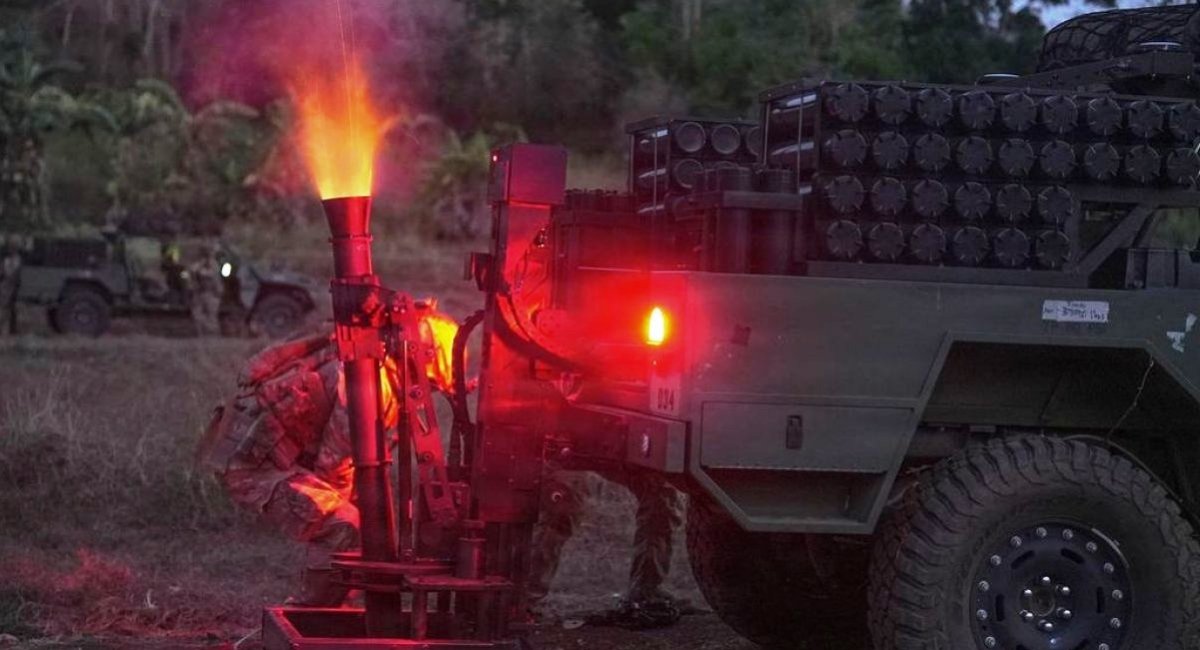
The U.S. Army has decided to acquire a weapon its manufacturer describes as the “world’s fastest mobile mortar system.” The phrase sounds almost like a marketing gimmick: a mortar is hardly the first weapon that comes to mind when discussing speed. It is essentially a tube, baseplate, bipod, and ammunition — a concept whose basic principles have changed remarkably little over many decades. Yet on September 3, 2026, Global Military Products announced a $12.9 million contract to procure and integrate Scorpion Light 81mm mortar systems for the U.S. Army. More intriguingly, the Americans are not mounting them on heavy armored vehicles but on lightweight, open Infantry Squad Vehicle–Utility platforms, or ISV-Us. The new Army configuration combines the Scorpion with government-furnished M253 mortar barrels and U.S. digital fire-control technology.
This is where the story becomes much more interesting than the contract itself. The U.S. Army is effectively trying to solve one of the central problems facing modern artillery in an unusual way. Traditionally, a combat vehicle survives by relying on armor. The Scorpion has virtually none. Traditionally, a firing position survives through concealment, fortification, and dispersion. Here, however, the primary emphasis is on something else: receive the target coordinates, stop, automatically lay the mortar, fire several rounds, stow the weapon, and leave before the enemy has enough time to determine where the shots came from. The entire combination of a compact vehicle, digital fire control, and automated laying is built around rapid “shoot-and-scoot” tactics.
In other words, the Scorpion’s most important protection may not be armor.
It may be the stopwatch.
The Mortar Has Always Been an Infantry Weapon Precisely Because It Needs So Little
The secret behind the mortar’s extraordinary longevity as a class of weapon lies in its simplicity. Infantry constantly needs its own artillery capable of hitting an enemy behind terrain, buildings, tree lines, or hills. A full-sized howitzer is too heavy and expensive for this role, while a mortar allows a relatively small group of soldiers to obtain indirect-fire capability directly at battalion level.
The 81mm class has proved to be an especially successful compromise. It provides substantially more firepower than lightweight 60mm mortars without becoming a heavy system in the 120mm category. The American M252/M253 family occupies precisely this niche: powerful enough to provide meaningful indirect fire support while remaining relatively compact.
The Scorpion does not fundamentally attempt to reinvent mortar ballistics. The Army configuration uses government-furnished M253 barrels. The innovation is everything surrounding the tube: powered laying, digital fire control, communications, and the vehicle carrying it.
That distinction matters because many modern artillery developments are following exactly this path. Radically changing what a weapon can do does not necessarily require inventing a new projectile or increasing its caliber. Sometimes it is enough to reduce the interval between receiving target coordinates and firing the first round — and then reduce just as dramatically the interval between the last round and abandoning the firing position.
The Scorpion is essentially an attempt to automate and compress that entire cycle.
Because the Most Dangerous Moment for a Mortar Crew Begins After the First Round
In a conventional mortar battery, much of the work is performed manually. Fire data must be received, firing settings determined, the weapon deployed and leveled, the mortar laid onto the target, corrections applied, and only then can sustained fire begin. When the target changes, the crew has to redirect the weapon.
In the past, several additional minutes could be acceptable.
Today, they can be fatal.
The modern battlefield is increasingly saturated with drones, counter-battery radars, acoustic sensors, electronic intelligence systems, and digital command networks. The time between detecting a firing position and transmitting its coordinates to a weapon capable of attacking it can potentially shrink dramatically. The old artillery principle of “fire and move” is therefore evolving from good tactical practice into a basic requirement for survival.
This is where the manufacturer’s description of the “world’s fastest mobile mortar” begins to make sense.
It is not primarily about how fast the mortar round flies.
It is about the speed of the entire kill chain.
During Army experimentation in Hawaii in 2025, the system demonstrated the ability to halt, conduct a simulated six-round fire mission, and begin moving again in roughly one minute and fifteen seconds. During later exercises, Scorpion crews demonstrated rapid multi-round fire missions under operational conditions. The manufacturer has also promoted deployment and displacement times measured in tens of seconds. Such figures should be treated as test results and manufacturer claims rather than guaranteed performance under every battlefield condition, but they clearly illustrate what the system is designed to achieve.
The priority is changing.
The traditional question for a mortar position was: how well can it be hidden?
The increasingly important question is:
How long does it intend to remain there at all?
And That Is Why the Americans Did Not Put the Scorpion on an Armored Personnel Carrier
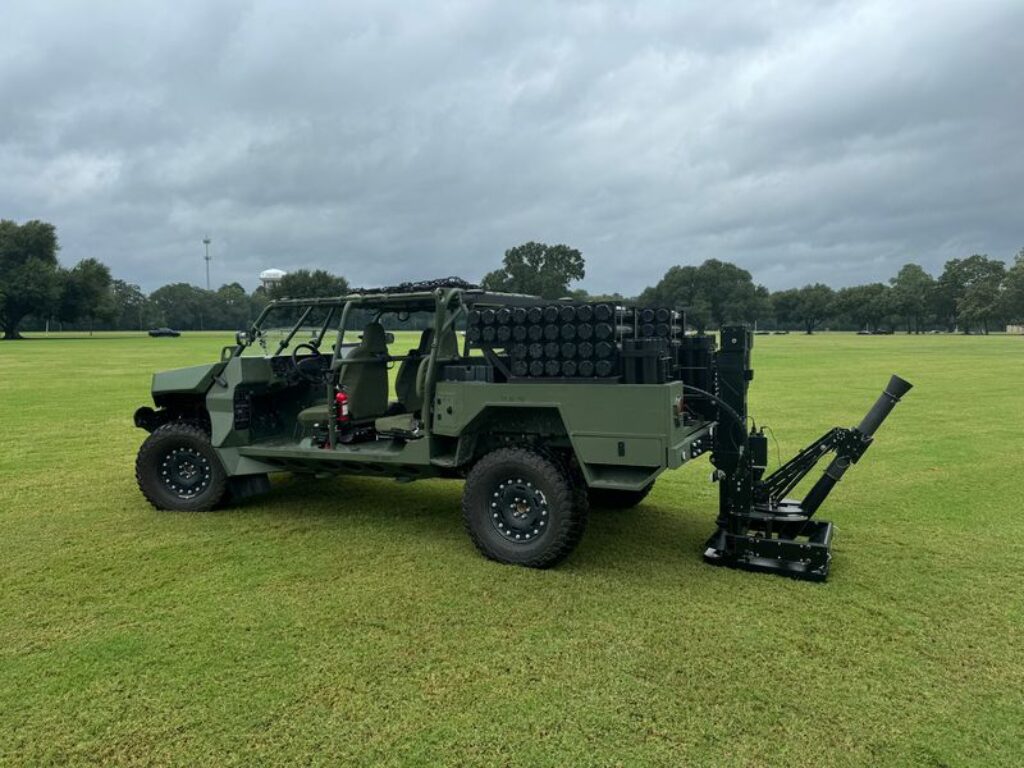
At first glance, the choice of the ISV-U may be the strangest element of the project. It is essentially an open lightweight tactical vehicle. The ISV-U is the utility version of the Infantry Squad Vehicle family, with a rear cargo area suitable for carrying equipment such as the Scorpion.
It offers no meaningful heavy armor protection.
But that is not necessarily a design failure. It is the consequence of a different philosophy.
Armor weighs a great deal. Weight demands a larger engine, increases fuel consumption, complicates air transport, reduces mobility in difficult terrain, and makes the entire vehicle larger. If a mortar system is intended to accompany lightweight mobile formations, move rapidly between positions, and remain easy to deploy in expeditionary operations, heavy armor begins to conflict with the system’s primary purpose.
The Scorpion makes the opposite trade.
Do not survive the hit. Deny the enemy enough time to arrange the hit.
There are obvious limitations to this logic. An FPV drone does not care how quickly the vehicle was moving five minutes earlier if its operator has already found it under a tree. Artillery fragments do not become less dangerous simply because the vehicle is highly mobile. Mobility therefore cannot replace concealment, dispersion, electronic protection, or intelligent selection of firing positions.
But for light expeditionary formations, the U.S. Army appears willing to accept the lack of armor in exchange for speed, transportability, and tactical mobility. The Army says the Scorpion is intended to provide indirect fire support in expeditionary operations where mobility and rapid response are central requirements.
That tells us something not merely about the Scorpion, but about how the United States increasingly wants its light forces to fight.
A Small Vehicle Is Being Asked to Perform Work That Once Required a Much Larger Fire-Support System

The most interesting part of the Scorpion is not actually mechanical.
The latest configuration integrates digital fire-control capabilities with the Nett Warrior communications environment. According to the manufacturer, this enables extremely rapid target acquisition and retargeting with minimal crew intervention.
The word autonomous needs to be treated carefully here. The Scorpion is not an autonomous combat robot independently selecting targets and deciding to fire. The important development is automation of the firing process: receiving a fire mission, calculating the required data, and laying the mortar while dramatically reducing the number of manual steps required from the crew.
Even that has potentially major consequences.
Consider the traditional chain. A scout or drone detects a target. Its coordinates are transmitted. A command post generates a fire mission. The mortar crew receives the data. Calculations and laying follow. Only then does the first round leave the tube.
Every human and every manual operation adds seconds.
A digital architecture attempts to compress that chain:
Sensor detects target → coordinates enter the network → vehicle receives fire mission → computer calculates firing solution → mortar automatically lays onto the target → crew fires.
This explains why the U.S. Army is interested in more than simply a mobile mortar.
It is buying the speed at which information can be turned into an explosion.
And That Is Directly Connected to the Kind of Army the United States Wants to Deploy
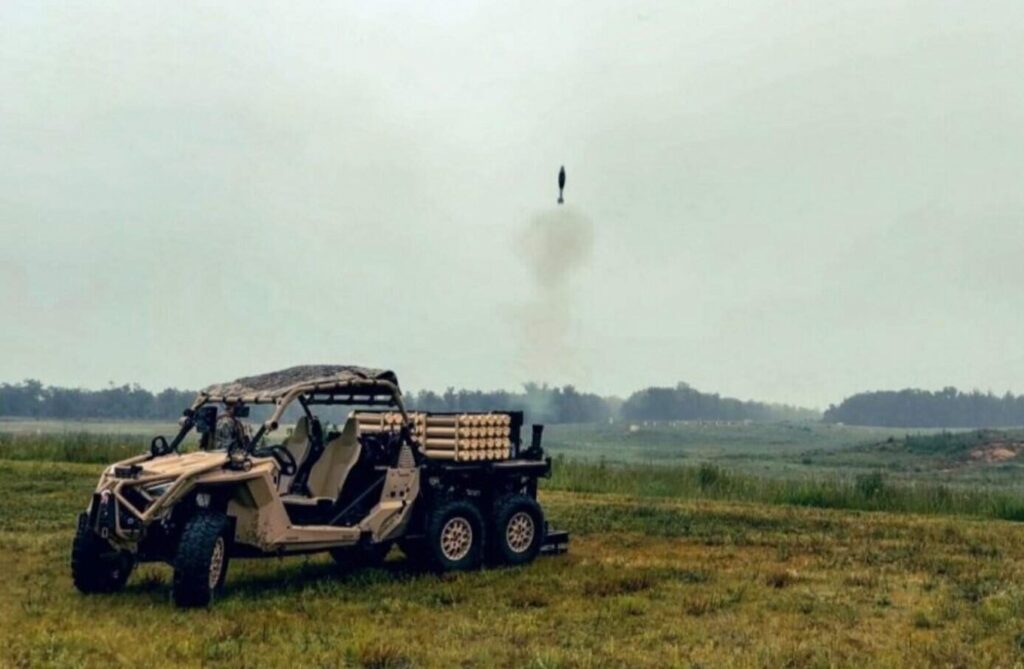
The Scorpion did not appear out of nowhere. Global Military Products and the U.S. Army have spent roughly two years testing and refining the system based on military feedback. The Army previously experimented with the Scorpion before moving to the new procurement and integration contract, while the U.S. Marine Corps has also selected versions of the system. The Marines use a configuration based on the smaller MRZR Alpha platform, whereas the Army version is mounted on the ISV-U, helping standardize the vehicle fleet inside Army formations.
That distinction is revealing.
The Pacific in particular forces American planners to think about units operating in dispersed formations, moving rapidly between positions, and retaining organic firepower without constantly depending on heavy artillery formations nearby. Lightweight vehicles and compact weapons become attractive because they are easier to move by air, ship, or across austere terrain.
A heavy armored mortar carrier can provide much better protection.
But it is harder to transport.
An ISV-U can go places and be moved in ways that a much heavier armored vehicle cannot. A light formation therefore gains organic 81mm indirect fire without transforming itself into a mechanized formation.
Something interesting is happening here.
The U.S. Army is not trying to make light infantry heavy.
It is trying to give light infantry some of the capabilities of heavy forces without taking away its lightness.
But the Scorpion Does Not Make the Traditional Mortar Obsolete
This may be one of the most important aspects of the concept.
The mortar remains valuable precisely because it can operate almost anywhere. If a vehicle breaks down, becomes stuck, or is simply too conspicuous for a particular mission, tying the weapon permanently to that vehicle would sacrifice part of the mortar’s original advantage.
The ideal mobile mortar therefore tries to preserve two seemingly contradictory characteristics.
Mounted on the vehicle, it gains speed, ammunition capacity, digital fire control, and the ability to rapidly change firing positions.
Separated from the vehicle, the underlying weapon can still retain much of the simplicity that made the mortar useful in the first place.
This is a curious form of technological evolution. Instead of replacing an old, simple weapon with a completely new and complicated one, the military is increasingly putting a sophisticated digital shell around a weapon that remains fundamentally simple at its core.
There Is Another Question: Why 81mm When 120mm Mortars Exist?
Modern armored vehicles can carry 120mm mortar systems, which deliver much heavier projectiles and substantially greater destructive power. The U.S. Army itself continues to examine mobile mortar concepts in multiple calibers. The Scorpion Light should therefore not be seen as a universal replacement for all mortar artillery.
The 81mm weapon represents a compromise.
Its ammunition is smaller and lighter. A relatively compact vehicle can carry a useful number of rounds. The mortar installation remains light enough to fit on platforms such as the ISV-U, preserving the mobility that defines the entire concept.
A 120mm system provides a heavier blow.
An 81mm system makes it easier to remain light and fast.
If the central mission is to appear suddenly, conduct a short fire raid, and disappear, the number of rounds carried and the mobility of the platform can become nearly as important as the destructive power of an individual bomb.
That brings us back to the fundamental purpose of the Scorpion.
It is not trying to become a miniature howitzer.
It is trying to become an extremely fast mortar.
And This Is Where an Old Tube Suddenly Becomes a Weapon of Digital Warfare
Take the mortar off the ISV-U and place it beside a comparable weapon from the Cold War, and there is little revolutionary about the fundamental principle.
It is still a smoothbore tube.
The bomb still follows a high ballistic trajectory.
Propellant and gravity still do most of the physical work.
What has changed is everything around it.
A drone can now provide the target coordinates.
A digital network can transmit them.
A computer calculates the firing solution.
A powered mechanism lays the weapon.
The crew services the system and fires.
After several rounds, the mortar is stowed, the vehicle moves away, and the next fire mission can potentially arrive while it is already heading toward another position.
That is why a $12.9 million contract is more interesting than it initially appears. The Army is not simply buying another mortar. It is experimenting with a broader idea about what short-range indirect fire should look like when reconnaissance, communications, targeting, and counter-battery response are all becoming faster.
For a century, artillery designers tried to make mortars more powerful, lighter, longer-ranged, and more accurate.
Now another performance characteristic is becoming increasingly important:
How little time does the mortar need to exist at the point from which it has just fired?
Seen this way, the phrase “world’s fastest mobile mortar” stops sounding like nothing more than advertising.
The Scorpion is not really racing other mortars.
It is racing the enemy’s reconnaissance-strike chain.
A drone has to find the vehicle. An operator has to recognize it. Coordinates have to enter the network. A commander has to make a decision. A weapon has to receive the mission. A shell or attack drone then has to reach the position.
During that interval, the Scorpion has to stop, fire, and disappear.
For decades, armor was expected to help an artillery crew survive the enemy’s response.
The new American system proposes a much more radical solution.
By the time the response arrives, there should be nobody left there.