China Is Building a Huge Fleet, While Taiwan Is Answering With a Missile From the 1970s: Why the Island Wants 400 Harpoons

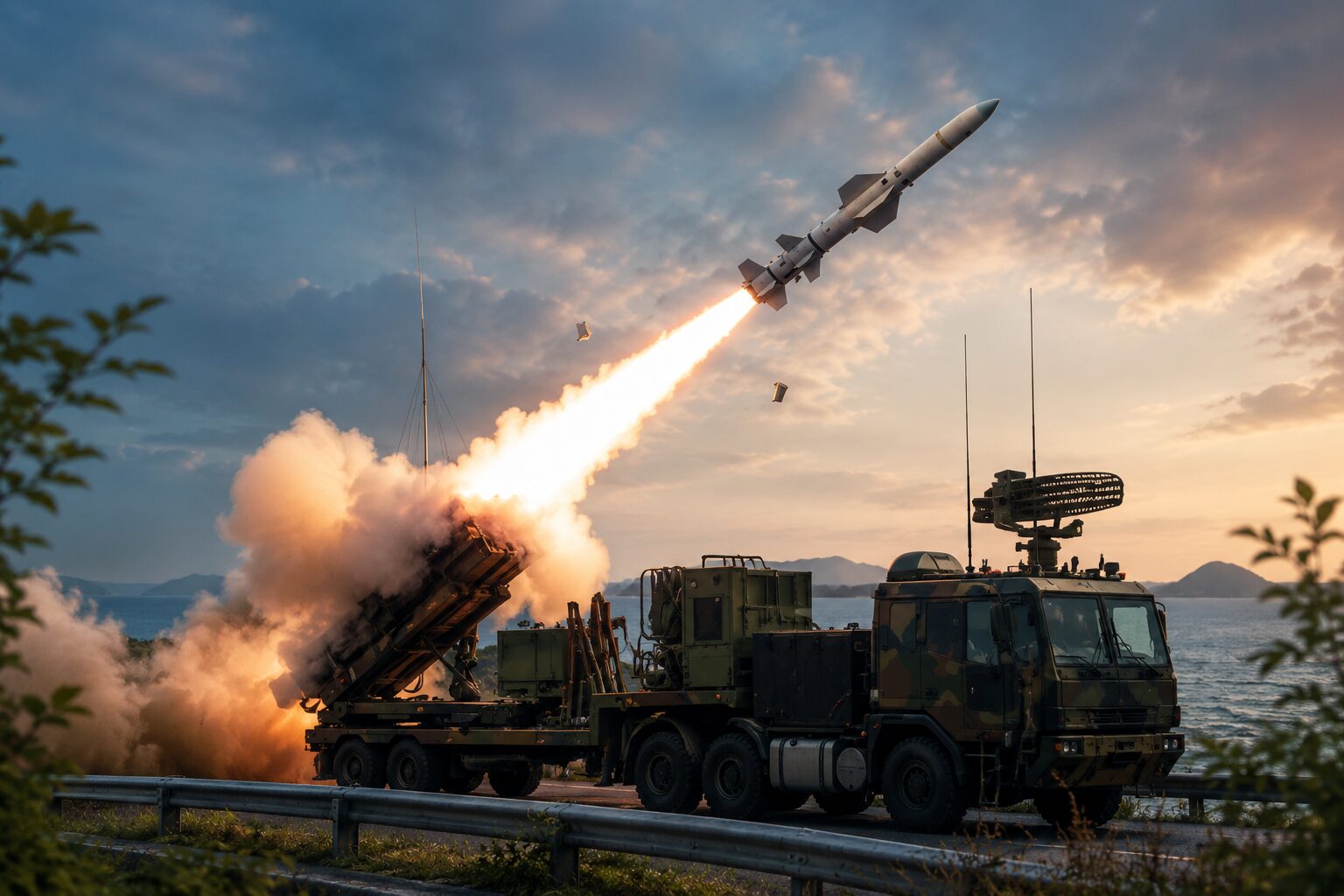
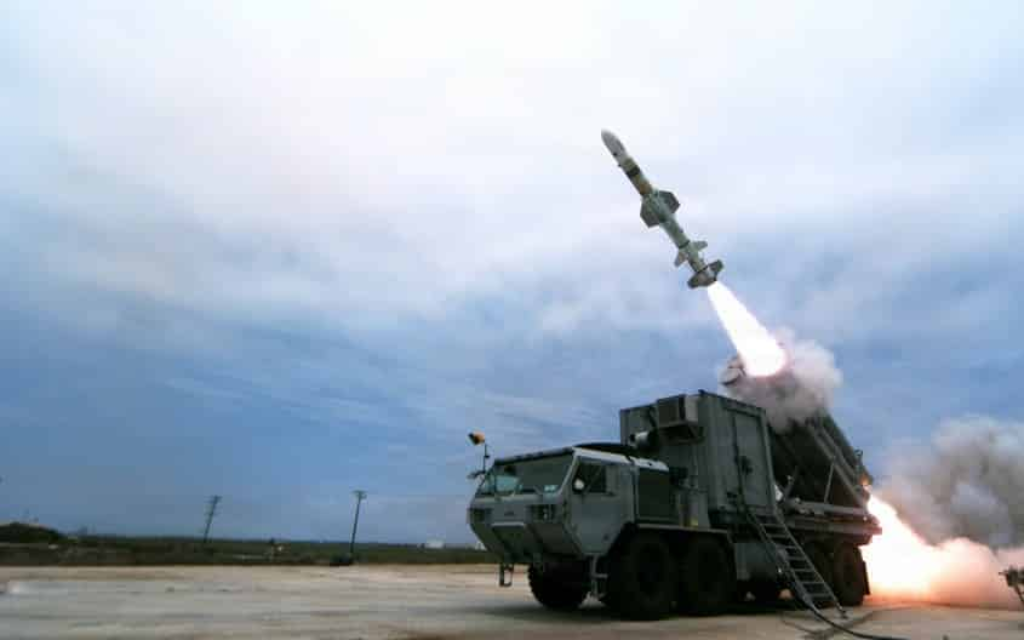
In late August 2026, the U.S. Navy announced the successful test of a weapon that, at first glance, hardly looks like a technological sensation. At the Point Mugu Sea Range in California, a mobile Harpoon Coastal Defense System launcher fired an anti-ship Harpoon missile and successfully struck a maritime target. The DT-1 test had actually taken place in July and represented the first phase of the system’s developmental testing, with a second phase still to follow. There was no hypersonic speed, artificial intelligence, or revolutionary seeker involved. In fact, the Harpoon family traces its origins back to the 1970s, with the first production versions entering service almost half a century ago.
Yet the most interesting part of the story lies elsewhere. The new coastal-defense system is effectively being developed not for the U.S. military itself, but primarily for Taiwan, which is acquiring 100 mobile launchers, 25 radar vehicles, and 400 RGM-84L-4 Harpoon Block II anti-ship missiles. The first five launchers and one radar vehicle have already arrived on the island, while production of the remaining equipment continues. The broader package also includes training missiles, spare parts, test equipment, training, and technical support.
The result is a curious picture. China is building the world’s largest navy by number of ships, commissioning new destroyers, frigates, amphibious vessels, and aircraft carriers, while Taiwan is responding with a weapon whose basic design dates back to the Cold War. And it is not buying a handful of experimental systems, but a hundred mobile launchers.
That is where the story becomes much more interesting.
Because Taiwan is not really buying 400 old missiles.
It is trying to turn the entire island into one enormous mobile coastal missile battery.
Why Harpoon When Far More Modern Missiles Exist?
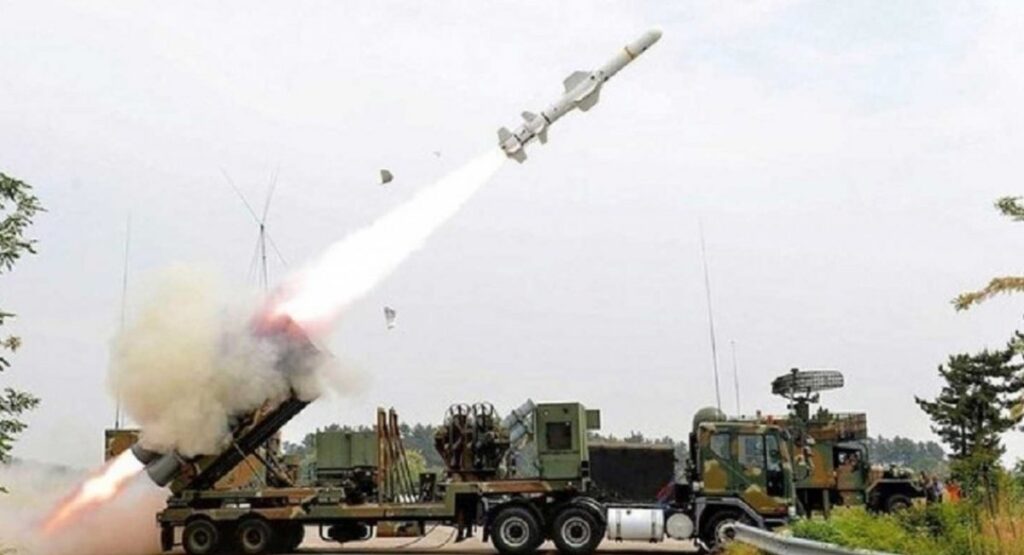
Compared with modern anti-ship weapons, Harpoon certainly looks conservative. It is subsonic. It does not offer hypersonic speed, does not perform spectacular high-speed maneuvers, and was not designed with the degree of low observability incorporated into some newer anti-ship missiles. If individual performance figures are compared in isolation, systems such as the American LRASM, Norwegian NSM, Japan’s emerging anti-ship weapons, or China’s own supersonic and ballistic anti-ship systems look considerably more impressive.
But that comparison somewhat misses the purpose of Taiwan’s purchase. The modern RGM-84L-4 is not simply the same Harpoon that entered service in the 1970s. Block II incorporates updated navigation and improved capabilities for operating in complex littoral environments, although the basic philosophy remains unchanged: a relatively compact subsonic anti-ship missile with an active radar seeker that can be launched from multiple types of platforms.
And here the maturity of the design becomes an advantage rather than a weakness. Harpoon has been in production for decades, is thoroughly understood, has an enormous operational history, and is already embedded within the American logistics and training infrastructure. Taiwan does not need to develop an entirely new missile, wait years for testing to finish, or build a completely new support structure around it. It can take an existing weapon and solve a different problem — making it numerous, mobile, and survivable.
That is why the most important component of HCDS may not even be the missile itself.
It is the truck.
One Hundred Launchers May Matter More Than Four Hundred Missiles
The number of mobile launchers is what makes Taiwan’s order particularly interesting. One hundred vehicles, each carrying four missiles, means the entire initial missile load can be distributed among a very large number of independent firing units. Even if the launchers are organizationally grouped into larger batteries, they can physically be dispersed, moved between prepared positions, hidden in shelters, and brought toward the coast only when needed.
This is fundamentally different from classical coastal defense. For much of the 20th century, straits and naval bases were protected by enormous fixed artillery batteries. Their guns could be extraordinarily powerful, their positions protected by concrete and armor, and their range sufficient to control large areas of sea. But there was a fundamental weakness: the enemy knew exactly where they were. As aircraft and precision-guided weapons became more capable, that became an increasingly serious disadvantage.
Anti-ship missiles removed the enormous gun from its concrete emplacement. Mounting those missiles on trucks took the next step — it removed the emplacement itself.
The coastal battery could now move.
And Taiwan is almost ideally suited to such a concept. The island is relatively small, meaning a mobile launcher does not need to travel hundreds of kilometers to relocate between operational areas. At the same time, its developed road network provides a large number of potential routes and firing positions. A launcher can remain concealed, move to a preselected location, fire, and then relocate again.
That creates an entirely different problem for the attacker.
Destroying a fixed missile battery is difficult.
But first finding one of a hundred constantly relocating trucks may be even harder.
Harpoon Then Becomes an Intelligence Problem
This is where an asymmetry of cost begins to emerge. Destroying a mobile launcher requires more than simply possessing a precision missile or guided bomb. First, the target has to be located. That requires satellites, reconnaissance aircraft, drones, electronic intelligence, human sources, traffic analysis, and other intelligence assets. The coordinates must then be passed to the strike platform, and the attack must take place before the launcher moves again.
The more launchers there are, the harder this problem becomes. Destroying ten or even twenty vehicles does not solve it because the remaining launchers continue to pose a threat. Meanwhile, the defender can employ decoys, false firing positions, civilian infrastructure, and simple dispersal, forcing the attacker to devote reconnaissance resources to every potential target.
One hundred launchers are therefore not simply a way to fire more missiles simultaneously.
Numbers themselves become a form of survivability.
This reflects one of the fundamental realities of modern warfare. It is not enough to possess a weapon capable of destroying an expensive combat system — you also have to find that system first. In some cases, locating the target is the most difficult part of the entire kill chain.
HCDS potentially forces China to solve that problem a hundred times over.
Taiwan Does Not Need to Sink the Entire Chinese Navy
Why does the island need such a large network of coastal anti-ship missiles in the first place? The answer lies in the geography of a potential conflict. China enjoys an overwhelming naval advantage over Taiwan, and attempting to offset that advantage symmetrically with Taiwanese destroyers, frigates, and submarines would be extraordinarily expensive. For every new Taiwanese warship, China could potentially build several of its own.
An amphibious operation, however, has one characteristic that cannot be eliminated simply by having more destroyers.
At some point, troops have to physically cross the water.
A major landing operation would require amphibious ships, transports, escorts, engineering equipment, fuel, ammunition, and an enormous logistical network. All of them would have to cross the Taiwan Strait and, at some point, operate relatively close to the island’s coastline.
At that point, geography begins working against the attacker.
Taiwan does not need to destroy the entire People’s Liberation Army Navy. Such a task would be unrealistic anyway. It needs to inflict enough losses on the specific force conducting the specific operation, disrupt its timetable, destroy some of its transports or amphibious vessels, force escorts onto the defensive, and ultimately interfere with the landing.
A representative of Taiwan’s Institute for National Defense and Security Research summarized the logic to Reuters in very simple terms: the objective is not to destroy every PLAN ship, but to prevent the amphibious force from accomplishing its mission.
That is an important distinction.
Because it completely changes the requirements placed on the weapon.
An Old Missile Does Not Have to Be Better Than a New Destroyer
Anti-ship missiles are often compared with naval air-defense systems almost as if they were participants in a duel. What is the radar’s detection range? How many targets can it track? How fast is the incoming missile? What is its radar cross-section? How many surface-to-air missiles are available in the ship’s vertical launch cells?
Real combat is considerably more complicated.
A single Harpoon against a modern Chinese destroyer does not look especially impressive. A modern warship has layered detection and air-defense systems, electronic warfare equipment, and countermeasures.
But coastal defense is not supposed to send one missile at one ship in a fair fight.
A large number of dispersed launchers makes it possible to attack from multiple directions, generate salvos, and force naval air defenses to engage many targets simultaneously. Even a relatively old anti-ship missile then becomes, above all, another unit of pressure on the defender.
Numbers begin to matter again.
Every incoming target must be detected, classified, assigned an interceptor, engaged, and confirmed destroyed. As the number of simultaneous targets increases, the probability grows that the defensive system will begin approaching the limits of its engagement capacity.
And Taiwan does not intend to rely on Harpoon alone.
Harpoon Will Be Only One Layer of Taiwan’s Missile Defense
Taiwan already fields its own Hsiung Feng family of anti-ship missiles. The Hsiung Feng II is a subsonic anti-ship cruise missile, while the Hsiung Feng III is a supersonic weapon. Both are used by coastal units as well. The American Harpoon therefore is not intended to replace Taiwan’s indigenous missiles. Instead, it adds another large layer to an existing arsenal.
The scale becomes clearer when looking beyond the current contract. Reuters estimated that, if current procurement programs are completed, Taiwan could possess approximately 1,850 anti-ship missiles of various types by early 2029. The estimate includes roughly 850 Harpoons and around 1,000 or more Hsiung Feng II and Hsiung Feng III missiles. This is not an officially disclosed inventory figure — Taiwan does not publish such numbers. Reuters derived the estimate from arms-sale documents, officials, and defense analysts, so it should be treated as an estimate rather than a confirmed stockpile.
Even so, the approximate scale reveals the direction of Taiwan’s strategy.
Taiwan is not searching for one perfect anti-ship missile.
It is assembling a very large number of missiles that are good enough.
Harpoon provides a mass subsonic component. Hsiung Feng III adds a supersonic threat. Different weapons bring different flight profiles, characteristics, and employment options, further complicating the task facing a naval group’s defenses.
Instead of relying on one technological wonder weapon, Taiwan is building a large distributed arsenal.
Taiwan Is Effectively Rebuilding the Coastal Fortress — Without the Walls
The basic idea is hardly new. For centuries, states have used geography to compensate for an enemy’s superiority at sea. Straits, harbors, and narrow passages were protected by fortresses, coastal artillery, and minefields. A ship might be far more powerful than an individual gun, but it still had to enter an area the defender had prepared in advance.
Anti-ship missiles changed the form of that defense without changing its fundamental logic.
Taiwan is attempting to build a modern version of the coastal fortress.
Except this fortress has no fixed walls.
Its “guns” travel on roads.
Its range is measured in tens or hundreds of kilometers.
And the location of each battery has to be rediscovered by the enemy almost in real time.
This is why a missile with an old lineage can still be a very modern component of the system. Harpoon does not need to technologically outperform the Chinese fleet. It only needs to be sufficiently long-ranged, accurate, numerous, and reliable to function within a much larger defensive network.
But that creates another important problem.
Missiles alone are not enough.
The Missile Island’s Greatest Weakness Is Targeting
A figure of 1,800 anti-ship missiles sounds impressive, but by itself it tells us surprisingly little about actual combat effectiveness. Taiwan cannot simply line hundreds of launchers along the coast and wait for Chinese ships to appear.
Every long-range anti-ship missile is merely the final link in a much longer kill chain.
First, a ship must be detected. Then it has to be identified. Its coordinates, speed, and direction of travel must be established. That information must reach a command center, be processed, and then be transmitted to the appropriate missile battery. The missile must fly toward the predicted target area, where its own seeker then has to locate the intended vessel among other ships, electronic interference, sea clutter, and reflections from the coastline.
The farther away the target is, the harder the problem becomes.
Ships do not remain stationary. Between detection and missile arrival, a vessel can travel several kilometers. Increasing missile range without a corresponding improvement in reconnaissance and targeting therefore rapidly produces diminishing returns.
That is why Taiwan is buying 25 radar vehicles together with its hundred launchers. It is also why the island is investing in drones and maritime reconnaissance, and why the creation of a Littoral Combat Command matters at least as much as the Harpoons themselves. The new command is intended to bring coastal radars, anti-ship missiles, and unmanned systems into a more integrated structure.
At that point, we are no longer really talking about a coastal missile battery.
We are talking about a distributed sensor-to-shooter network.
And China Would Likely Try to Break the Network Itself
This allows us to view the potential confrontation from a different perspective. The most efficient approach would not necessarily be to hunt down every launcher one by one. A better option may be to disrupt the system that tells those launchers where to fire: radars, command posts, communications networks, and reconnaissance assets.
A battery may still have four Harpoons available, but if it no longer knows where the target is, its combat value drops sharply.
The real test of Taiwan’s concept is therefore whether the network can continue operating after losing some of its nodes. A centralized system can be extremely efficient in peacetime, but several precision strikes may cripple its command structure. A distributed architecture is much more resilient, but it requires greater autonomy at the unit level, redundant communications, and the ability to receive targeting information from multiple sources.
As a result, the confrontation between Harpoon and the Chinese fleet actually becomes a very different contest.
China has to find the launchers.
Taiwan has to find the ships.
Both sides have to pass coordinates to their weapons.
And both have to do it before the other side changes the situation.
Modern anti-ship warfare therefore looks less and less like a duel between a missile and a destroyer.
It increasingly resembles a competition between two reconnaissance-strike networks.
Taiwan Has Another Problem: Surviving the First Strike
Mobility matters because Taiwan’s strategy assumes that its coastal missile forces must survive the opening phase of a potential conflict. A large portion of the island’s military infrastructure lies within range of China’s extensive missile arsenal. Fixed positions, major air bases, known radar installations, and ammunition depots would be obvious targets.
Simply possessing weapons therefore does not guarantee an opportunity to use them.
Launchers have to survive.
Their crews have to survive.
Missiles need to be dispersed.
Communications must continue functioning.
Command structures must retain the ability to make decisions.
Reuters described Taiwan’s expanding anti-ship arsenal in precisely this context: the island wants forces capable of surviving an initial missile and air assault while retaining the ability to attack an amphibious fleet or ships involved in a blockade.
Once again, a hundred relatively simple mobile launchers begin to make more sense than a handful of extraordinarily expensive and complex systems.
They can be dispersed.
Losing one does not destroy the entire system.
Neither does losing ten.
Even after a serious opening strike, the defender could theoretically retain enough launchers to generate substantial salvos.
This is resilience through numbers.
But 400 Harpoons Do Not Create an Impenetrable Wall
It is equally important not to go too far in the opposite direction. A huge missile inventory does not make Taiwan automatically immune to a maritime operation. The modern Chinese fleet possesses powerful shipboard air defenses, aircraft, electronic warfare systems, and its own long-range strike capabilities. China can also attempt to destroy coastal launchers before they fire, suppress communications, deploy decoys, and attack reconnaissance assets.
There is also some very simple arithmetic.
Four hundred missiles are a finite resource.
Some could be destroyed on the ground.
Some launches may fail.
Some missiles will be intercepted.
Others may fail to acquire their targets or strike less important vessels.
Even a successful hit does not guarantee that a large warship will sink.
Moreover, a Chinese maritime operation would not necessarily resemble a giant column of amphibious ships simply sailing across the strait into Taiwanese missiles. It could involve blockade operations, large-scale preliminary strikes, aircraft, submarines, drones, mines, and attempts to dismantle the island’s defensive network gradually.
Harpoon is therefore not a weapon that solves the problem of Chinese military superiority by itself.
Its task is more limited.
And that is precisely why it is more realistic.
Taiwan Is Not Buying a Weapon of Victory — It Is Buying a Weapon of Disruption
This is perhaps the key to understanding the entire HCDS program.
It is virtually impossible for Taiwan to build a navy equal to China’s. But defending the island does not actually require such equality. The weaker side only needs to make a specific enemy operation so difficult, slow, and costly that it stops unfolding according to plan.
That does not necessarily require sinking aircraft carriers.
Transports may matter more.
Amphibious ships matter.
Supply vessels matter.
Ships supporting the landing matter.
And above all, the maritime corridors through which reinforcements and supplies must continuously move matter.
Amphibious operations are extraordinarily sensitive to logistics. Landing the first troops is not enough. They must continually receive ammunition, fuel, vehicles, equipment, and additional personnel. If anti-ship missiles force transports to remain farther offshore, alter their routes, delay reinforcements, or compel escorting warships to devote much of their effort to protecting sea lines of communication, those missiles are already doing their job.
This is why asking whether “Harpoon can defeat a Chinese destroyer” is almost the wrong question.
The better question is:
Can several hundred Harpoons, combined with hundreds of Hsiung Feng missiles, make a maritime operation too risky?
And that question has a much less obvious answer.
That Is Why the California Test Matters More Than It Appears
In July 2026, something fairly routine happened at Point Mugu. A truck moved into position, launched a subsonic anti-ship missile, and the missile successfully attacked a maritime target. In late August, the U.S. Navy announced the successful completion of the first developmental testing phase and preparations for the next stage.
There was no technological revolution.
But behind that one truck stand a hundred mobile launchers.
Behind them are 400 new Harpoons.
Alongside them are existing and future Hsiung Feng missiles.
Beyond those are mobile radars, drones, command posts, and communications networks.
And the entire structure is being assembled for one very specific purpose: to turn the several hundred kilometers of water between mainland China and Taiwan into a space where any major naval formation must constantly expect a missile attack.
That is why Harpoon’s age is somewhat deceptive.
Taiwan is not trying to defeat one of the world’s largest and most modern navies with a technologically superior missile. It is trying to impose an entirely different mathematics of war: many launchers, many missiles, many potential firing positions, and far too many targets that must be located and destroyed before a maritime operation can begin.
Half a century ago, Harpoon was developed to allow aircraft and warships to strike enemy ships beyond the range of naval gunfire.
Today, the same missile is being given a very different role.
It is becoming part of a distributed coastal-defense network.
And if Taiwan’s concept works, the most important achievement of HCDS will not be the ability of one Harpoon to sink one ship.
It will be creating a situation in which China can never be certain how many missiles survived the opening strike, where their launchers are hiding, or from which section of coastline the next salvo will come.