Did Firearms Destroy the Samurai? Why the Famous Story of Oda Nobunaga’s “First Machine Gun” Turned Out to Be a Myth

In 1543, a weapon arrived on the Japanese island of Tanegashima that local warriors had barely encountered before. The Portuguese brought matchlock arquebuses — heavy, slow to reload, and fairly primitive by modern standards. Yet only three decades later, firearms had become one of the most important instruments of Japanese warfare. Thousands of gunners took part in battles, Japanese gunsmiths mass-produced their own arquebuses, and commanders learned to combine them with spearmen, archers, cavalry, and field fortifications.
And this is where one of the most famous stories in 16th-century military history begins.
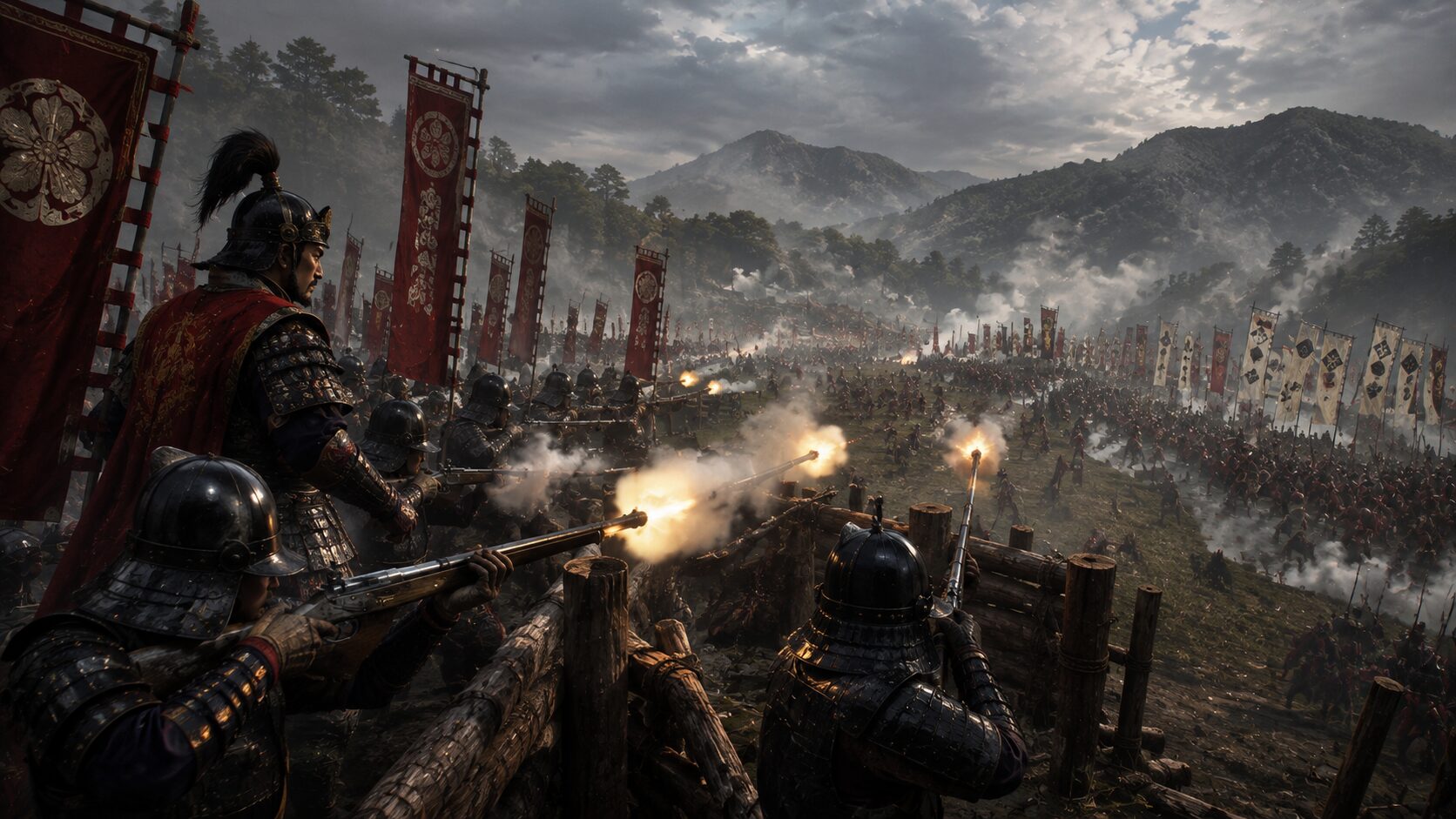
On May 21, 1575, the army of Takeda Katsuyori attacked the combined forces of Oda Nobunaga and Tokugawa Ieyasu near Nagashino. According to the traditional story, Nobunaga deployed 3,000 arquebusiers divided into three ranks of 1,000 men each. The first rank fired and withdrew to reload. The second stepped forward, followed by the third. By the time the third rank had fired, the first was supposedly ready to shoot again. Instead of isolated volleys, the attackers faced an almost continuous wall of lead.
For the 16th century, this sounds revolutionary. In Europe, the famous countermarch system that allowed ranks of musketeers to maintain sequential fire is primarily associated with military reforms of the late 16th century. This would mean that Japan, introduced to European matchlock firearms only 32 years before Nagashino, had suddenly overtaken the Europeans in the tactics of using their own weapon.
The story was repeated for decades in books, textbooks, films, and popular culture. Nagashino became a Japanese symbol of a military revolution: the old world of samurai valor supposedly collided with the new world of mass gunfire — and lost.
There is only one problem.
We do not actually know whether Nobunaga’s famous three-rank firing system ever existed.
Modern research increasingly treats the classic image of Nagashino as a later myth. The most reliable early account of the battle, Ōta Gyūichi’s Shinchō Kōki, does not describe the famous system of three rotating ranks. Moreover, it refers to around 1,000 arquebuses in the main position rather than 3,000. The story of exactly 3,000 gunners firing in a perfectly organized three-stage rotation became established through later texts and was ultimately canonized by Japanese military historiography in the early 20th century.
But this is where the story becomes even more interesting.
It does not mean that the revolution never happened.
It did.
It simply did not happen as neatly as later generations imagined.
The Japanese Received a European Gun — and Almost Immediately Began Making Their Own
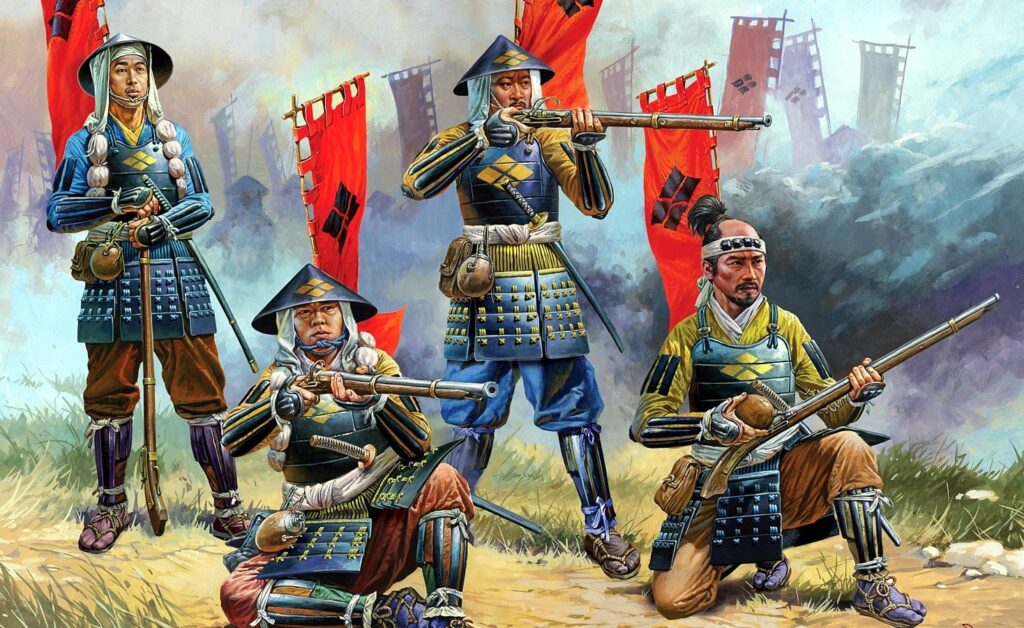
The arrival of the arquebus in Japan became an almost perfect example of technological adaptation. The new weapon did not remain an exotic foreign curiosity. Japanese craftsmen studied its construction, learned to reproduce its components, and rapidly established domestic production. The very word tanegashima — the name of the island where the Portuguese firearm first became famous — eventually became one of the Japanese terms for the matchlock gun itself.
The reason for this rapid success was not simply the skill of Japanese gunsmiths. The arquebus arrived at exactly the right historical moment. Japan had already spent decades in internal warfare. Following the Ōnin War of 1467–1477, the authority of the Ashikaga shogunate weakened, provincial rulers fought one another, alliances shifted constantly, and the ability to increase military power quickly could determine the survival of an entire domain.
The Sengoku period became a gigantic laboratory of natural selection for military technologies. If a new weapon offered an advantage, nobody was going to wait decades for tradition to approve it. It was purchased, copied, manufactured, and handed to soldiers.
And here lies another important point. The Japanese army of the 16th century was already very different from the army of solitary samurai warriors later created by popular culture.
The Samurai Army Was Becoming an Infantry Army
The medieval ideal of the samurai was indeed closely associated with the mounted warrior and the bow. But the great wars of the Sengoku period gradually changed the very nature of Japanese armies. Daimyō needed not dozens of superb individual fighters but thousands of controllable soldiers capable of holding formation, following orders, and fighting collectively.
As a result, the role of the ashigaru — foot soldiers armed primarily with long yari spears, bows, and later arquebuses — steadily increased. Some yari reached several meters in length, allowing dense formations to resist other infantry units and complicate cavalry action. Mass warfare was gradually replacing the individual duel.
Command systems changed as well. Units carried banners, commanders relied on signals, and the famous sashimono worn on warriors’ backs helped distinguish formations within huge masses of troops. A 16th-century commander increasingly had to control not a few dozen retainers but a complex system of military units.
The arquebus fit perfectly into this transformation.
It possessed one enormous advantage over traditional weapons: training a man to fire a matchlock with reasonable effectiveness did not require the years of practice necessary to produce a skilled archer.
But it also had one enormous weakness.
After firing, the gunner was nearly defenseless.
One Shot — and Twenty Seconds of Vulnerability
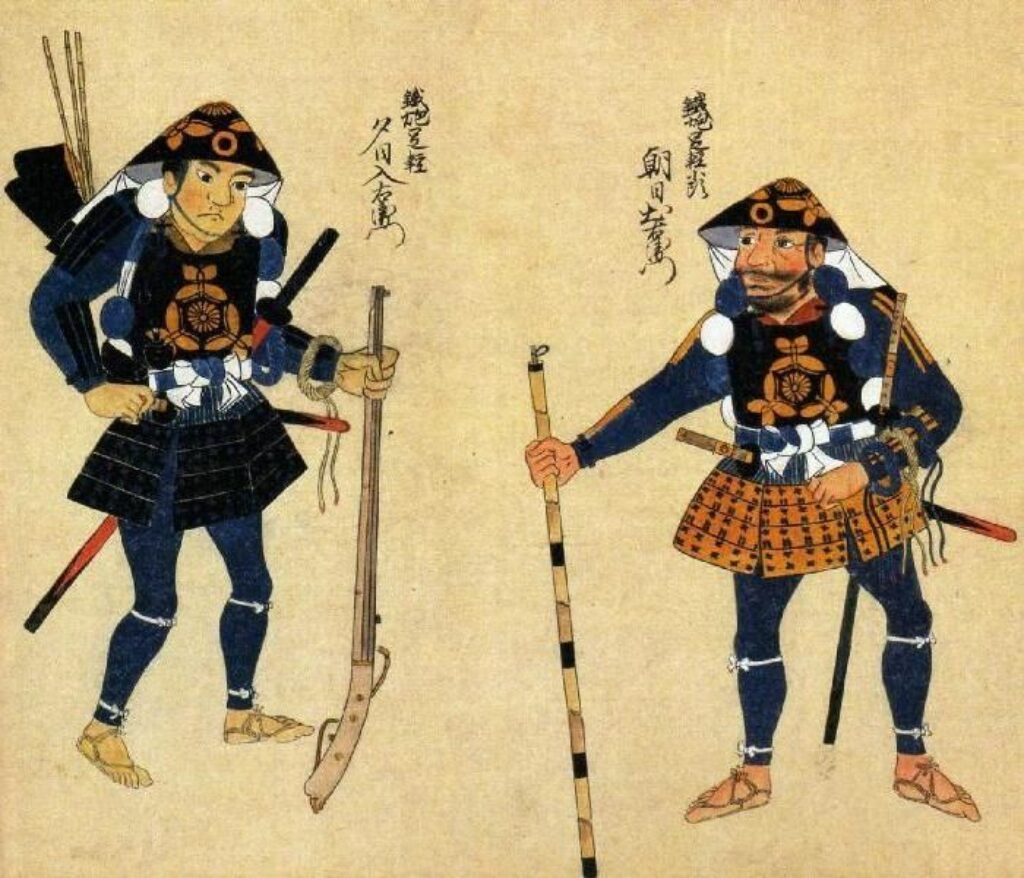
The matchlock arquebus was a muzzle-loading weapon. The shooter had to pour in powder, insert the ball, ram the charge, prepare the priming powder, return the burning match to position, and only then aim again. The exact rate of fire depended on training and conditions, but rapid follow-up shots were impossible.
For an individual fighter, that was a serious weakness.
For an organized formation, it was an engineering problem.
If one gunner is reloading after firing, another can shoot. If there are dozens or hundreds of them, their fire can be distributed over time. Even without a perfectly standardized drill, it becomes possible to maintain pressure on the enemy far longer than any single shooter could manage.
Japanese commanders understood this relatively quickly. And this is where the real revolution lies.
Not necessarily in the invention of one perfect system of rotating ranks.
But in transforming the gun from an individual weapon into the weapon of a unit.
Nobunaga Was Experimenting With Organized Gunfire Long Before Nagashino
Oda Nobunaga did not suddenly discover the arquebus in 1575. He had used firearms much earlier and clearly understood the value of concentrating gunners.
In its description of the attack on Muraki fortress in 1554, the Shinchō Kōki mentions sequential shooting by Nobunaga’s troops. Some researchers interpret the episode as evidence that he was already experimenting with organized alternating fire. Yet caution is necessary even here: sequential firing by separate groups does not automatically mean the later classic countermarch in which entire ranks move forward and backward in a synchronized cycle.
The distinction may seem minor, but it is actually fundamental.
Three ranks may not even be enough to maintain continuous fire with slow-loading matchlocks. Later European countermarch systems often used considerably greater depth — six, ten, or more ranks — because the front rank needed time to move backward, reload, and return to firing position.
That is why the famous formula — “the first thousand fired, then the second, then the third, and by then the first thousand had reloaded” — looks suspiciously elegant.
Real warfare was messier.
But no less effective.
So What Actually Happened at Nagashino?
In the spring of 1575, Takeda Katsuyori besieged Nagashino Castle, which belonged to an ally of Tokugawa Ieyasu. The combined forces of Tokugawa and Oda Nobunaga marched to its relief, and the opposing armies eventually met at Shitaragahara near the castle.
Nobunaga prepared his position in advance. Wooden barriers were constructed across the front, the terrain itself made rapid attacks difficult, and numerous gunners were positioned behind the defenses. The most reliable source refers to roughly 1,000 arquebusiers in the main formation. Another approximately 500 firearms were assigned to the detachment of Sakai Tadatsugu, meaning that the total number of guns was clearly above 1,000. However, the famous figure of exactly 3,000 and their division into three perfectly synchronized groups are not confirmed by contemporary evidence.
Even more importantly, the Takeda army had firearms of its own. Modern estimates suggest that it may have possessed roughly 1,000–1,500 guns. Nagashino therefore should not be imagined as a battle between technologically advanced Nobunaga and archaic samurai who somehow decided to charge muskets with swords.
Both sides knew the arquebus.
The difference was how it was integrated into the wider system of battle.
Nobunaga Did Not Win With a Gun. He Won With a System
This is perhaps the most important twist in the entire story.
Firearms alone did not guarantee victory. An arquebusier remained vulnerable, especially while reloading. Rain and humidity could cause problems for powder and burning matches. Range and accuracy were limited. Gunners needed protection.
The Oda-Tokugawa position was therefore not simply a long line of men carrying guns.
It was a prepared defensive system.
Wooden barriers disrupted the momentum of attacks. Terrain restricted maneuver. Spearmen could protect the shooters. Large numbers of arquebusiers made it possible to maintain intense fire even without a perfect three-rank rotation. Other elements of the army held the line and counterattacked when necessary.
The Takeda did not encounter a miraculous new weapon.
They encountered a combination of old and new weapons functioning as a single system.
That mattered far more than the invention of three firing ranks.
The Famous “Takeda Cavalry Charge” Probably Did Not Happen the Way We Imagine It Either
Another image of Nagashino, firmly established through paintings, books, and especially cinema, is that of magnificent masses of mounted samurai charging directly into the barricades under relentless gunfire.
Reality was more complicated.
The Takeda army was not a gigantic cavalry corps. Samurai certainly used horses, but large numbers of infantry fought alongside them. The battle consisted of repeated attacks by different formations rather than one enormous cavalry avalanche.
Modern historiography has increasingly revised the traditional picture of Nagashino. Katsuyori’s supposed recklessness, the unique character of Takeda cavalry, the 3,000 guns, and the famous three-stage firing system all appear to have been shaped substantially by later storytelling.
The outcome of the battle, however, was very real.
The Takeda suffered a severe defeat.
Many of the clan’s most experienced commanders and retainers were killed, and its offensive power was seriously weakened. Yet the clan itself survived for another seven years and was destroyed only in 1582. The popular claim that “the Takeda army ceased to exist at Nagashino” is therefore another exaggeration.
Nagashino was not the end of the samurai.
It was a lesson in what Japanese warfare was becoming.
Yet the Japanese Really Did Become One of the Most Firearm-Intensive Military Powers of Their Age
And this is something the legend of the three ranks can actually obscure.
The myth may be questionable, but the speed at which Japan adopted firearms was entirely real. Only a few decades separated the arrival of the first Portuguese examples from armies in which guns had become a standard component of military organization.
By the end of the 16th century, arquebusiers were regularly present in Japanese military contingents. Documents associated with the armies involved in Toyotomi Hideyoshi’s invasion of Korea in 1592 show formations in which the number of arquebusiers could rival the number of spearmen and exceed that of archers.
The war in Korea then demonstrated just how far Japanese infantry had progressed in the use of firearms within half a century.
The transformation had been astonishingly fast.
In 1543 — a handful of guns brought by foreigners.
By the 1550s — active production and battlefield use.
By the 1570s — mass formations of gunners.
By the 1590s — major expeditionary armies in which the arquebus had become one of the principal infantry weapons.
Japan had completed this transformation within a single lifetime.
But Were the Japanese the First in the World to Use Volley Fire?
No.
And this is where the original story turns completely on its head.
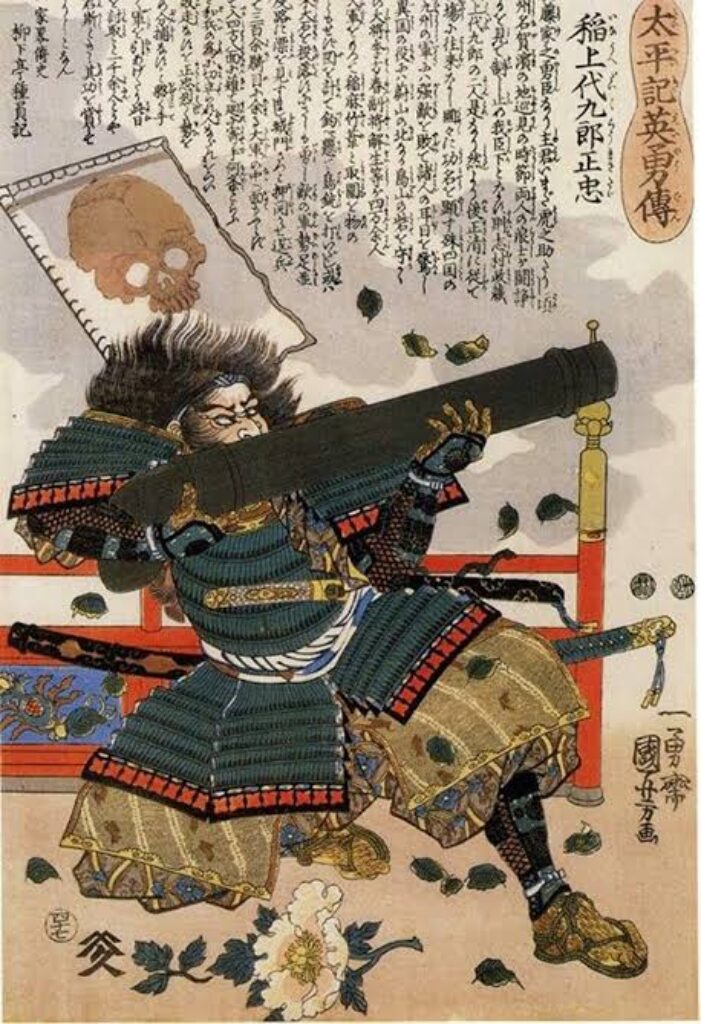
Historian of gunpowder warfare Tonio Andrade notes that Chinese forces were using organized volley fire with arquebuses by 1560 at the latest — fifteen years before Nagashino. Therefore, even if we accept that Japanese troops used some form of rotating fire in 1575, it cannot reasonably be described as the first volley fire in world history.
That does not make the Japanese case any less fascinating. There is evidence that organized sequential firing was indeed used in 16th-century Japan, and it is quite possible that Japanese armies developed some forms of such tactics before they became widespread in Europe. But turning the subject into a competition over “who invented the volley first” is not particularly useful.
Chinese, Japanese, Ottoman, and European armies were all confronting essentially the same technical problem.
A gun fires quickly.
It reloads slowly.
How do you make a hundred such guns fire almost continuously?
Different armies gradually arrived at variations of the same answer: organize the shooters so that some are firing while others prepare their next shot.
The gunpowder revolution was unfolding in several parts of Eurasia at roughly the same time.
So Why Did the Legend of Nobunaga’s Three Ranks Become So Famous?
Because it tells an almost perfect story of modernization.
On one side stand the Takeda horsemen — elite samurai, tradition, personal valor, the old order. On the other stand Nobunaga, ashigaru gunners, wooden barricades, and the cold mathematics of mass fire.
The old world charges forward.
The new world pulls the trigger.
And the old world dies.
It is difficult to imagine a more powerful historical image.
This interpretation became especially popular in the late 19th and early 20th centuries, when Japan itself was undergoing rapid military modernization. In 1903, the Imperial Japanese Army General Staff published a study of Nagashino in which three-stage firing played an important role. This version helped shape the classic image of the battle that would be repeated in popular literature for decades.
It produced an extraordinarily attractive national narrative.
The Japanese received a Western weapon.
They mastered it almost immediately.
Then they supposedly invented tactics that Europeans themselves would adopt only later.
The problem is that the story became more elegant than the evidence.
The Irony Is That Nobunaga Does Not Need the Legend
Because the real achievement of 16th-century Japanese armies is more interesting than the myth.
Nobunaga did not need to invent three-stage volley fire to qualify as a military innovator. His advantage lay in his ability to combine different instruments into one system: mass infantry, arquebuses, spears, field fortifications, logistics, and centralized command.
The arquebus perfectly suited his age.
It was not the weapon of an individual hero.
It was the weapon of organization.
A skilled archer took years to produce. An arquebusier could be trained much more quickly. A samurai could spend a lifetime perfecting individual martial skill. Several hundred disciplined ashigaru could generate a volume of fire that no individual talent could replace.
And this represented a much deeper revolution than the mere appearance of the gun.
The very idea of who wins a war was changing.
The Samurai Did Not Disappear. He Became the Commander of a New Army
The firearms revolution did not destroy the samurai. On the contrary, Japan was unified by members of the samurai military elite — Oda Nobunaga, Toyotomi Hideyoshi, and Tokugawa Ieyasu.
But the character of their armies changed.
Instead of forces based primarily on the individual martial qualities of elite warriors, large organized formations emerged. Arquebusiers fired. Spearmen protected them. Archers remained useful. Cavalry was employed where it could provide an advantage. Engineers built fortifications. Scouts gathered intelligence. Commanders coordinated the actions of thousands of men.
War was becoming a system.
That is why the Sengoku period produced not only mass firearm use but also enormous armies, complex sieges, and new castle complexes. One of the clearest examples was Nobunaga’s struggle against Ishiyama Hongan-ji, which lasted roughly a decade, from 1570 to 1580. Superiority in any single weapon was no longer enough. Success required logistics, blockade, naval power, artillery, diplomacy, and the ability to sustain military pressure for years.
By the end of the 16th century, Japan possessed a military system radically different from the one that had existed a century earlier.
And then that same system helped bring an end to the age that had created it.
Japan’s Most Famous Firearms Revolution May Never Have Happened
This is the central paradox of Nagashino.
The famous scene usually presented as the revolution probably never happened in the form we know. We cannot confidently say that Nobunaga’s 3,000 gunners stood in three perfect ranks, firing synchronized volleys into attacking Takeda warriors. Modern research regards this picture as a later construction, and the most reliable early account does not confirm it.
Yet the revolution itself was entirely real.
It simply did not happen on the morning of one particular battle.
It unfolded over roughly half a century.
In 1543, the Japanese encountered an unfamiliar European firearm. Within a few years, they learned to manufacture it on a large scale. They then created formations of gunners, experimented with organized fire, and integrated arquebusiers with other branches of the army. By Nagashino, firearms had already become a normal part of warfare. By the campaigns in Korea, Japanese armies had become some of the most heavily matchlock-equipped military forces of their age.
So the real lesson of Nagashino does not need three ranks.
Japan received a foreign technology and did not simply copy it. It integrated that technology into its own military system, established mass production, and transformed the way wars were fought within a few decades.
Nobunaga did not win because he was the first man in history to invent volley fire.
And the samurai were not defeated because peasants with guns suddenly shot them off the battlefield.
The reality was more interesting.
The old samurai army was not destroyed by firearms. It picked them up — and transformed itself into an army of a new age.