
A $100 Million Fighter Against a Cheap Drone? Embraer Wants to Bring the Turboprop Back Into Air Defense

Modern air defense has encountered a rather strange economic problem. It is capable of destroying extremely sophisticated targets — ballistic missiles, cruise missiles, and combat aircraft. Yet when a relatively slow and inexpensive drone enters protected airspace, it may have to be intercepted with a weapon that costs many times more than the target itself.
A modern jet fighter can be scrambled. A surface-to-air missile can be launched. Additional ground-based air defense systems can be deployed.
Or there is another option that at first glance seems almost anachronistic: send a turboprop aircraft to intercept it.
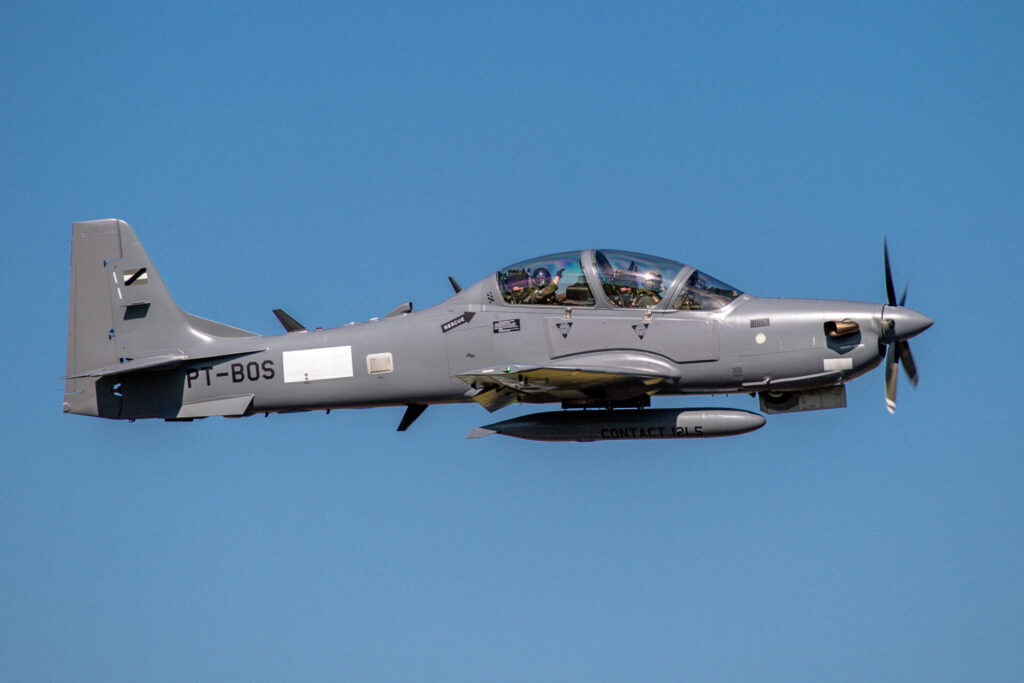
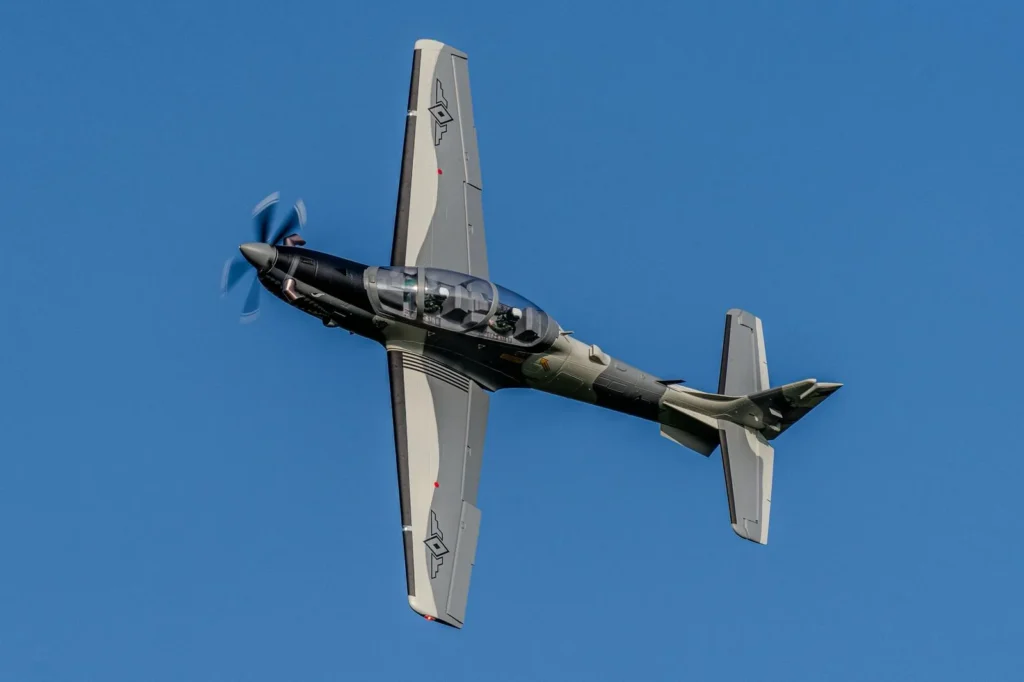
This is exactly the niche Brazil’s Embraer is now trying to occupy with the A-29 Super Tucano. Originally developed as a trainer and light attack aircraft, the company is turning it into a specialized drone hunter. Against the backdrop of rapidly proliferating low-cost long-range UAVs, the concept looks considerably less exotic than it would have just a few years ago.
Why Send a Propeller-Driven Aircraft After a Drone?
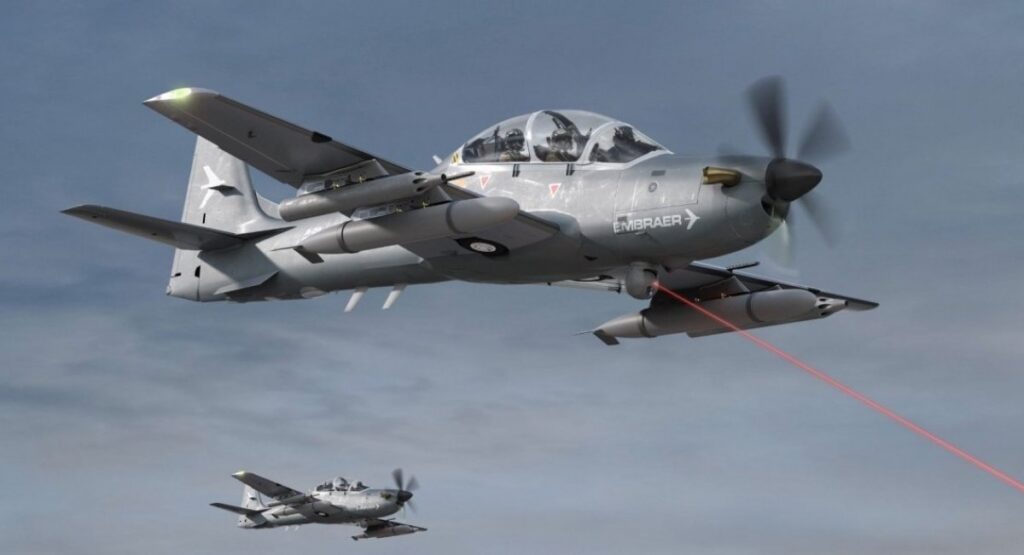
The paradox is that one of the Super Tucano’s greatest disadvantages in conventional air combat becomes an advantage here.
It is slow.
Modern jet fighters were designed to operate in an entirely different speed regime. Intercepting a small UAV traveling at roughly 150–250 km/h is not necessarily the most convenient mission for them.
The Super Tucano can operate comfortably at much lower speeds, remain near the target for longer periods, and make repeated attack runs.
Embraer representatives have explicitly pointed to this logic. Compared with a jet fighter, the A-29’s lower speed can become an advantage when tracking and illuminating UAVs, many of which may be flying at around 100 knots, or approximately 185 km/h.
This creates an interesting concept.
The A-29 is not supposed to replace a conventional fighter.
It is supposed to free conventional fighters from missions for which they are too expensive and excessive.
Embraer Is Already Turning the Idea Into a Real System
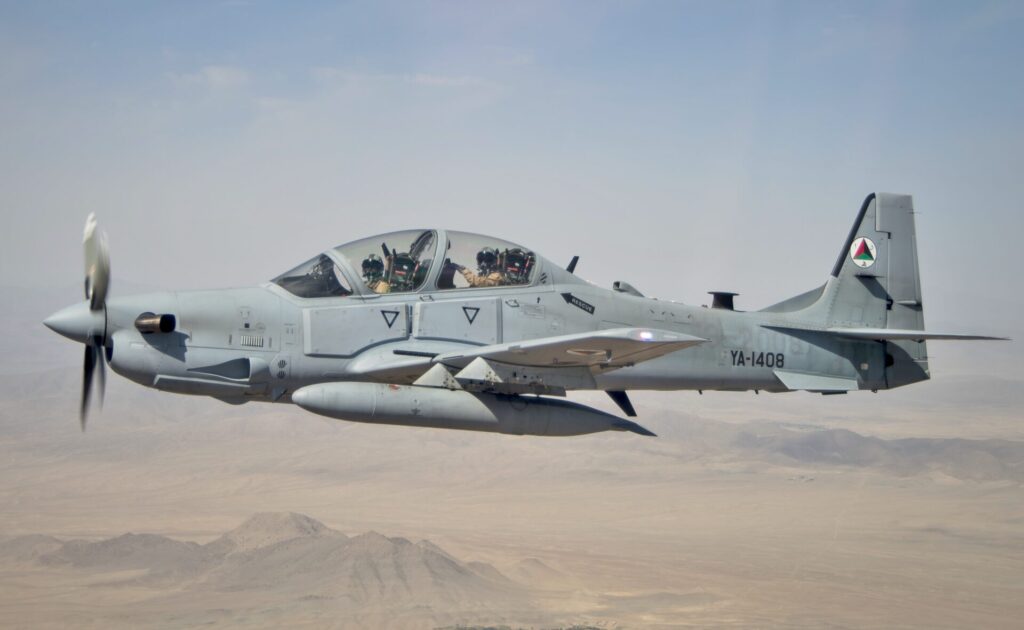
An Afghan Air Force A-29 Super Tucano soars over Kabul, Afghanistan, Aug. 14, 2015. The A-29 is the Afghan Air Force’s latest attack airframe in their inventory.
(U.S. Air Force photo/Staff Sgt. Larry E. Reid Jr., Released)
The initial C-UAS concept unveiled by Embraer in November 2025 is relatively straightforward.
The aircraft receives information about an incoming target through a data link. It is then directed toward the interception area, where the crew uses the aircraft’s electro-optical/infrared system to search for and track the UAV.
Once the target is acquired, things become more interesting.
Embraer has identified two principal weapons for the mission: laser-guided 70mm rockets and the aircraft’s two internally mounted .50-caliber machine guns.
The engagement chain therefore looks something like this:
external detection → target data transmitted to the A-29 → EO/IR search → tracking → rocket or machine-gun engagement.
The aircraft does not necessarily need its own powerful radar.
A ground-based or external radar network can detect the target and tell the crew where to look. Once the A-29 reaches the appropriate area, its own optical sensors can take over the tracking mission.
In effect, the Super Tucano becomes a flying weapons platform integrated into an existing air-defense network.
Then Embraer Added Artificial Intelligence
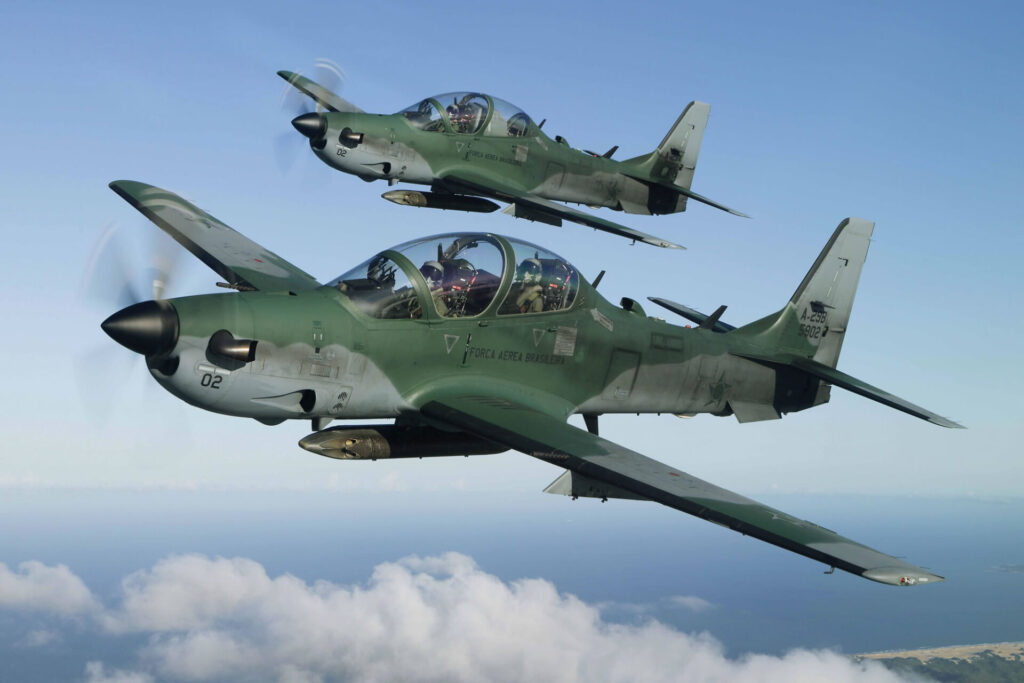
The concept took another step forward in March 2026.
Embraer signed an agreement with Valkyrie Aero to integrate the Gunslinger system, which uses artificial intelligence algorithms for C-UAS missions.
The company describes the process using a classic sequence:
Find — Fix — Finish.
In other words: detect the target, establish its precise location, and destroy it.
The purpose is to reduce crew workload when searching for and tracking small airborne targets. This becomes especially important at night or when the aircraft is receiving information about multiple objects.
Embraer also emphasizes another major Super Tucano advantage — endurance. Instead of performing a short interception mission, an A-29 can potentially remain on station for an extended period, waiting for targets to appear.
At that point, the aircraft starts looking less like a light attack platform and more like an airborne patrol interceptor for air-defense missions.
Why Not Just Use a Conventional Fighter?
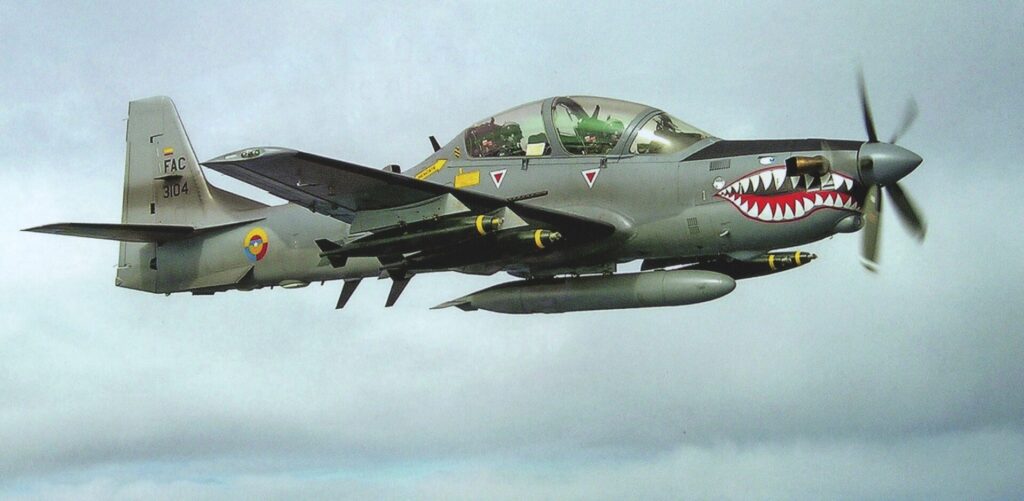
Because the economics can become absurd.
A modern fighter is an extraordinarily expensive system, and the purchase price of the aircraft itself is only part of the equation.
Every flight hour means fuel consumption, engine and airframe wear, ground-crew labor, maintenance, and eventually component replacement.
If the target is a high-speed cruise missile or an enemy combat aircraft, those costs are entirely justified.
But what if the target is a relatively simple drone?
Systematically using a fourth- or fifth-generation fighter to hunt such aircraft is somewhat like firing an anti-tank gun at mosquitoes: technically possible, occasionally necessary, but a rather strange basis for an entire defensive system.
The Super Tucano is much simpler.
Its Pratt & Whitney Canada PT6A-68C turboprop engine produces around 1,600 horsepower. The aircraft was specifically designed to operate from relatively austere airfields, offers long endurance, and has substantially lower operating costs than a full-scale jet fighter.
Yet it is far from primitive.
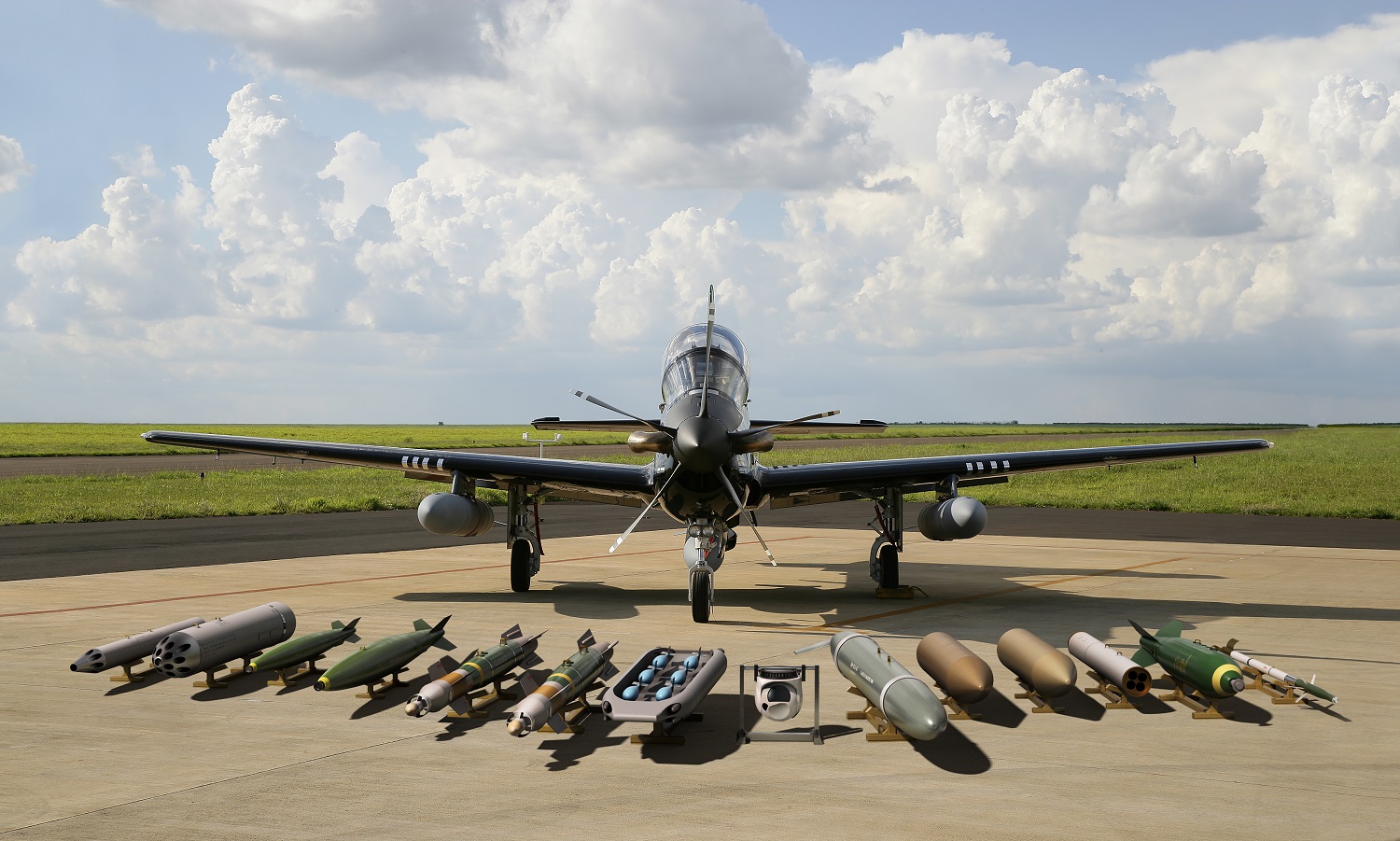
The aircraft can carry a modern EO/IR sensor with laser designation capability, secure communications, data links, night-vision-compatible systems, and a defensive aids suite. Five external hardpoints are compatible with NATO-standard weapons, while two .50-caliber machine guns are installed internally in the wings.
It is this combination of a relatively inexpensive platform and modern electronics that makes the concept interesting.
Why the Machine Gun Suddenly Matters Again
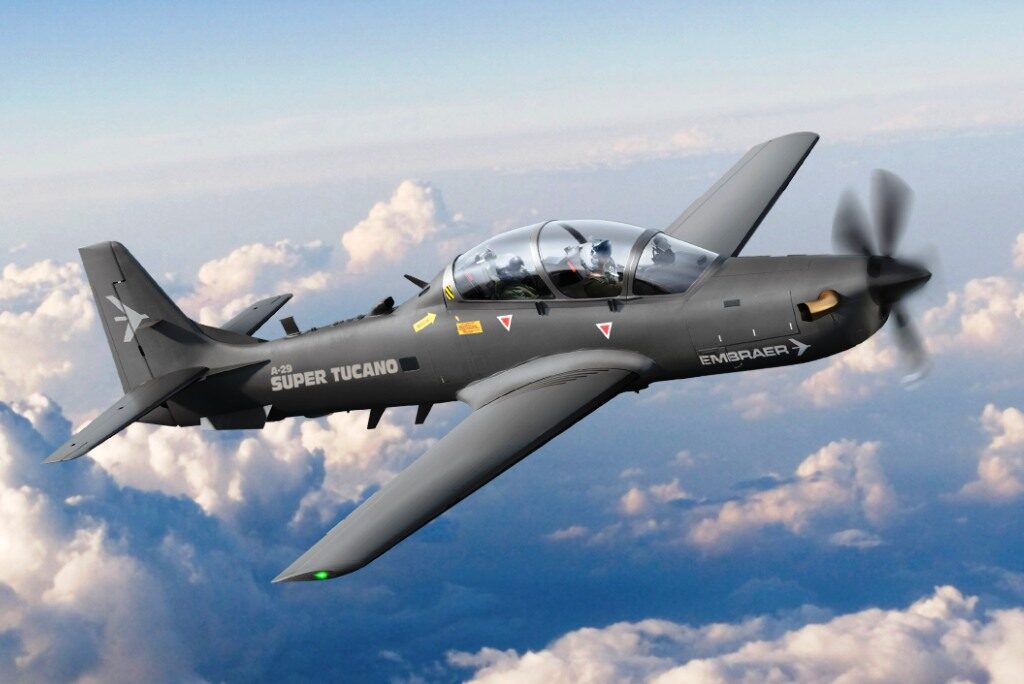
Perhaps the most attractive part of the concept is not the missile or rocket armament.
It is the machine guns.
The A-29 carries two internally mounted .50-caliber machine guns. In modern fighter combat, such weapons would have a relatively limited role.
Against a slow-moving drone, the situation is very different.
If the crew has already detected and overtaken the target, using machine-gun fire potentially turns the interception into a very inexpensive operation.
This creates almost ideal economics for countering low-cost UAVs.
The expensive sensors can be shared across the wider air-defense network, the aircraft itself is reusable, and only a relatively small quantity of ammunition has to be expended to destroy each target.
There is, however, an important limitation.
Shooting down a UAV with machine-gun fire is considerably more difficult than it sounds. The pilot needs the correct attack geometry, stable target tracking, and reasonably accurate range information. There is also the danger of colliding with debris from the destroyed drone.
That is why Embraer proposes a second option for more demanding engagements.
A 70mm Rocket Instead of an Expensive Air-to-Air Missile
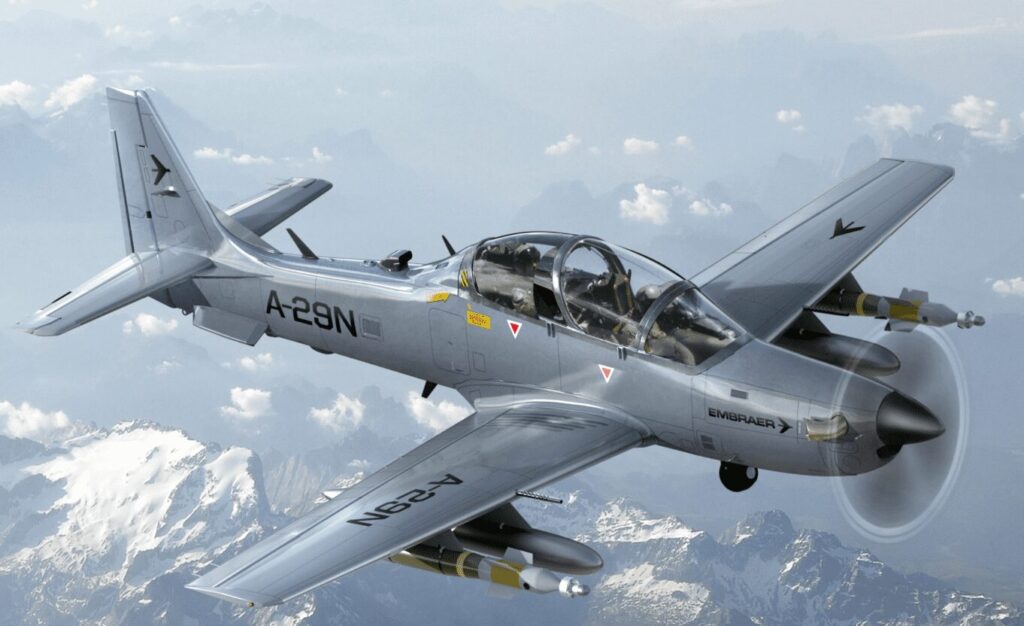
Embraer’s official materials already list laser-guided 70mm rockets among the A-29’s available weapons, including APKWS.
This is a particularly interesting combination.
APKWS essentially converts a conventional 70mm unguided rocket into a precision-guided weapon through the addition of a laser-guidance section.
The system was originally developed primarily for attacking ground targets, but the basic idea of an inexpensive guided rocket is well suited to engaging relatively slow airborne objects.
This creates an intermediate layer between machine guns and full-size air-to-air missiles.
Machine guns — for the simplest targets.
APKWS — for targets that are inconvenient or dangerous to approach closely.
Conventional fighters — for fast and sophisticated airborne threats.
This layered economics of interception is arguably the central argument behind Embraer’s proposal.
The Super Tucano Is No Small Experimental Program
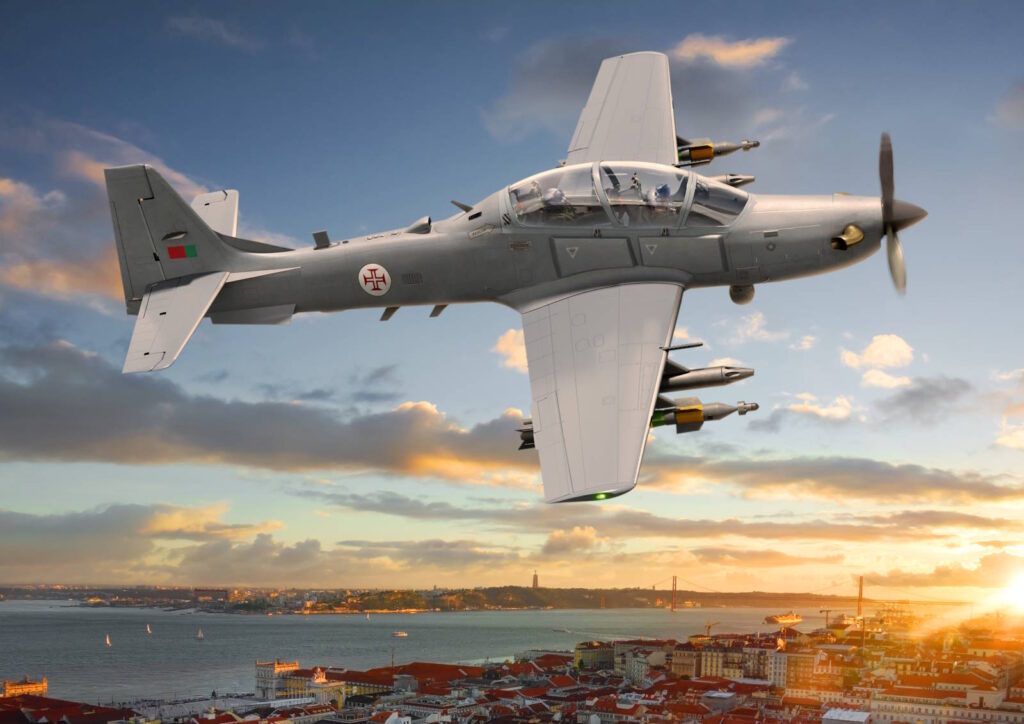
There is another factor that distinguishes Embraer’s proposal from many new counter-drone projects.
The aircraft already exists.
And it exists in significant numbers.
According to current manufacturer figures, the A-29 has been selected by more than 22 air forces, while the global fleet has accumulated hundreds of thousands of flight hours. Earlier Embraer statistics also cited approximately 60,000 combat flight hours.
In other words, the company is not proposing the development of an entirely new interceptor aircraft.
It is adding another mission to an existing platform.
That substantially reduces technical risk.
Moreover, Embraer says the counter-UAS configuration could be incorporated into both newly manufactured aircraft and A-29s already operated by customers.
The potential market therefore includes not only countries considering the purchase of new aircraft, but also existing Super Tucano operators.
There Is One Problem: You Still Have to Get the Aircraft
This is where the original Latvian angle provides a useful detail — not as the central story, but as an example.
Even if the concept proves attractive, aircraft production cannot be expanded overnight.
Uruguay, for example, received its first ordered Super Tucanos roughly a year and a half after placing the order. If Embraer’s backlog continues to grow, delivery times could become longer.
And this may ultimately become one of the biggest limitations of the proposal.
Demand for affordable counter-drone systems is increasing much faster than the defense industry can build new production capacity.
At the same time, the A-29 is not required only for potential C-UAS customers. It remains a trainer, light attack aircraft, reconnaissance platform, and counterinsurgency aircraft.
That creates a somewhat ironic situation: one of the Super Tucano’s greatest advantages is that it is already in serial production, yet growing demand could itself create a delivery bottleneck.
Is the Turboprop Fighter Coming Back?
The Super Tucano is obviously not a universal solution to the drone problem.
It has clear limitations.
The aircraft requires an airfield, pilots, maintenance, and supporting infrastructure. Operating it in an environment saturated with hostile air defenses would be extremely dangerous. It cannot replace ground-based surface-to-air missile systems, electronic warfare, or conventional fighters.
Weather conditions can also impose restrictions.
But Embraer is approaching the problem from a different direction.
The A-29 is not supposed to replace air defense. It is supposed to fill the gap between a cheap target and an excessively expensive means of destroying it.
That is why the Super Tucano story is considerably more interesting than a report about one small country potentially buying the aircraft.
What we are seeing is an attempt to create a new category of airborne interceptor.
Not an aircraft intended to fight enemy fighters.
Not primarily a strike aircraft designed to attack ground targets.
But a relatively inexpensive manned aircraft capable of patrolling a designated area for hours, receiving targeting information from the wider air-defense network, finding a UAV with its own optical sensors, and destroying it with a 70mm guided rocket or a burst of machine-gun fire.
Embraer has already conducted ground and flight testing associated with the basic concept and expects to move its C-UAS solution toward demonstrations and customer availability in the second half of 2026.
If the concept proves effective, aviation history may take a rather ironic turn.
After decades of pursuing greater speed, stealth, supersonic performance, and increasingly expensive missiles, one of the most widespread aerial threats of the 21st century may turn out to be best countered by an aircraft whose apparent shortcomings suddenly become advantages.
Because hunting a cheap, slow drone does not always require a fighter costing tens of millions of dollars. Sometimes what you need is an aircraft that can fly slowly enough, stay airborne long enough — and do it cheaply enough.






