
Aviation Under Sanctions: How Successfully Has Rostec Really Replaced Western Technology?

Western sanctions were expected to bring Russia’s civil aviation industry to a standstill. After 2022, Russian airlines lost direct access to new Boeing and Airbus aircraft, official maintenance services, software updates, and a large share of genuine spare parts. At the same time, it became clear that Russia’s own passenger aircraft also depended heavily on foreign engines, avionics, composite materials, and hundreds of imported components.
The collapse never came. Russian airlines continue to operate, while domestic manufacturers have succeeded in replacing a number of critical systems with locally produced alternatives. At the same time, however, the promised rapid transition to entirely Russian-built aircraft has not materialized.
The latest restructuring of Rostec’s aviation assets illustrates the industry’s current reality. The state corporation must simultaneously keep an aging fleet of Western aircraft flying, complete the long-running import substitution programs for new airliners, and restore serial production lines that only a few years ago were building aircraft almost by hand.
The key question is no longer whether Russia can develop a domestic engine or avionics system. It has already demonstrated that it can.
The real question is whether Russian industry can manufacture all of these systems on time, at scale, and in quantities sufficient for one of the world’s largest domestic aviation markets.
A New Holding Company for Old Problems
According to Ukraine’s Foreign Intelligence Service, Rostec is preparing another major consolidation of its aviation assets. The plan reportedly places Red Wings Airlines, cargo carrier Sky Gates, air ambulance operators, and Avia Capital Services under the management of Ilyushin Finance Co.
Officially, such restructuring would improve centralized fleet management, maintenance, leasing, and spare-parts distribution. Ukrainian intelligence presents a more critical interpretation, arguing that the move is intended to conceal financial losses and redistribute limited resources toward strategically important operators. These claims are difficult to verify independently and should therefore be viewed as the assessment of one side in an ongoing conflict.
Nevertheless, the consolidation itself appears logical.
As engine shortages, longer maintenance cycles, and restricted access to original spare parts continue to challenge operators, it becomes increasingly difficult for individual airlines to support small fleets consisting of multiple aircraft types.
A centralized organization can allocate engines more efficiently, coordinate maintenance, redistribute aircraft, and optimize spare-parts inventories.
However, restructuring does not create new components. It merely allows existing resources to be managed more efficiently.
Keeping Boeing and Airbus Flying
Immediately after sanctions were imposed, Russia’s highest priority was not producing new domestic aircraft—it was keeping existing Boeing and Airbus fleets operational.
Before 2022, Russian airlines operated more than 700 commercial aircraft, the majority of which were manufactured by Boeing and Airbus. These aircraft handled most passenger traffic on the country’s busiest routes.
Russia weathered the initial sanctions shock better than many Western observers expected. Airlines relied on existing inventories, domestic maintenance capabilities, component redistribution between aircraft, and parallel import channels through third countries. Some parts also began to be repaired or refurbished domestically.
However, this represents adaptation rather than genuine import substitution.
An original Boeing component purchased through intermediaries remains a foreign-made component. Removing an engine from one aircraft to keep another flying reduces the total number of operational aircraft. Repairing components previously considered non-repairable can extend service life but still requires documentation, testing, specialized materials, and technical expertise that may themselves be affected by sanctions.
In the short term, Russia bought valuable time.
In the long term, however, the challenge remains. The fleet continues to age, maintenance costs keep rising, and obtaining critical spare parts becomes increasingly expensive and complicated.
Superjet: Rebuilding an Aircraft Almost From Scratch
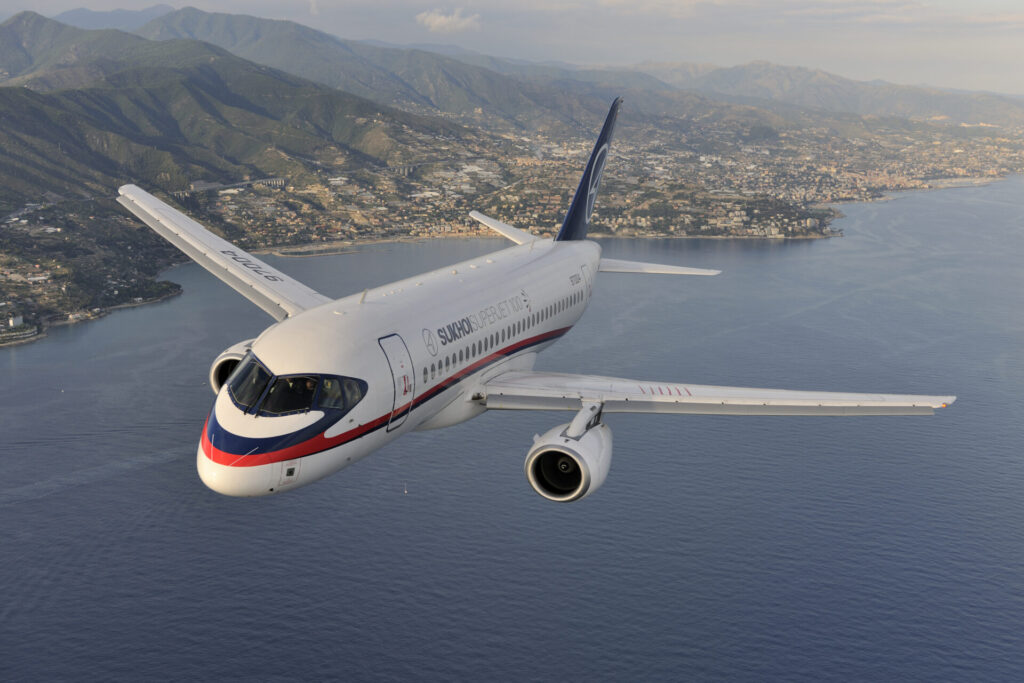
Perhaps no aircraft better illustrates Russia’s dependence on foreign suppliers than the Sukhoi Superjet 100.
Although marketed as a Russian aircraft, many of its most important systems originated abroad. The greatest challenge proved to be the SaM146 engine, jointly developed by Russia’s Saturn Design Bureau and France’s Safran. The French side supplied the hot section and numerous critical technologies.
Following the collapse of this partnership, Russia was effectively forced to develop an entirely new engine for the aircraft.
The result is the PD-8.
At the same time, engineers replaced avionics, environmental control systems, landing gear components, auxiliary power units, fire protection systems, and numerous other imported parts.
The import-substituted SJ-100 powered by PD-8 engines has already entered advanced flight testing. During 2025, one prototype completed a cross-country flight from Komsomolsk-on-Amur to Zhukovsky as part of its certification program.
This represents a significant engineering achievement.
Russia has not merely installed a different engine—it has effectively rebuilt the aircraft around an entirely new domestic industrial supply chain.
Yet there is a considerable difference between flying a prototype and establishing reliable serial production.
The first deliveries of the import-substituted SJ-100 were originally expected in 2023, but deadlines have slipped repeatedly. Commercial deliveries are now expected no earlier than 2026.
From an engineering perspective, the project is approaching success.
From a manufacturing perspective, it remains several years behind schedule.
MC-21: A Domestic Airliner That Became Heavier
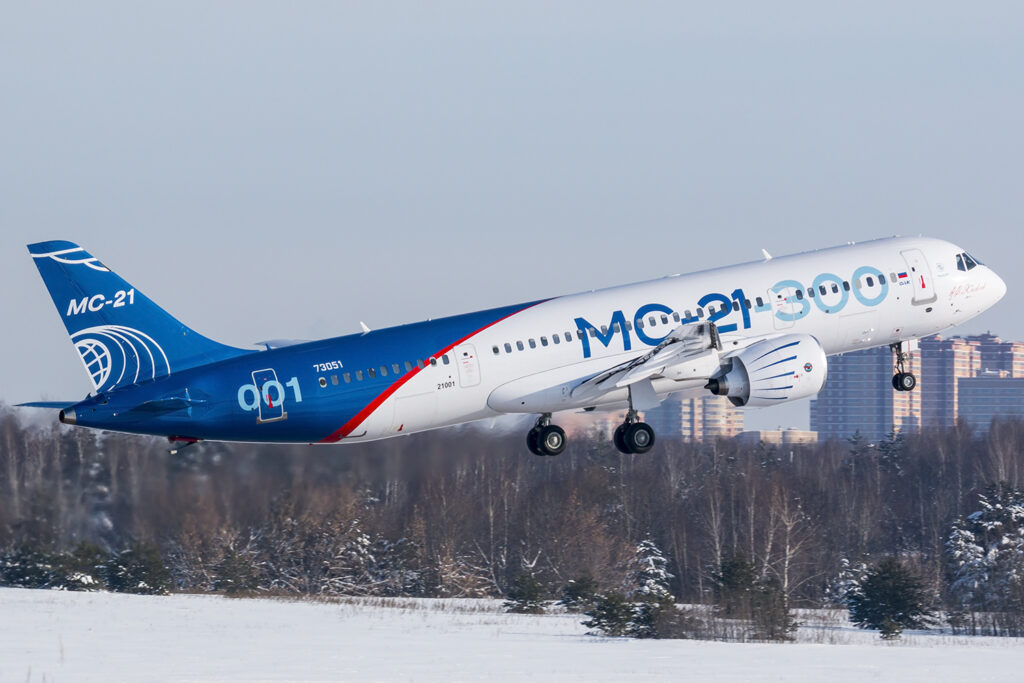
The MC-21 was intended to symbolize Russia’s return to the global narrow-body airliner market.
Originally conceived as an international program, it relied on Pratt & Whitney PW1400G engines, imported avionics, foreign systems, and composite materials sourced abroad. Even its advanced composite wing depended heavily on imported raw materials.
Sanctions forced a complete redesign.
American engines were replaced by the domestic PD-14, imported composite materials gave way to Russian alternatives, while avionics, flight controls, communications equipment, environmental systems, and numerous other components also underwent replacement.
By early 2026, Russian-produced composite materials had been fully integrated into the aircraft, while two domestically equipped MC-21 prototypes were participating in certification testing.
This is arguably one of the most impressive achievements of Russia’s import substitution program.
Russia successfully preserved production of its advanced composite wing, completed certification of the PD-14 engine, and assembled an almost entirely domestic modern narrow-body airliner.
However, replacing foreign systems came at a price.
Industry sources indicate that the import-substituted version became heavier than originally planned, reducing range and fuel efficiency. Engineers have since worked to reduce weight and recover some of the lost performance.
Initial deliveries were originally expected in 2024.
They are now anticipated no earlier than late 2026, while production is projected to reach approximately 36 aircraft annually by 2030—well below earlier government ambitions of 72 aircraft per year.
This clearly illustrates the distinction between technological capability and industrial capacity.
Building the aircraft proved possible.
Producing it in large numbers remains another challenge entirely.
Tu-214: Reviving an Old Airliner Is Not Easy
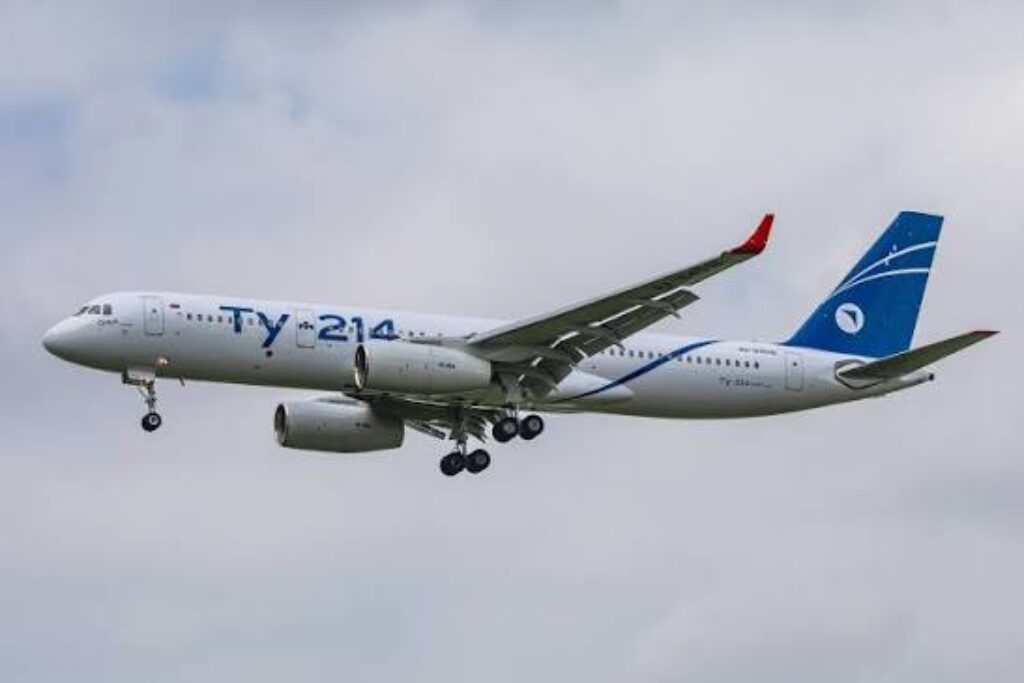
Alongside new aircraft development, Russia also decided to dramatically expand production of the Tu-214.
On paper, the decision appeared sensible.
The aircraft already existed, used domestically produced PS-90A engines, and had long served both government operators and a handful of commercial airlines.
Yet maintaining production of a few aircraft annually differs greatly from operating a modern serial assembly line.
The Kazan Aviation Plant has had to expand facilities, purchase new equipment, rebuild supplier networks, and recruit thousands of additional workers. Numerous imported navigation and flight systems also required replacement.
By late 2025, the import-substituted Tu-214 had received approval for its modified type design, clearing the way for expanded commercial production.
Production rates, however, remain modest.
Only one Tu-214 was completed during 2024, while current projections aim for approximately twenty aircraft annually by 2028.
The Tu-214 may help alleviate Russia’s airliner shortage in the short term.
It is not, however, a rapid solution.
Its three-person cockpit, heavier weight, and lower operating efficiency make it less competitive than the more modern MC-21.
Engines Remain the Greatest Challenge
Seats, displays, and electronic systems can be replaced.
Modern turbofan engines are another matter entirely.
Russia has preserved a complete domestic aero-engine industry—something only a handful of nations possess.
The PD-14 has already entered serial production.
The smaller PD-8 continues flight testing aboard the SJ-100 and the Be-200 amphibious aircraft.
Development of the heavy PD-35 also continues, although on a delayed schedule.
Possessing domestic engines means Russian aircraft are no longer simple assemblies of imported components.
They represent genuine national technological capabilities.
However, engines also demand world-class metallurgy, manufacturing precision, quality control, and long-term reliability.
Producing several prototypes is only the beginning.
Manufacturing dozens of engines annually while maintaining overhaul intervals and a global support network is a far greater challenge.
Ultimately, serial production—not prototype success—will determine whether the PD-8 and PD-14 become genuine long-term achievements.
Import Substitution Has Succeeded—Mass Production Has Not
It would be inaccurate to describe Russia’s aviation program as a complete failure.
During the past several years, Russian industry has developed or localized:
- PD-8 and PD-14 engines;
- the MC-21 composite wing;
- domestic avionics;
- auxiliary power units;
- environmental control systems;
- Russian-produced landing gear, cockpit glazing, and cabin components;
- replacements for many SaM146 engine components.
Even relatively minor but critical items—such as domestically produced spark plugs for the SaM146—have successfully completed certification, demonstrating the depth of localization achieved.
These are genuine engineering accomplishments.
Sanctions have neither destroyed Russia’s aviation industry nor eliminated its ability to design advanced aerospace systems.
However, declaring victory would be equally misleading.
The true measure of any aviation industry is not the number of prototypes or ceremonial presentations—it is the number of production aircraft delivered to airlines.
This remains Russia’s greatest challenge.
Production volumes remain well below official targets, and delivery schedules have slipped repeatedly.
Government production plans have already been revised downward several times.
Sanctions are only part of the explanation.
The industry also faces shortages of skilled personnel, expensive financing, limited manufacturing capacity, and the need to support both civilian and military aerospace programs simultaneously.
How Successfully Has Rostec Adapted?
If assessed objectively, the results appear mixed.
Russia has succeeded in maintaining commercial air transport.
Domestic airlines continue operating Western-built aircraft through maintenance, alternative supply chains, and careful fleet management.
Russia has largely succeeded in replacing many critical technologies.
It now possesses domestic engines, composite materials, avionics, and industrial supply chains for the SJ-100, MC-21, and Tu-214.
Russia has failed to meet its original certification schedules.
Virtually every major program has slipped by several years.
Mass production remains the biggest obstacle.
Current output is nowhere near sufficient to replace the country’s aging Boeing and Airbus fleet.
The result is neither complete success nor outright failure.
Rather, it is an expensive and difficult industrial transformation.
Rostec has demonstrated that Russia’s aviation industry can survive under technological isolation.
Whether it can truly thrive remains an open question.
The Hardest Phase Is Still Ahead
Time is not on Russia’s side.
Even with parallel import channels, Western-built aircraft will continue aging while maintenance becomes increasingly costly.
At the same time, Russia’s new domestic airliners must complete certification, enter serial production, and prove themselves in demanding commercial service.
Corporate restructuring may improve management efficiency and optimize resource allocation.
It cannot replace the need to manufacture new aircraft, engines, and spare parts.
Russia has unquestionably built real alternatives to many foreign aviation systems.
The next—and far more difficult—challenge is producing those alternatives quickly, consistently, economically, and at industrial scale.
That, rather than another corporate reorganization, will ultimately determine the future of Russia’s civil aviation industry.






