From Warship to Coastline: Russia Wants to Turn the A-192M Naval Gun Into a New Coastal Artillery System

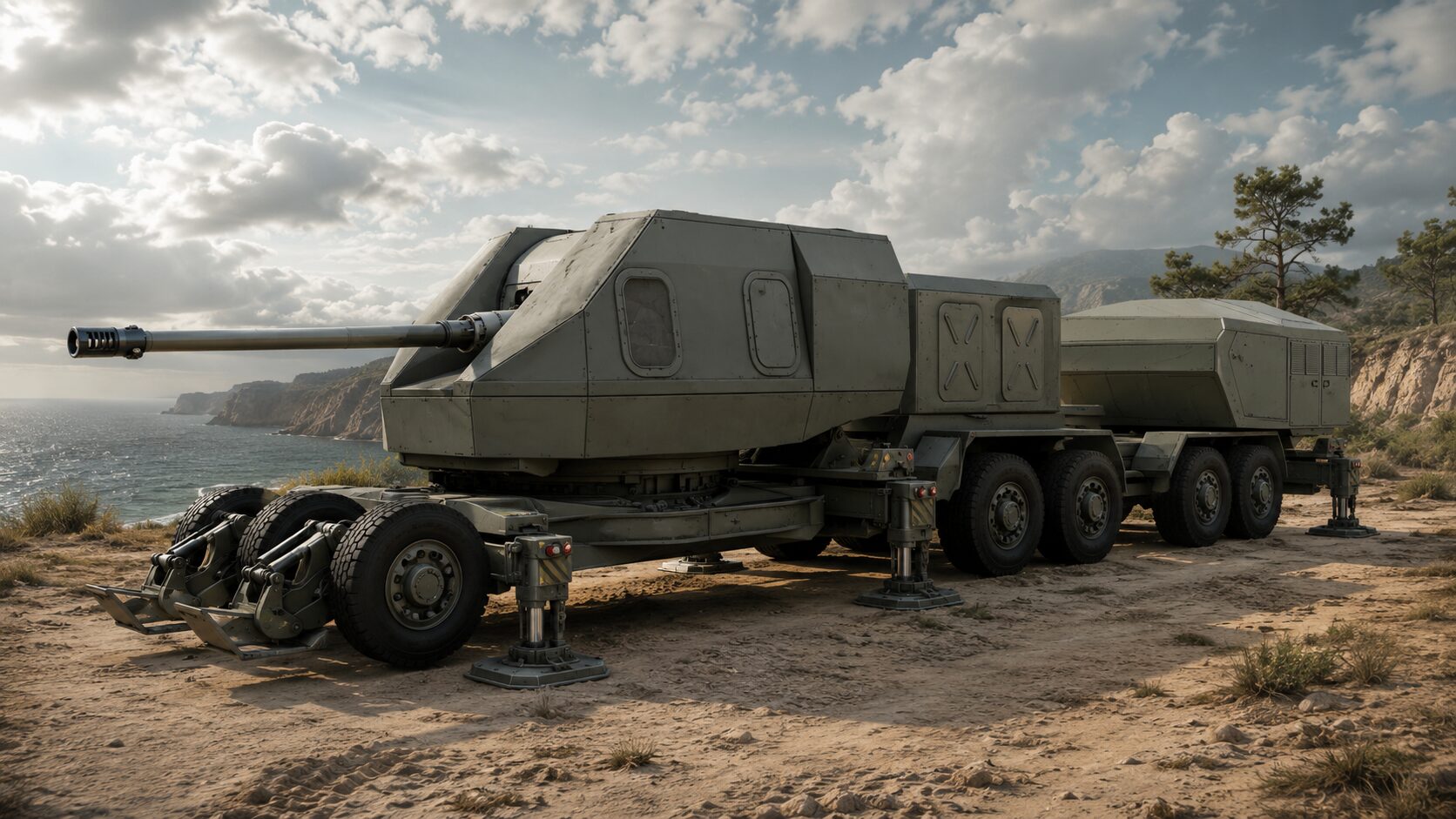
While the world’s attention is focused on hypersonic missiles, strike drones, and precision-guided weapons, Russia appears to be revisiting a far more traditional form of firepower—large-caliber artillery. But this time, the concept comes with an unusual twist. The Arsenal Machine-Building Plant in St. Petersburg, known for producing naval gun systems, has patented a new coastal artillery platform built around the 130 mm A-192M “Armat” naval gun. If the project ever reaches production, it would become one of the most ambitious attempts in recent decades to adapt modern naval artillery for land-based operations.
An Old Concept With Modern Technology
Although the proposal may seem unconventional, the idea itself is far from new.
During the Soviet era, engineers actively pursued the unification of naval and coastal defense systems. One of the best examples was the A-222 Bereg coastal artillery complex, which used a 130 mm gun sharing the ballistic characteristics of the AK-130 twin naval mount. Designed primarily to engage amphibious assault ships and fast attack craft, the Bereg remains in limited service with the Russian Navy today.
The newly patented system takes that concept a step further by replacing the aging AK-130-derived weapon with the far more modern A-192M. This single-barrel naval gun is currently installed aboard Project 22350 Admiral Gorshkov-class frigates and is also being integrated into the modernization of the nuclear-powered battlecruiser Admiral Nakhimov.
Compared to the massive twin-barrel AK-130, the A-192M is dramatically lighter while maintaining comparable ballistic performance, making it a much more practical candidate for deployment on a mobile land platform.
What the New System Looks Like
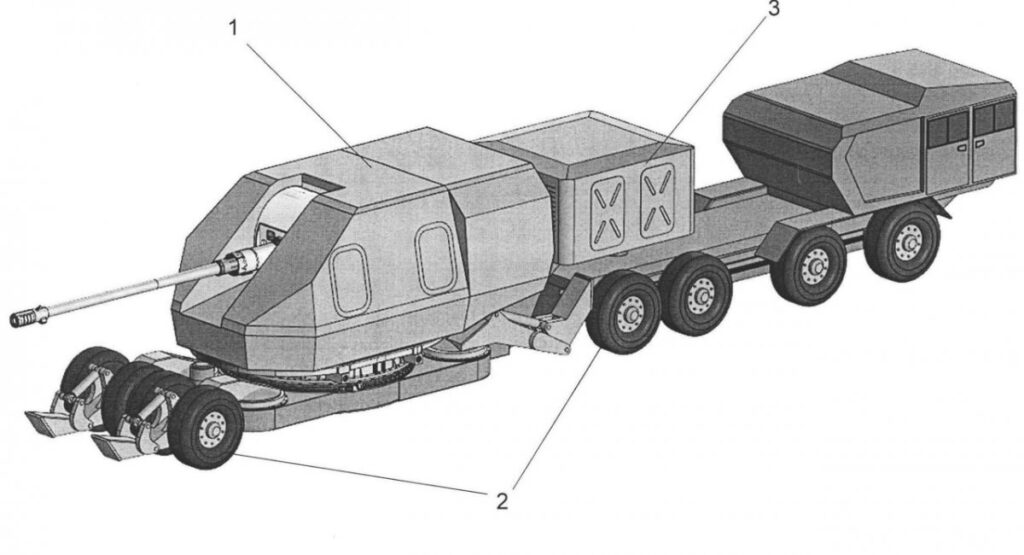
According to the patent, the artillery system is mounted on a heavy multi-axle trailer rather than on a conventional self-propelled chassis.
Once the trailer reaches its firing position, four hydraulic stabilizers lower the platform onto the ground, absorbing recoil during firing and providing the stability required for a high-caliber weapon.
One of the most interesting aspects of the design is its automated loading mechanism. The patent describes a pendulum-style ammunition feed system intended to preserve the rapid rate of fire associated with naval artillery while minimizing crew involvement during loading operations.
Essentially, the engineers are attempting to bring the automation and sustained fire capability of a modern warship gun onto land.
Why the A-192M?
Although the A-192M is not a new weapon, it remains one of Russia’s most advanced naval artillery systems.
Technical Specifications
- Caliber: 130 mm
- Weight: approximately 25 tons
- Maximum firing range: around 23 km with conventional ammunition
- Automatic loading system
- Compatible with the existing family of 130 mm naval ammunition
Its relatively compact size is perhaps its greatest advantage.
The older AK-130 twin mount weighed nearly 90 tons, making any mobile land adaptation virtually impossible. By comparison, the significantly lighter A-192M offers much greater flexibility for coastal defense applications.
Why Build Another Coastal Gun?
At first glance, the project raises an obvious question.
Russia already operates Bastion and Bal coastal missile systems, both capable of engaging hostile naval targets at long range.
So why develop another artillery platform?
The answer is cost.
Anti-ship missiles are extremely expensive. Using them against small landing craft, unmanned surface vessels, or lightly armed patrol boats may not always be economically justified.
Artillery shells, on the other hand, are dramatically cheaper and allow sustained fire without consuming valuable missile inventories.
For this reason, coastal artillery has not disappeared entirely. Several countries continue to maintain gun-based coastal defense systems alongside modern missile batteries.
A Patent Is Not a Production Vehicle
Despite the attention the project has received, it is important to separate engineering concepts from actual procurement.
At this stage, the system exists only as a registered patent.
There is no publicly available evidence that a working prototype has been built, that firing trials have begun, or that the Russian Ministry of Defense has committed funding for serial production.
Military history is filled with promising concepts that never progressed beyond the patent office.
The trailer-based configuration also presents practical challenges. While it reduces development costs compared to a fully self-propelled vehicle, it also limits mobility, increases deployment time, and requires a heavy tractor vehicle as well as carefully prepared firing positions.
Conclusion
The new patent demonstrates that Russia continues to explore relatively inexpensive ways of strengthening its coastal defenses by adapting existing naval technology for land use.
From an engineering standpoint, the concept is logical. The A-192M is already in production, uses standardized ammunition, and incorporates a proven automatic loading system.
Whether this patent eventually becomes a fielded weapon is another question entirely.
Until a prototype appears and testing begins, the project should be viewed as an interesting concept rather than an imminent addition to Russia’s coastal defense forces.
If it does reach operational service, however, it would represent one of the most unusual attempts in recent years to give traditional coastal artillery a new role in an era dominated by missiles, drones, and precision-guided weapons.