Some weapons eventually become more than just weapons.
Their names turn into symbols of an era.
For Americans, the Colt Single Action Army revolver became such a symbol. For the British, it was the Lee-Enfield rifle. For Soviet soldiers, it was the Kalashnikov assault rifle.
For the United States Marine Corps, that symbol became the KA-BAR.
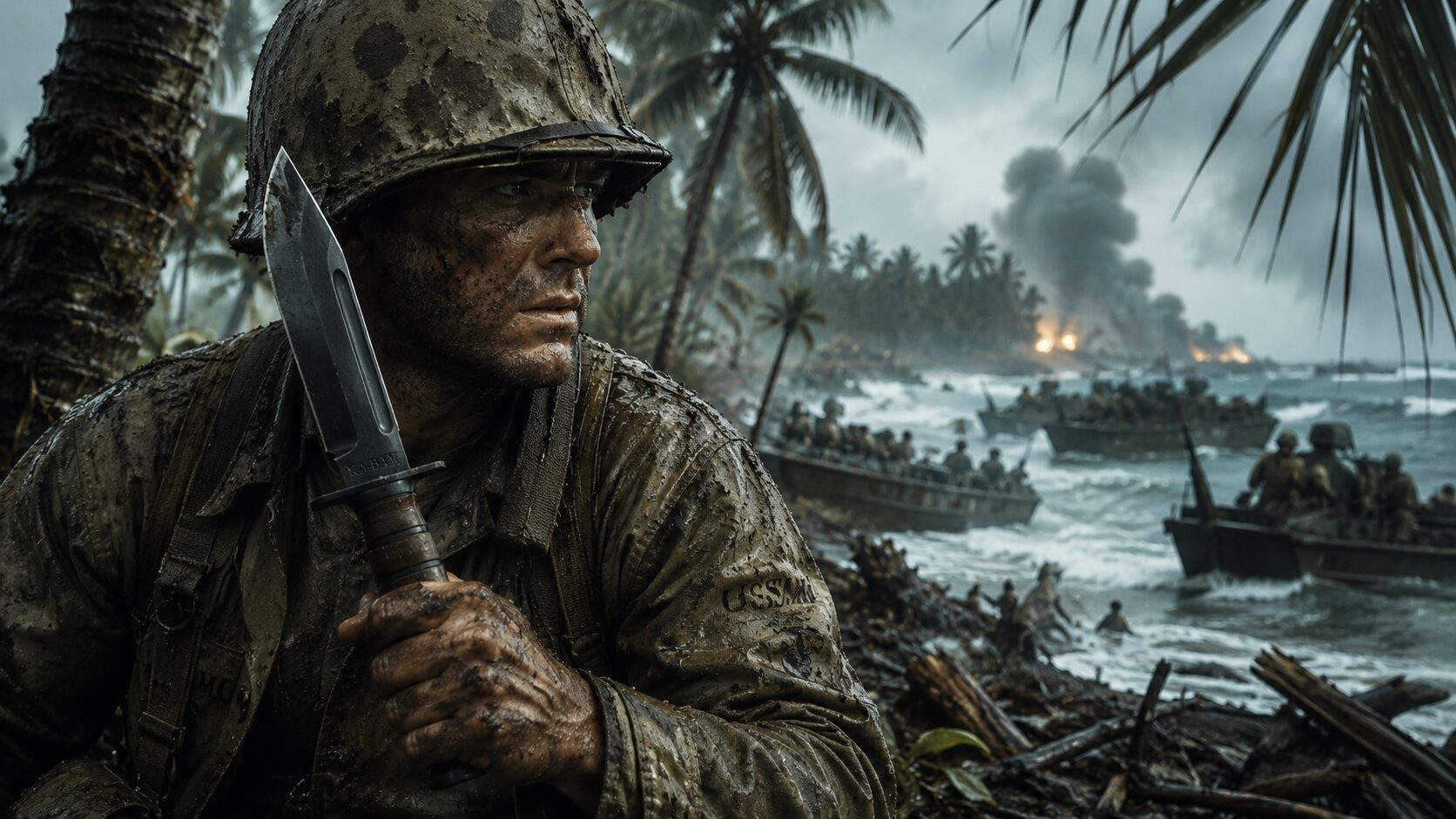
Over more than eighty years of service, it has passed through the jungles of the Pacific, the frozen hills of Korea, the rice paddies of Vietnam, the deserts of Iraq, and the mountains of Afghanistan. It was carried by Marines on Guadalcanal and in Fallujah. It was used to cut vines, open ammunition crates, breach wire obstacles, and, when necessary, fight in close combat.
What makes the story remarkable is that the KA-BAR was never designed to become a legend.
It was created to solve a very practical problem: American soldiers were dissatisfied with the knives they had.
When the Bayonet Was No Longer Enough
At the beginning of World War II, the United States possessed an impressive arsenal of firearms, but its situation regarding combat knives was far less satisfactory.
Technically, every soldier had a bayonet.
The problem was that a bayonet was designed for a rifle first and foremost.
It was awkward for everyday tasks.
Its long blade was cumbersome to carry.
It was poorly suited for cutting brush, preparing food, opening crates, or performing routine camp duties.
There was also the famous M1918 Trench Knife, a fearsome weapon inherited from World War I. However, it had been designed almost exclusively for killing an enemy in the confines of a trench. As a general-purpose field tool, it was nearly useless.
The problem became especially apparent in the Pacific Theater.
In the jungles of the Solomon Islands and New Guinea, soldiers often had to hack their way through dense vegetation. They needed a tool capable of performing dozens of different tasks.
The U.S. military began looking for a new knife.
And eventually found one.
The Birth of a Legend
In 1942, the United States Marine Corps issued requirements for a new combat knife.
It needed to be strong enough for hard field use.
Practical enough for everyday work.
And effective as a weapon when required.
Designers borrowed elements from several commercial hunting knives already available on the market.
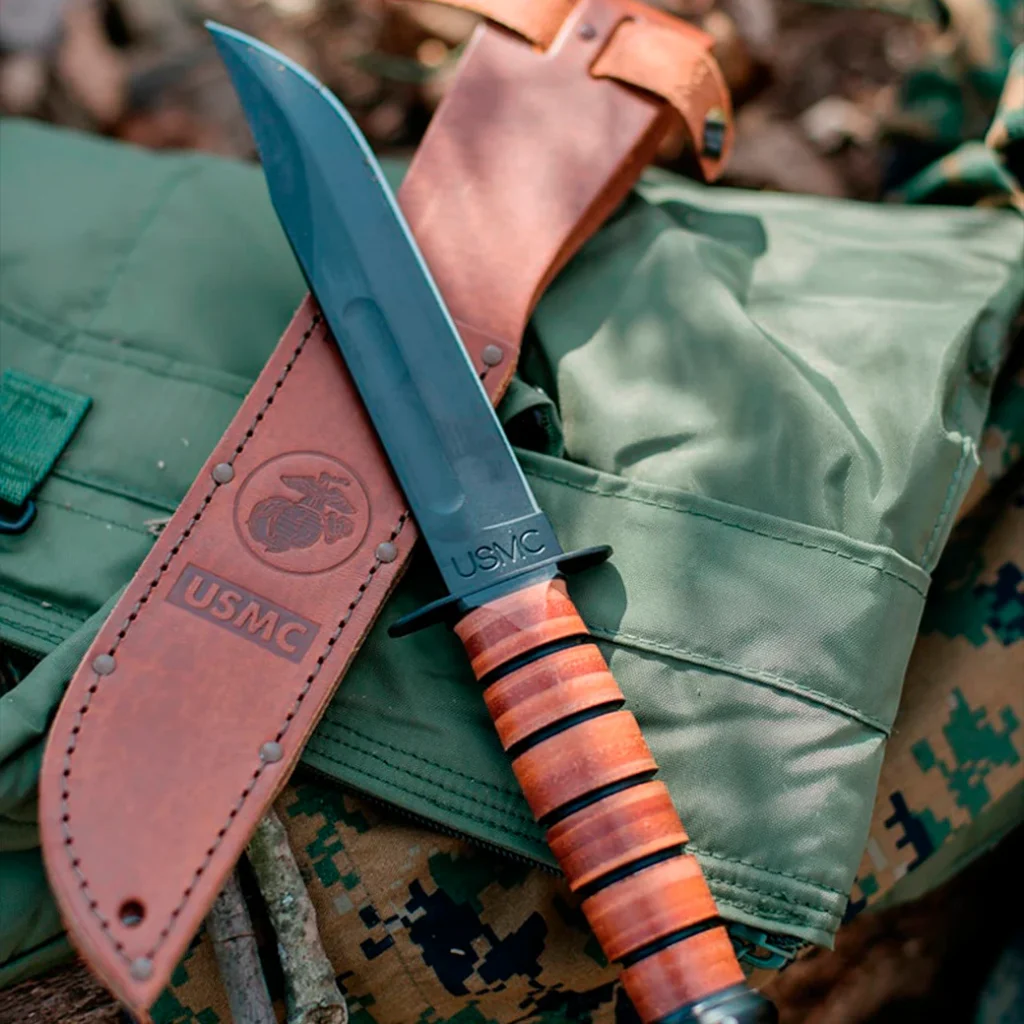
The result was the USMC Mark 2 Combat Knife.
It would later become known throughout the world as the KA-BAR.
The origin of the name remains surrounded by legend.
The most famous story involves a letter sent by a hunter thanking the company for a knife that had helped him kill a bear. Because the letter was damaged and the handwriting poor, only part of the phrase could supposedly be read: “KA BAR.”
Historians still debate whether the story is true.
But the name proved so memorable that it eventually became more famous than the knife’s official designation.
A Simple Design That Turned Out to Be Brilliant
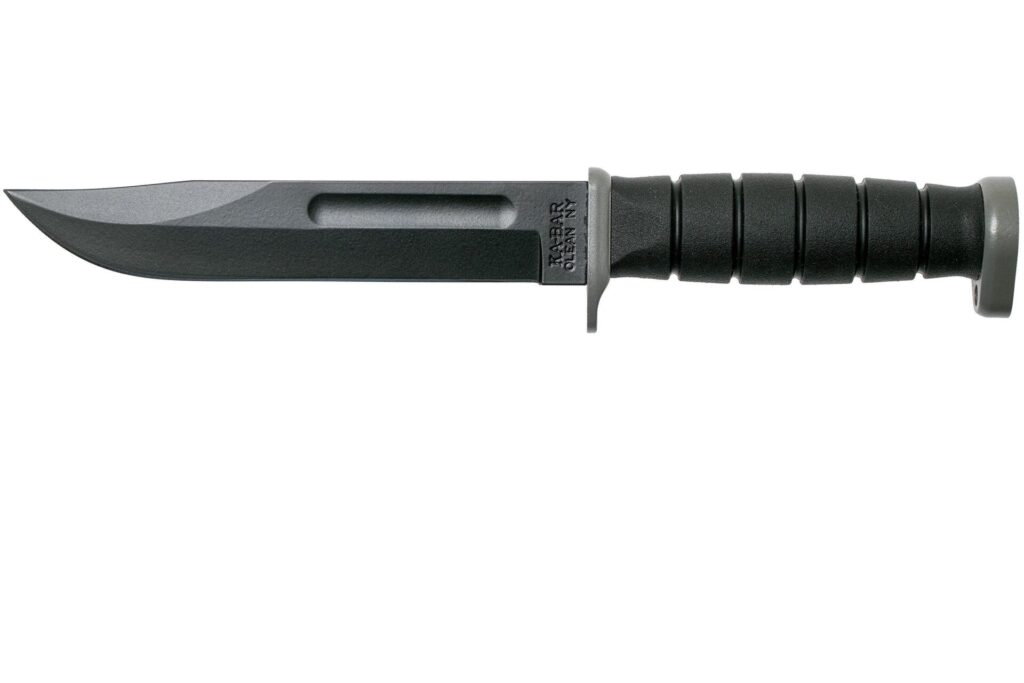
At first glance, the KA-BAR does not look revolutionary.
There are no complicated mechanisms.
No exotic materials.
No unusual engineering solutions.
That simplicity was precisely its greatest strength.
The blade measured approximately seven inches, or 178 millimeters.
That was enough length for both utility work and combat use.
The blade was made from 1095 carbon steel.
By modern standards it is a relatively simple steel, but it offers two important advantages: it is easy to sharpen and highly resistant to impact.
The clip-point blade profile provided an excellent balance between cutting and thrusting capability.
The knife could cut, chop, and stab with equal confidence.
The handle was constructed from stacked leather washers.
Today this may seem old-fashioned, but during wartime it proved almost ideal.
Cheap.
Reliable.
Easy to manufacture.
Comfortable even when wet.
A small steel guard protected the hand without turning the knife into a specialized fighting weapon.
The result was a tool equally at home in a field kitchen or a close-quarters battle.
The Ultimate Test in the Pacific
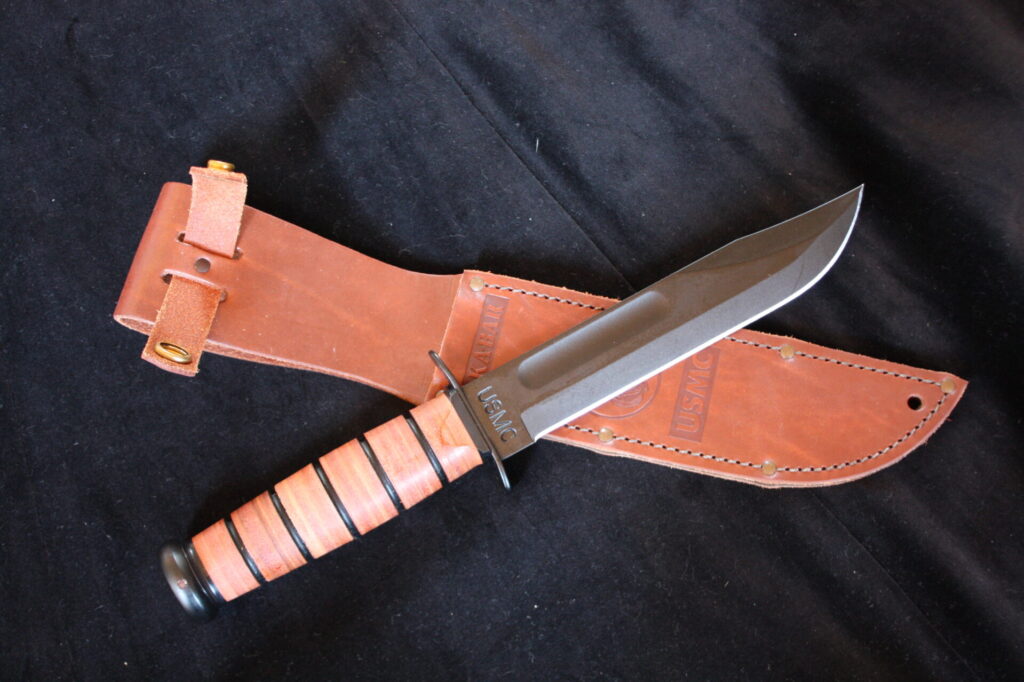
Every weapon must eventually prove itself in war.
For the KA-BAR, that test came in the Pacific.
Guadalcanal.
Tarawa.
Saipan.
Peleliu.
Iwo Jima.
On each of these islands, Marines used their knives every day.
Interestingly, most of the time the knife was not used as a weapon.
Soldiers cut roots.
Opened wooden crates.
Sliced rope.
Processed captured equipment.
Built shelters.
Opened ration cans.
Many veterans’ accounts give the impression that the knife was used for everything except its official purpose.
It was during these campaigns that the KA-BAR earned its reputation as a universal survival tool.
If a Marine could carry only one knife, this was the one he wanted.
The Knife That Refused to Retire
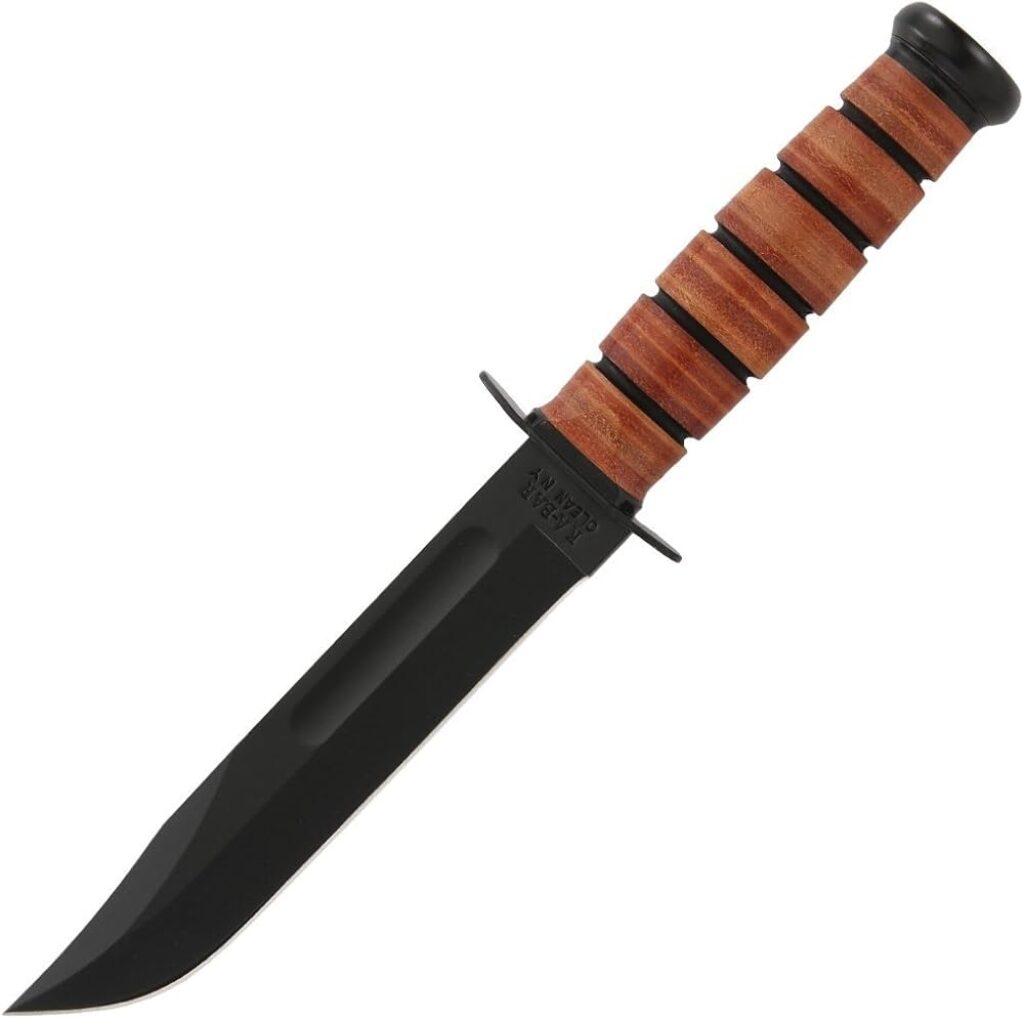
After World War II, many military weapons quickly disappeared into museums.
The KA-BAR did not.
The reason was simple.
It continued to do its job extremely well.
It remained useful during the Korean War.
Then came Vietnam.
After Vietnam came Lebanon, Grenada, Panama, and Somalia.
In the twenty-first century, the knife returned to combat with American troops in Afghanistan and Iraq.
During those decades, the world changed dramatically.
Satellites appeared.
Drones emerged.
Precision-guided weapons transformed warfare.
Digital battlefield management systems became commonplace.
Yet the knife remained almost unchanged.
For any designer, that is the highest compliment possible.
Myths About the Legend
Over the decades, numerous myths have grown around the KA-BAR.
The first claims that it is the greatest combat knife ever made.
The truth is more complicated.
There are stronger knives.
There are knives better suited specifically for fighting.
There are specialized designs that outperform the KA-BAR in individual roles.
Its strength was never absolute superiority.
Its strength was versatility.
Another myth suggests that the knife was designed solely for killing.
That is not entirely accurate.
From the beginning, designers envisioned it as a multipurpose field tool.
Its combat role was important, but it was never the only consideration.
A third myth claims that every American serviceman carries a KA-BAR.
In reality, the knife is primarily associated with the United States Marine Corps.
That is where it became an enduring symbol.
Why the KA-BAR Still Exists
The fate of most military knives is predictable.
After a few years, a new model appears.
Then another.
And another.
Older designs gradually fade away.
That never happened to the KA-BAR.
It proved to be an exceptionally successful compromise.
Large enough to function as a weapon.
Practical enough to serve as a tool.
Strong enough for demanding work.
Affordable enough for mass production.
The combination was so effective that more than eighty years later, the knife is still manufactured in a form remarkably close to the original.
Many modern owners never use it for military purposes at all.
They buy a KA-BAR because they are purchasing more than a knife.
They are purchasing a piece of history.
A Legend in a Sheath
Over decades of service, the KA-BAR has accompanied multiple generations of soldiers.
It witnessed the jungles of Guadalcanal and the frozen hills of Korea.
It passed through the rice fields of Vietnam and the deserts of the Middle East.
It survived the Cold War, the collapse of the Soviet Union, and the rise of drone warfare.
Few pieces of military equipment can boast such a biography.
Perhaps that is why the KA-BAR has long ceased to be merely a knife for the American Marine.
It has become a symbol.
As recognizable as the Eagle, Globe, and Anchor emblem of the United States Marine Corps.
And judging by its continued popularity, this old knife has no intention of fading into history anytime soon.