
China’s “Bohai Sea Monster” Has Returned — And Now It Looks Like a Missile Carrier From the Future

This material is based on reporting by The War Zone, Defense Blog, analysis by H.I. Sutton, and other open sources.
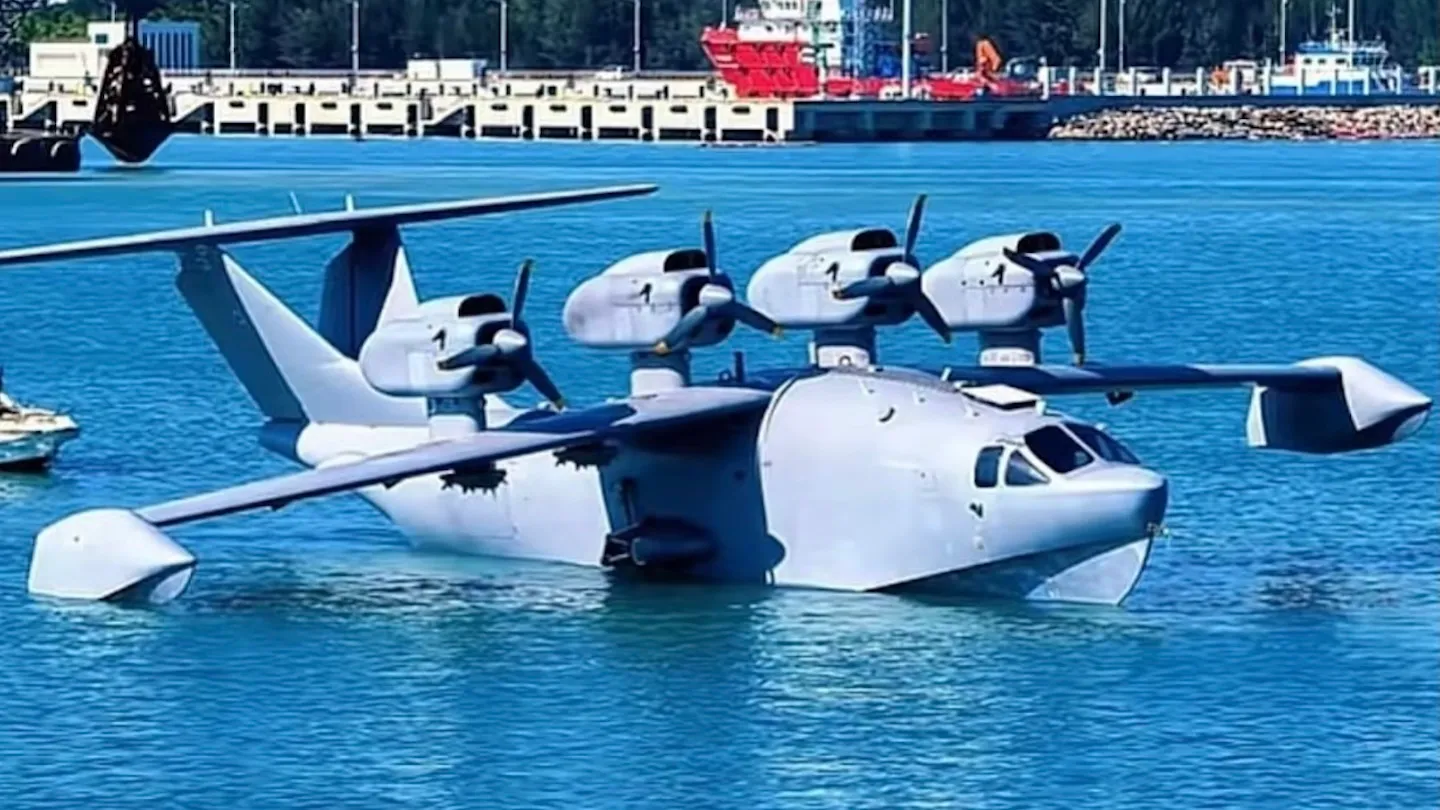
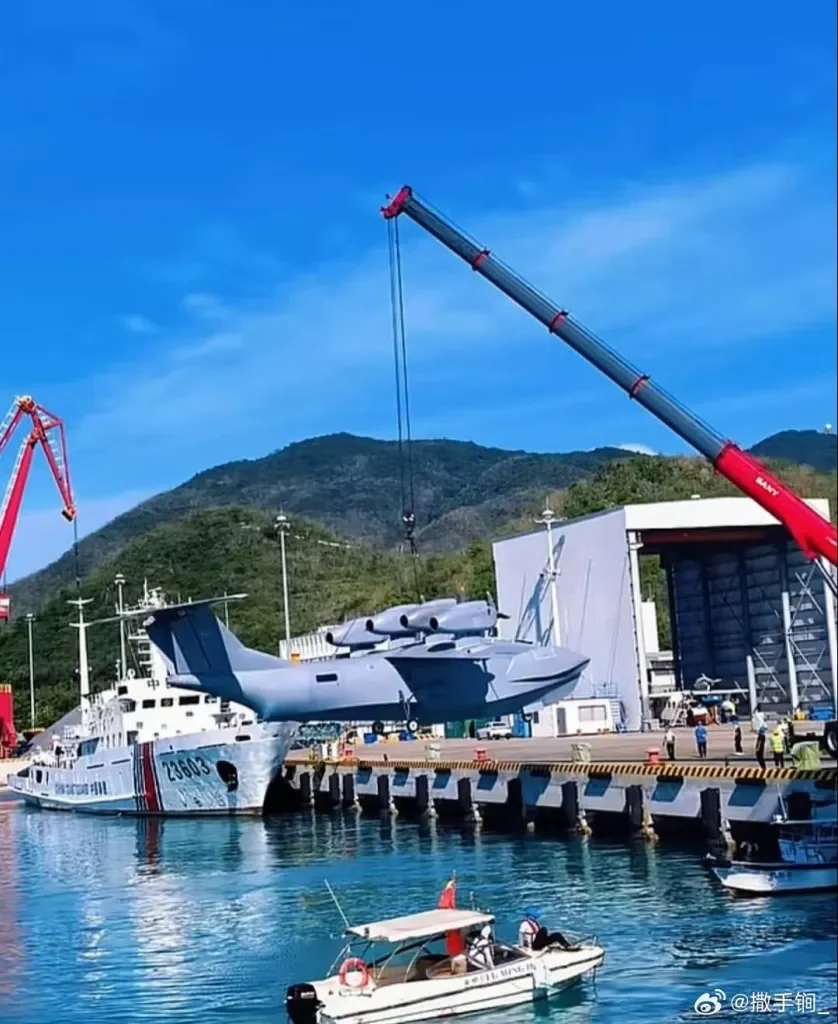
China’s mysterious ekranoplan known unofficially as the “Bohai Sea Monster” has reappeared in new photographs — and now it appears increasingly likely that this is not simply some strange experimental transport aircraft. Fresh images reveal what seem to be full underwing hardpoints, immediately raising the obvious question: is China trying to revive one of the Cold War’s most bizarre military concepts — the armed ekranoplan?
And if that is indeed the case, the story becomes far more interesting than simply another exotic Chinese prototype.
Because ekranoplans have always felt like machines from an alternate timeline. Giant vehicles skimming just meters above the sea at aircraft-like speeds while remaining below the radar horizon. In the Soviet Union, they were once viewed as potential weapons of the future naval war. Then the Soviet Union collapsed — and with it, the entire concept appeared to die as well.
But now it seems China may be trying again.
The Strangest Machines of the Cold War
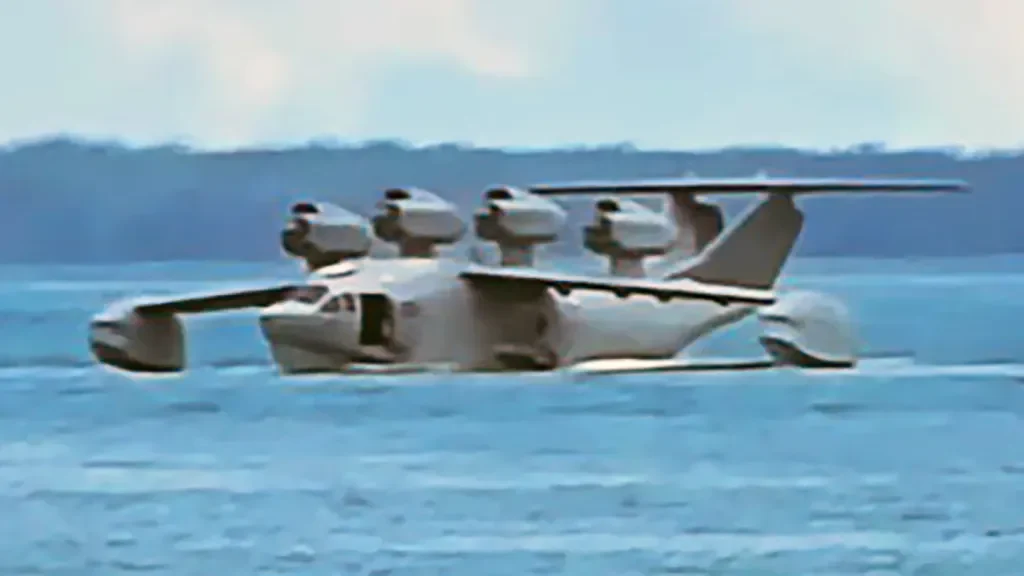
The history of ekranoplans has always looked like a mixture of engineering brilliance and technical madness.
The concept itself emerged in the early 20th century, but it was the Soviet Union that transformed it into something almost mythical. Soviet engineers became fascinated with the so-called “ground effect” — the phenomenon in which an aircraft flying very close to the surface gains additional lift thanks to the compressed air cushion between the wing and the water.
The result was an extremely strange machine.
Not quite an airplane.
Not quite a ship.
And not exactly a hovercraft either.
An ekranoplan could skim across the sea at hundreds of kilometers per hour while remaining only a few meters above the surface. More importantly, it could stay below the radar horizon of many naval systems.
During the Cold War, that looked almost like the perfect breakthrough weapon.
That is why the Soviet Union began building gigantic machines such as the KM — the famous “Caspian Sea Monster,” which shocked American intelligence analysts so much that the CIA initially struggled to understand what they were seeing in satellite imagery. Later came the Lun-class ekranoplan — essentially a flying anti-ship missile carrier.
Then the Soviet Union collapsed.
And with it, most Soviet ekranoplan programs disappeared as well.
China Is Unexpectedly Reviving an Old Soviet Dream
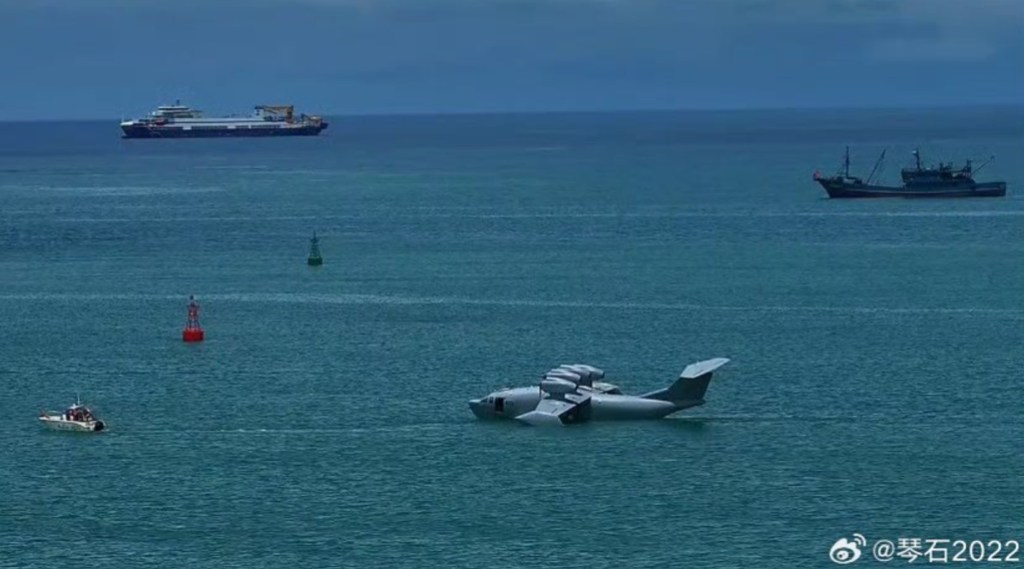
The first images of the “Bohai Sea Monster” emerged back in 2025. Analyst H.I. Sutton noticed an extremely unusual vehicle at a Chinese pier — a machine with a flying-boat hull, enormous V-tail, and high-mounted wing.
At first, many observers could not even determine what exactly they were looking at.
Some believed it was a seaplane.
Others thought it was a transport platform.
Still others assumed it was simply a technology demonstrator.
But the new photographs have dramatically changed perceptions of the project.
Now visible are:
— four turboprop engines,
— full propellers,
— and most importantly, underwing pylons designed for external payloads.
And this is where things become especially interesting.
Because transport aircraft generally do not require weapons hardpoints under their wings.
Anti-ship strike platforms, however, absolutely do.
A Small “Lun” for the 21st Century
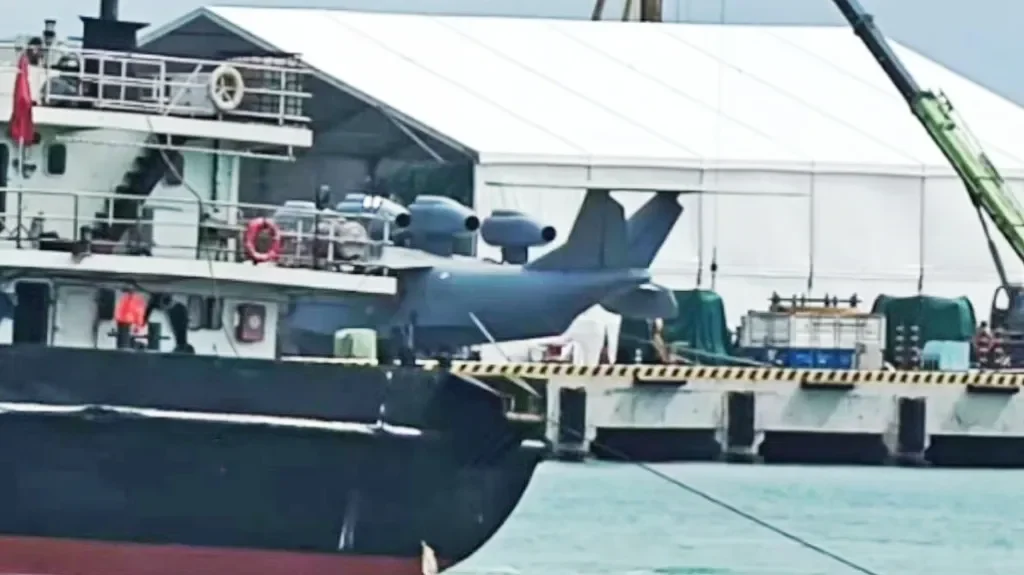
Technically, the Chinese ekranoplan looks unusual even by modern standards.
The aircraft uses a WIG — Wing-In-Ground effect — configuration. In other words, it flies only a few meters above the water, exploiting ground effect to increase lift and reduce fuel consumption.
The design includes:
— a flying-boat hull,
— a high-mounted wing,
— wingtip sponsons,
— a combined V-tail,
— and four turboprop engines with three-blade propellers.
The shift toward turboprop propulsion is particularly interesting.
Earlier, many analysts assumed China might use jet engines similar to those of the Soviet Lun-class ekranoplan. But a turboprop configuration makes much more sense for a modern operational concept:
— lower fuel consumption,
— greater range,
— easier maintenance,
— lower infrared signature,
— and significantly better efficiency for long-duration patrol missions.
In effect, China appears to be building not a Cold War “monster,” but a far more practical and flexible platform.
Why Would China Even Need an Ekranoplan?
And this leads to the central question.
Why would Beijing pursue such an unusual platform in an era dominated by satellites, drones, and hypersonic missiles?
The answer likely lies in the geography of the Pacific.
For China, the primary potential conflict zones today include:
— Taiwan,
— the South China Sea,
— island chains,
— and vast maritime regions with relatively limited airfield infrastructure.
And an ekranoplan suddenly begins to make sense in exactly that kind of war.
Such a platform could potentially:
— rapidly transport cargo,
— operate between islands,
— fly below portions of radar coverage,
— bypass certain naval mine threats,
— and potentially function as a carrier for missiles, drones, or anti-submarine weapons.
The newly observed hardpoints especially suggest a strike role.
Theoretically, a platform of this size could carry:
— lightweight anti-ship missiles,
— torpedoes,
— depth charges,
— reconnaissance pods,
— or even strike drones.
In many ways, China may be attempting to create a kind of “maritime strike drone carrier” — a platform optimized for rapid coastal warfare.
A Machine Between Aircraft and Warship
Perhaps the most fascinating aspect of the entire story is something else.
For decades, ekranoplans were considered a technological dead end.
Too complicated for navies.
Too limited for aviation.
Too dependent on weather.
And too vulnerable in serious warfare.
But modern strategic realities are gradually changing perceptions.
Today, militaries are once again searching for:
— low-cost logistics solutions,
— platforms optimized for Pacific warfare,
— methods of reducing radar exposure,
— and carriers for distributed strike systems.
And suddenly, the ekranoplan no longer looks entirely obsolete.
It is no coincidence that the United States explored similar ideas under DARPA’s Liberty Lifter program before it was eventually canceled.
China, however, appears determined to push further.
The Return of the “Sea Monsters”
It is still impossible to say with certainty whether the “Bohai Sea Monster” will become a fully operational combat platform or remain merely an experimental technology demonstrator.
But the very fact that it exists is already highly revealing.
Because China increasingly appears interested in pursuing asymmetric military solutions rather than simply copying American hardware.
And the ekranoplan fits that philosophy remarkably well.
It is a machine designed for a very specific kind of warfare:
— fast,
— maritime,
— networked,
— and optimized for the enormous spaces of the Pacific Ocean.
Most importantly, it represents the return of a concept the world considered dead for nearly thirty years.
And perhaps that is exactly why the Chinese “Bohai Sea Monster” has generated so much fascination.
Because it no longer looks like technology from the past.
It looks like a very strange piece of the future.






