The history of aviation is filled with legendary machines: the elegant Spitfire, the agile Messerschmitt, and the mighty B-17 Flying Fortress. However, if we look at the raw statistics and the sheer impact on the outcome of the largest land battles in history, one aircraft stands above all others.
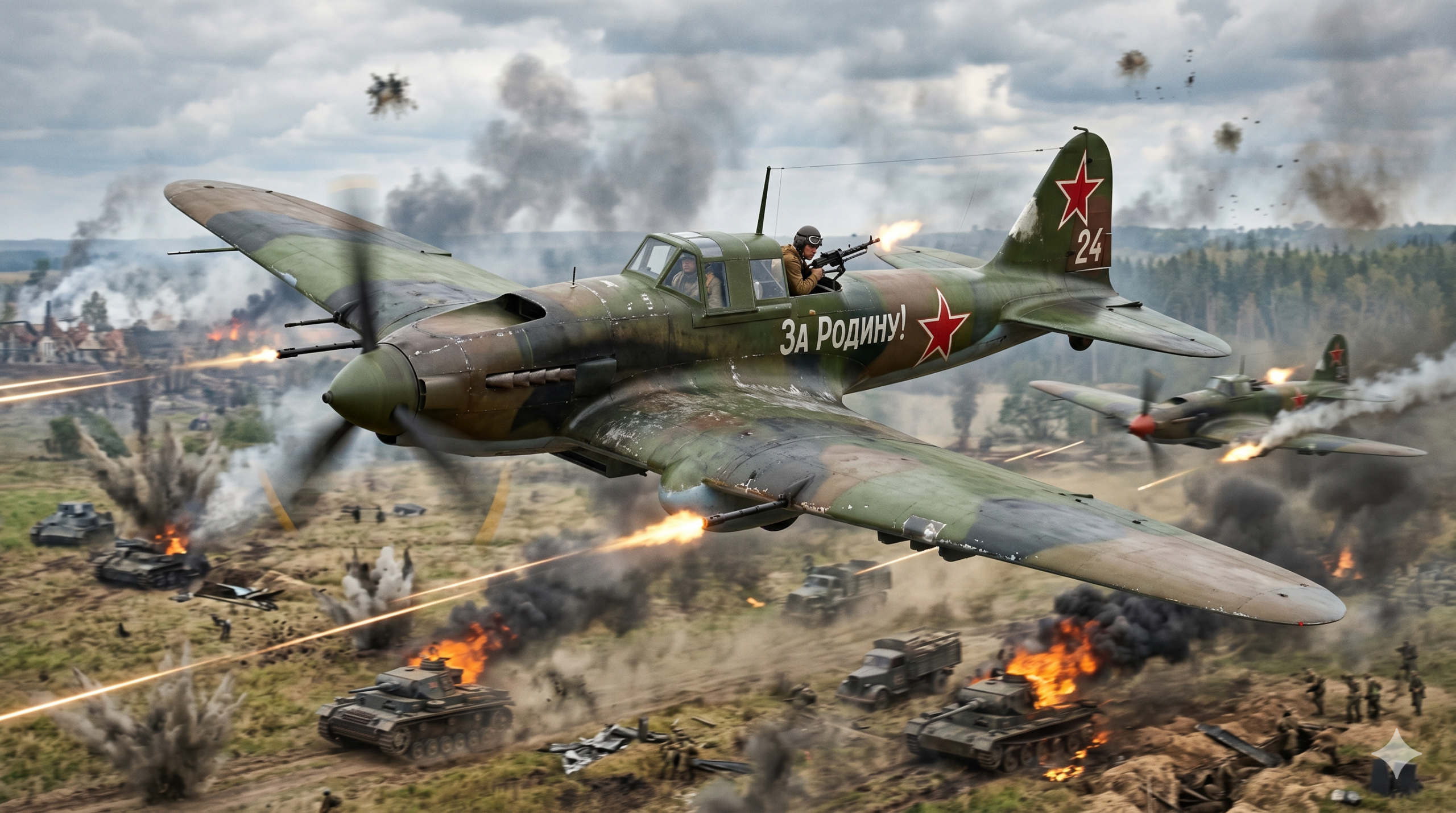
The Ilyushin Il-2, famously known as the Sturmovik, holds the title of the most mass-produced combat aircraft in history. With 36,183 units manufactured during the war, it became the backbone of the Soviet Air Force and a symbol of the industrial might of the USSR.
The Philosophy of the “Flying Tank”
In the late 1930s, designer Sergey Ilyushin proposed a revolutionary concept. Unlike other designers who treated armor as an “add-on” to protect the pilot, Ilyushin made the armor an integral part of the aircraft’s load-bearing structure.
The front and center sections of the Il-2 were built as a monolithic armored shell (often called the “armored bathtub”). This shell protected:
- The engine and radiators.
- The fuel tanks.
- The pilot’s cockpit.
This design turned the Il-2 into a literal “flying tank.” While conventional fighters would be shredded by machine-gun fire, the Il-2 could absorb dozens of hits and keep flying. German pilots and anti-aircraft gunners, frustrated by its resilience, nicknamed it the “Concrete Plane” (Betonflugzeug) and “Iron Gustav.”
“The Black Death” and the Reality of War
German ground troops feared the appearance of the Il-2, calling it the “Black Death” (Schwarzer Tod). The Sturmovik operated at extremely low altitudes—often just 5 to 10 meters above the ground. This allowed it to appear suddenly, striking with cannons, rockets, and specialized anti-tank bombs.
During the Battle of Kursk, the Il-2 became a nightmare for German panzer divisions. They utilized PTAB (anti-tank submunitions), which could saturate an entire column of vehicles, punching through the thinner top armor of Tiger and Panther tanks.
However, this glory came at a heavy price. Early versions were single-seaters, leaving them vulnerable to attacks from the rear. To fix this, a second seat for a rear gunner was added. The statistics for these gunners were grim: on average, for every pilot killed, seven rear gunners perished. They had less armor protection and were the primary targets for German interceptors.
Industrial Heroism: “As Necessary as Bread”
The astronomical production numbers were the result of a total mobilization of the Soviet home front. When factories were evacuated east in 1941, production temporarily slowed. This prompted Joseph Stalin to send a famous, blunt telegram to factory directors:
“The Il-2 aircraft are as necessary to our Red Army now as air, as bread… It is a mockery of our country and the Red Army. I ask you not to try the government’s patience and demand that you manufacture more Il-2s.”
The workers, many of whom were women and teenagers, performed the impossible. By 1943, factories were churning out dozens of planes every single day.
World War II Production Comparison
| Aircraft Model | Country | Role | Approx. Units Produced |
| Ilyushin Il-2 | USSR | Ground Attack | 36,183 |
| Messerschmitt Bf 109 | Germany | Fighter | 34,852 |
| Supermarine Spitfire | UK | Fighter | 20,351 |
| P-51 Mustang | USA | Fighter | 15,875 |
The Legacy
The Il-2 was not the fastest or the most maneuverable aircraft of the war. It was, however, the perfect tool for a war of attrition. It was easy to fly, incredibly durable, and possessed enough firepower to halt a tank offensive.
Today, the Il-2 remains a testament to the grit of the 1940s. Only a handful of these machines remain in flying condition today, mostly reconstructed from wreckage found in forests and marshes. Each time one takes to the sky, it serves as a moving memorial to the pilots who flew them and the workers who built them under the harshest conditions imaginable.