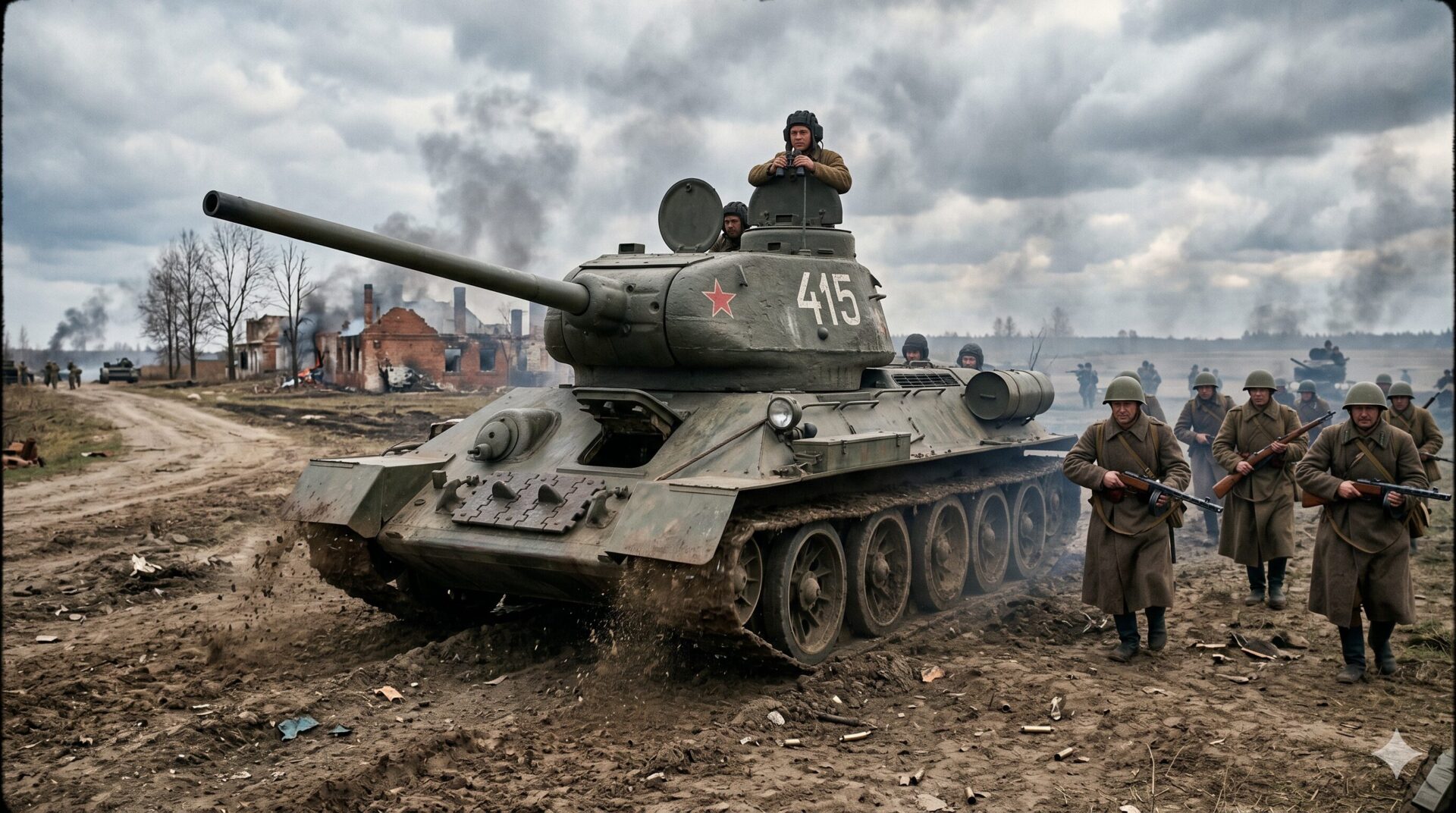
The T-34 tank is more than just a piece of military hardware; it is a symbol of an era, the quintessence of Soviet engineering, and one of the most recognizable silhouettes in the history of global tank design. Its appearance on the battlefields of World War II was a profound shock to the enemy and a turning point that defined the concept of the “Main Battle Tank.”
Below is a detailed analytical review of the history, construction, combat application, and legacy of this legendary machine.
Chapter 1: The Birth of a Legend – From BT to A-32
The history of the T-34 began in the mid-1930s when it became evident that the concept of “fast tanks” (the BT series) had exhausted its potential. The primary drawbacks of the BT series were its thin armor and the complex wheel-and-track drive system, which provided speed on highways but was unnecessarily fragile in off-road conditions.
Mikhail Koshkin and the “Universal Tank” Concept
In 1937, the Design Bureau of the Kharkiv Plant No. 183 was headed by Mikhail Koshkin. He was tasked with creating a tank that combined the mobility of the BT series with heavy armor and serious firepower.
The initial project, the A-20, still retained the wheel-and-track system. However, Koshkin simultaneously pushed for the A-32, a pure-track design. Koshkin’s main argument was that abandoning the wheels would save weight, which could then be used to thicken the armor.
The Legendary Run
In March 1940, two T-34 prototypes set off on a grueling test run from Kharkiv to Moscow. It was a brutal trial: the tanks traveled under their own power through deep snow and mud. Koshkin personally participated, which severely damaged his health (he contracted pneumonia and died shortly after), but the tanks proved their reliability. In the Kremlin, Joseph Stalin personally approved the machine, famously calling it a “swallow.”
Chapter 2: Technological Breakthrough – Why Was the T-34 Superior?
By 1941, the T-34 had no equal in its overall balance of characteristics. The secret lay in the “Golden Triangle”: Firepower — Protection — Mobility.
1. Rational Armor Sloping
This was the T-34’s most significant innovation. Instead of simply increasing the thickness of the steel plates, Soviet engineers placed the armor at sharp angles.
- The Effect: When a shell hit, its trajectory was often deflected (ricochet), and the “effective thickness” of the armor nearly doubled. A 45mm front plate provided protection equivalent to almost 90mm of vertical armor.
2. The V-2 Diesel Engine
While most tanks of the era (including the German Panzer III and IV) ran on gasoline, the T-34 was equipped with the 12-cylinder V-2 diesel engine producing 500 hp.
- Advantages: Diesel is less flammable than gasoline, reducing the risk of fire. The engine provided immense torque and was fuel-efficient, giving the tank an impressive range of 300–400 km.
3. Wide Tracks
The T-34 had low ground pressure. Where German tanks with their narrow tracks bogged down in the Russian “Rasputitsa” (mud season), the T-34 maneuvered with confidence.
4. Firepower
In 1941, the 76mm F-34 gun was exceptionally powerful. It could destroy any German tank from a distance of over a kilometer, while German fire was often ineffective until they closed to a dangerous 300–500 meters.
Chapter 3: Trial by Fire (1941–1942)
1941: Shock for the Panzerwaffe
When German units first encountered the T-34 near Grodno and Mtsensk, it triggered “Tank Panic.” General Heinz Guderian noted in his memoirs that the T-34 was vastly superior to German machines. The German 37mm anti-tank guns (nicknamed “door knockers”) were powerless against its armor.
1942: Evacuation and “Tankograd”
The T-34’s genius also lay in its manufacturability. When Ukraine was occupied, production was moved to the Urals (Uralvagonzavod) and Gorky (Sormovo). The design was simplified to the absolute limit so it could be assembled by women and teenagers in factories.
- Innovations like automatic submerged arc welding (the Paton method) allowed for rapid hull construction.
- Non-essential features were stripped away to maximize output.
This allowed the USSR to produce thousands of tanks monthly, while Germany focused on complex, expensive, and time-consuming “Tigers.”
Chapter 4: Modernization – The T-34-85
By 1943, the situation had changed. The arrival of the German “Tiger” and “Panther” tanks meant the 76mm gun could no longer penetrate enemy armor head-on. Additionally, the T-34-76 had a major ergonomic flaw: a cramped two-man turret where the commander also acted as the gunner.
The result was the T-34-85:
- New Gun: The 85mm S-53 gun allowed the T-34 to engage Tigers on equal footing.
- Three-Man Turret: The turret now housed a commander, gunner, and loader. This finally allowed the commander to focus on his primary job: tactical leadership.
- Vision: A commander’s cupola was added to provide 360-degree visibility.
This version became the pinnacle of the series and led the charge from the Kursk Bulge all the way to Berlin.
Chapter 5: Comparison with Contemporaries
| Feature | T-34-76 (1941) | Panzer IV Ausf. F | T-34-85 (1944) | Panther (Germany) |
| Weight (tons) | 26.5 | 22.3 | 32.2 | 44.8 |
| Gun (mm) | 76 | 75 (Short) | 85 | 75 (Long) |
| Front Armor | 45mm (Sloped) | 50mm (Vertical) | 90mm (Turret) | 80mm (Sloped) |
| Engine | Diesel | Gasoline | Diesel | Gasoline |
While the “Panther” technically outmatched the T-34 in armor and long-range accuracy, it was mechanically temperamental and prohibitively expensive. The T-34 won through mass production and field repairability.
Chapter 6: Honest Flaws
Despite its greatness, the T-34 was not perfect. Veterans often noted:
- Ergonomics: The interior was extremely cramped, significantly trailing Western counterparts.
- Transmission: Until 1943, the gearbox was notoriously difficult. Drivers sometimes had to use a hammer to shift gears, leading to rapid exhaustion.
- Optics: Early in the war, Soviet sights were inferior to Zeiss optics, making long-range engagements difficult.
Chapter 7: Post-War Service
The T-34’s journey didn’t end in Berlin. After 1945, the USSR exported thousands of tanks to its allies.
- Korean War: T-34-85s were the primary strike force for North Korea, initially overwhelming UN forces.
- Middle East: These tanks saw extensive action in the Arab-Israeli wars.
- The Balkans & Africa: Even in the 1990s, the T-34 was spotted in combat in Yugoslavia and Angola.
To this day, some countries (such as Vietnam and Laos) still keep these tanks in active service or reserve storage.
Conclusion
The T-34 was the Soviet response to a historical challenge. It was a machine born of immense national strain, a machine that broke the back of the Nazi war machine. It wasn’t the most armored or the most precise, but it was optimal. The T-34 represents the victory of common sense and mass production over over-engineering.
As one veteran put it: “A tank isn’t just iron. It’s our life, our home, and our shared victory.” The T-34 proved its right to be called the “Weapon of Victory” on the field of battle, leaving its track marks on human history forever.