Space Is No Longer a Safe Rear Area: The U.S. Has Officially Made Anti-Satellite Weapons a Top Priority

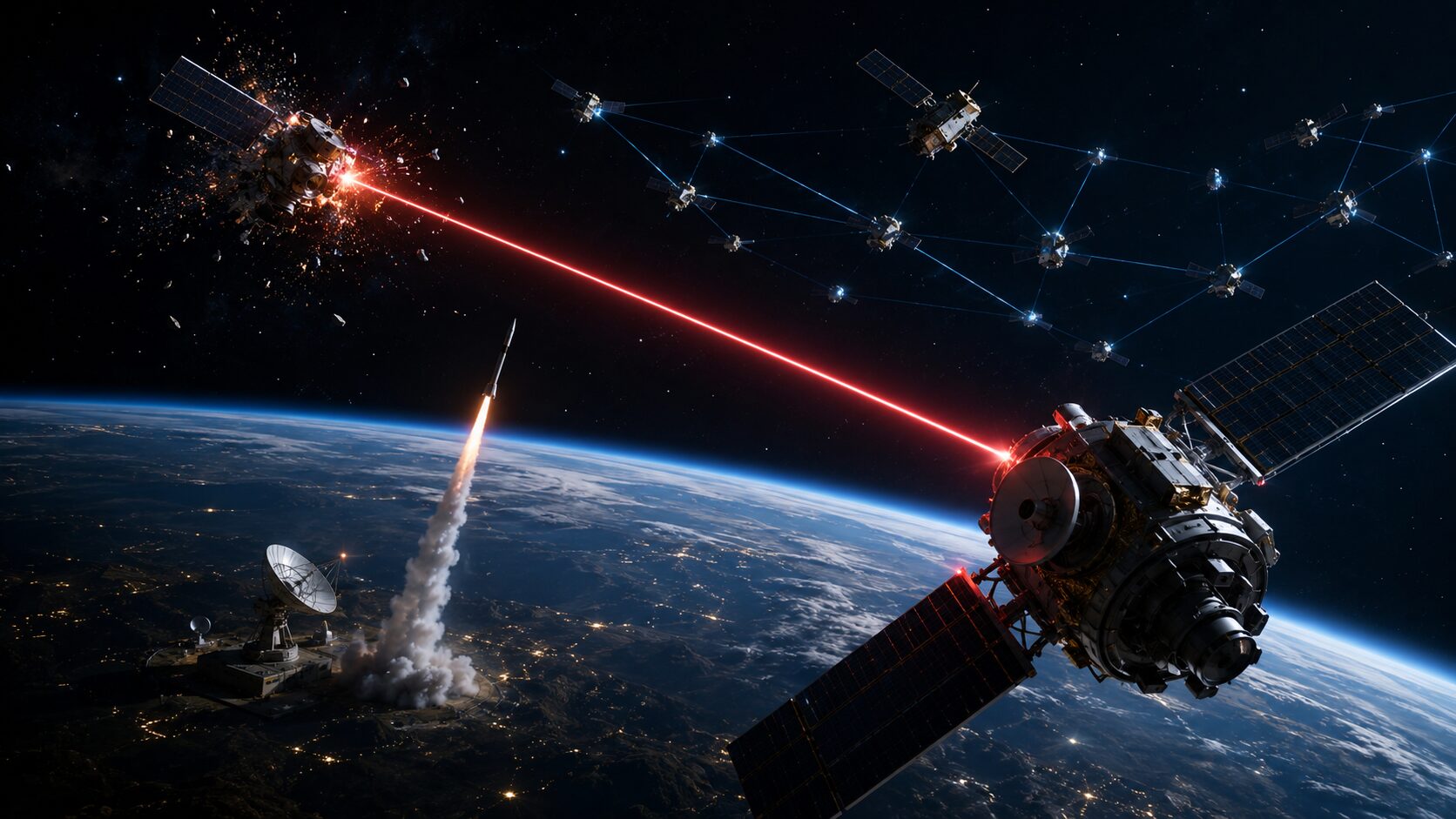
Until relatively recently, military satellites were viewed primarily as infrastructure. They observed the Earth, provided communications and navigation, detected missile launches, and transmitted data to forces operating below. Now, U.S. military leaders are effectively proposing that satellites be treated much more like combat assets.
General Stephen Whiting, head of U.S. Space Command, has said American space systems need to be able to “shoot, move, and communicate” much like forces operating in other domains. More importantly, the top two priorities on SPACECOM’s list for fiscal years 2029–2033 are integrated space fires and capabilities for countering proliferated constellations in low Earth orbit.
This marks an important threshold. Washington is no longer talking only about protecting its own satellites. Developing ways to affect an adversary’s spacecraft has now publicly become one of its highest military priorities.
The reason is straightforward. A modern military deprived of space support begins to lose a significant portion of its capabilities. Satellites provide positioning data, secure communications, missile warning, intelligence, surveillance, reconnaissance, and increasingly targeting information for long-range weapons.
Disabling an adversary’s satellites could therefore become just as important as destroying its airfields, radars, command posts, or communications centers.
There is only one problem: space itself has changed dramatically.
It Used to Be Enough to Shoot Down a Satellite. Now There May Be Thousands of Them
The traditional concept of an anti-satellite weapon is relatively simple. A ground-launched interceptor is fired into space, placed on an intercept trajectory, and physically destroys the target satellite.
The United States, China, Russia, and India have all demonstrated such capabilities in various forms.
But this approach has two serious disadvantages.
The first is cost.
Using an expensive interceptor against individual satellites makes sense when the enemy has relatively few of them. Modern space architecture, however, is increasingly shifting toward large distributed constellations in low Earth orbit — proliferated LEO, or pLEO.
Instead of dozens of spacecraft, there may be hundreds or even thousands.
Lt. Gen. Rick Zellmann, deputy commander of U.S. Space Command, described the problem in simple terms: if a system consists of 10,000 satellites, nobody is realistically going to attempt to destroy all 10,000 using individual direct-ascent anti-satellite missiles.
The attacker instead needs a one-to-many solution — a way to disrupt a significant part of the network with a relatively small number of actions.
The second problem is even more troublesome.
Physically destroying satellites creates debris.
And that debris does not immediately disappear.
China’s 2007 anti-satellite test and Russia’s 2021 test generated large debris clouds. According to the Secure World Foundation, anti-satellite tests conducted by the United States, Russia, China, and India have collectively generated thousands of catalogued fragments, many of which remain in orbit.
This creates an uncomfortable paradox: by destroying the enemy’s satellites, a country can also create a long-term threat to its own spacecraft.
For that reason, a future space war may look nothing like a spectacular series of exploding satellites.
Much of it could be almost invisible.
You Do Not Necessarily Have to Destroy a Satellite
To deny an adversary access to space-based services, a spacecraft does not necessarily need to be physically destroyed.
Its communications can be jammed.
Navigation signals can be disrupted.
Optical sensors can potentially be dazzled or damaged with lasers.
Ground control stations can be attacked.
Networks can be penetrated through cyber operations.
Another spacecraft can even maneuver close to the target.
This is why U.S. military officials increasingly discuss both kinetic and non-kinetic counterspace capabilities.
Kinetic weapons physically damage or destroy a target. Non-kinetic systems can potentially achieve a similar military effect while leaving the satellite itself intact.
That distinction is fundamental.
If an intelligence satellite stops transmitting imagery for several crucial hours during a military operation, it may not matter whether the spacecraft remains physically undamaged.
From the military perspective, the mission has been accomplished.
Such weapons can also offer major advantages over conventional anti-satellite missiles. Attribution may be more difficult, some effects can be reversible, and orbital space is not filled with thousands of additional debris fragments.
Secure World Foundation assessments indicate that non-destructive counterspace capabilities are already increasingly relevant, while physical destruction of enemy satellites has not become a routine feature of modern warfare.
Counterspace capabilities are now being developed across multiple categories, including co-orbital systems, direct-ascent missiles, electronic warfare, directed-energy systems, and cyber capabilities.
The United States Already Has an Official Anti-Satellite Weapon
Interestingly, the United States is not starting from zero.
The best-known publicly acknowledged offensive counterspace capability fielded by the U.S. military is the Counter Communications System, or CCS.
This is a ground-based electronic warfare system intended to disrupt an adversary’s satellite communications. The U.S. Space Force has continued upgrading this capability, including the newer Block 10.3 configuration associated with the Meadowlands system.
In photographs, such equipment looks considerably less dramatic than a futuristic orbital interceptor. It consists primarily of antennas, electronics, and ground-based support equipment.
But that is precisely the point.
A satellite does not necessarily need to be hit by a missile to be removed from the battle.
If the communications link between the spacecraft and its users can be disrupted, the military effect may be similar.
American officials have also hinted for years that the country possesses counterspace capabilities that remain classified. Exactly what those systems can do is naturally unknown, and Whiting did not disclose what future “integrated space fires” will actually look like.
What has changed is that expanding those capabilities is now publicly near the very top of SPACECOM’s priority list.
Why China Worries Washington So Much
China is the main explanation repeatedly cited by U.S. military officials.
The scale of Beijing’s expansion in space has been remarkable.
According to Lt. Gen. Gregory Gagnon, when Xi Jinping came to power in 2013, China operated fewer than 100 satellites. U.S. military estimates now put the Chinese orbital fleet at roughly 1,900 spacecraft, including more than 500 remote-sensing satellites.
For the Pentagon, the problem is not simply the number.
Reconnaissance satellites are components of a much larger kill chain.
A satellite detects an object.
Its position is determined.
The information enters a command-and-control network.
That information can then potentially provide targeting support for long-range weapons.
This is particularly important when discussing mobile forces such as aircraft carriers, destroyers, cruisers, and aircraft operating across the Pacific.
That creates an interesting situation.
Protecting an aircraft carrier does not necessarily require intercepting a missile that is already flying toward it.
The kill chain could potentially be broken much earlier.
For example, the satellite responsible for locating the carrier could be disabled before targeting information is passed onward.
This is where anti-satellite warfare stops being an exotic side issue and becomes part of conventional competition for information superiority.
China Can Also Attack American Satellites
Of course, the same logic works in both directions.
According to U.S. assessments, China is developing or already possesses multiple ways of affecting spacecraft, including ground-launched anti-satellite missiles, lasers, electronic warfare systems, cyber capabilities, and maneuverable co-orbital spacecraft.
One particularly interesting example is Shijian-21, or SJ-21.
Officially, it is associated with satellite servicing and space-debris mitigation. It has demonstrated sophisticated rendezvous and proximity operations and the ability to move another spacecraft into a different orbit.
From a civilian perspective, that is extremely useful technology.
From a military perspective, it is somewhat unsettling.
If one spacecraft can approach another, interact with it, and alter its orbit, the technological boundary between an orbital servicing vehicle and a potential anti-satellite weapon becomes very thin.
And this illustrates one of the fundamental problems with the emerging space arms race.
Almost any advanced servicing spacecraft can potentially have dual-use applications.
A Robot With Manipulator Arms: Repair Vehicle or Weapon?
The United States is developing similar technologies.
Northrop Grumman has been working on the Mission Robotic Vehicle, or MRV, designed to service other spacecraft in orbit. DARPA and the U.S. Naval Research Laboratory have also been involved in technologies related to robotic servicing and manipulation.
Its official mission is entirely peaceful and extremely useful.
A satellite worth hundreds of millions of dollars may still have perfectly functional electronics but run out of propellant needed for station-keeping and orbital maneuvers. An orbital servicing vehicle could potentially extend its operational life.
Now change the mission.
Instead of interacting with a friendly satellite, the robotic vehicle approaches an adversary’s spacecraft.
Its manipulator interferes with an antenna.
The satellite’s orientation is altered.
An optical sensor is obstructed.
Or the spacecraft is simply pushed into an undesirable orbit.
The underlying technology changes very little.
Only the command changes.
Future space warfare may therefore look far stranger than traditional science fiction suggests. Instead of giant battle stations and visible laser cannons, some of its most important systems could look almost indistinguishable from ordinary repair and servicing spacecraft.
But How Do You Fight Thousands of Satellites?
This brings us back to perhaps the most interesting part of the new U.S. priority list: counter-pLEO.
The Pentagon itself is moving toward distributed satellite constellations.
The logic is obvious.
A single enormous satellite costing a billion dollars is an attractive target. Destroy it and a major capability may disappear at once.
If the same mission is performed by hundreds of smaller satellites, losing a handful of them changes relatively little.
But that creates a new problem for the attacker.
How do you disable not one satellite, but an entire network?
U.S. military planners have highlighted several possible approaches.
One is cyber warfare.
If an attacker can penetrate the common control architecture rather than individual spacecraft, it may become possible to affect large portions of a constellation simultaneously.
Another possibility is directed energy.
A laser does not require a multimillion-dollar interceptor missile for every shot. Depending on its power, wavelength, atmospheric conditions, and target characteristics, directed energy could potentially dazzle optical sensors or damage sensitive components.
This produces a new arms race.
One side deploys thousands of satellites to make its architecture resilient against individual losses.
The other searches for weapons capable of affecting many satellites at once.
The first side then begins protecting its network against those weapons.
It is a very familiar story.
It is simply happening hundreds of kilometers above the Earth.
Satellites May Have to Learn to Dodge
Whiting identified several additional priorities for U.S. Space Command, including improved command and control, better space-domain awareness, and greater ability for spacecraft to maneuver.
The last point is particularly interesting.
Traditional satellites follow highly predictable orbits. Their positions can often be calculated well in advance.
That is perfectly acceptable in peacetime.
In wartime, it can become a vulnerability.
As Whiting has emphasized, there are no trenches or physical shelters in space. A satellite remains exposed on a predictable trajectory and may eventually enter the engagement envelope of an adversary’s weapon.
Future military spacecraft may therefore need significantly greater maneuverability.
But maneuvering in space consumes propellant.
The more often a satellite changes orbit, the faster it burns through its limited fuel supply and the shorter its operational life becomes.
That leads naturally to another technology: on-orbit refueling.
And suddenly systems such as robotic servicing vehicles no longer look like merely convenient ways of extending the lives of expensive satellites.
They become part of the combat resilience of an entire military space architecture.
Golden Dome Adds Another Layer
Separate from dedicated counterspace capabilities, the United States is also pursuing the ambitious Golden Dome missile-defense architecture.
One of its most discussed potential elements involves space-based interceptors designed not to destroy satellites, but to engage ballistic missiles during particular phases of flight.
Yet the technological boundary once again becomes blurred.
If a spacecraft can maneuver in orbit, detect and track a target, communicate with a larger sensor network, and physically intercept that target, many of the technologies involved may have broader applications.
This does not mean every future Golden Dome interceptor would automatically be an anti-satellite weapon.
But the underlying infrastructure — sensors, tracking, communications, command systems, and maneuverable orbital vehicles — would make the American military presence in space far more active than the traditional model of passive satellites following predetermined orbits.
Space Is No Longer a Safe Rear Area
This is where the new American approach becomes truly significant.
For decades, satellites functioned as something resembling the secure rear area of a modern military.
An aircraft could be shot down.
A ship could be sunk.
A radar could be destroyed.
A command center could be bombed.
Meanwhile, a satellite continued orbiting hundreds or thousands of kilometers above the battlefield.
That assumption is now obsolete.
As Whiting has argued, there is effectively no sanctuary in space. Even the most advanced spacecraft is of limited value if an adversary can destroy, disrupt, or disable the infrastructure on which it depends.
That is why the United States is no longer speaking only about defense.
The logic is becoming much harder: if an adversary intends to attack American orbital infrastructure, the U.S. wants the ability to respond — potentially through kinetic weapons, electronic warfare, cyber operations, directed energy, or capabilities that remain classified.
And this is no longer merely speculation by outside analysts.
SPACECOM has placed integrated space fires and counter-pLEO at the top of its priorities for fiscal years 2029–2033.
That is the real significance of the story.
The United States has not announced one spectacular new “satellite killer.” Something more fundamental is happening.
America’s military space forces are evolving from an organization that primarily supports warfare on Earth into forces expected to be capable of fighting in their own domain.
The next arms race may therefore look very different from the previous ones.
It could involve thousands of small satellites, orbital tugs, spacecraft equipped with robotic arms, lasers, electronic warfare systems, cyberattacks, maneuvering interceptors, and military satellites that may literally have to evade threats in orbit.
That is why Whiting’s idea that future space forces must be able to “shoot, move, and communicate” matters far more than it might initially appear.
For the Pentagon, the military satellite of the future is no longer simply infrastructure in orbit. It is becoming a combat asset.