The Book That Sent Tens of Thousands to the Stake: How the Malleus Maleficarum Changed Europe

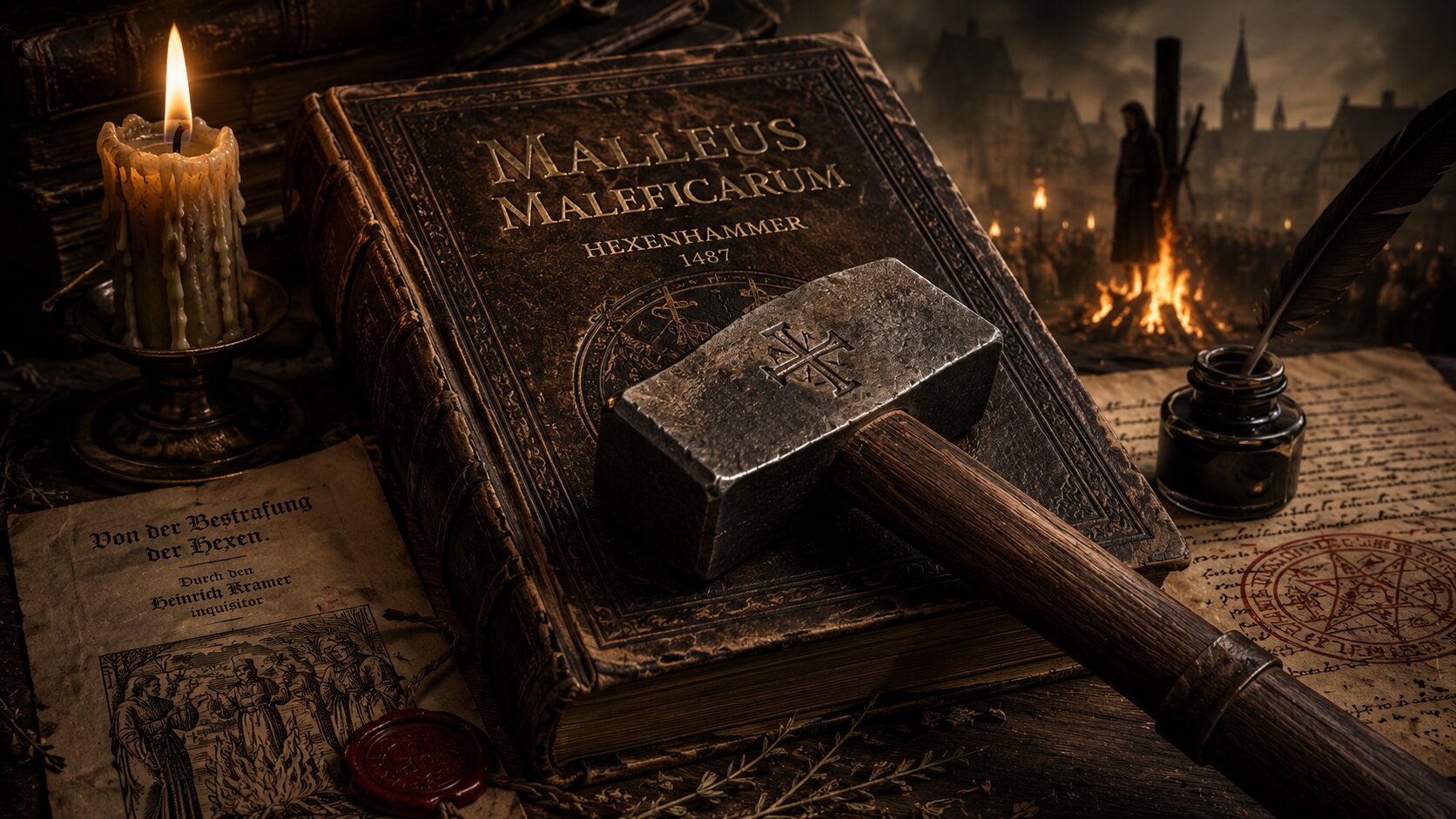
In 1487, a book was published in Germany that contained no groundbreaking scientific discoveries, no revolutionary philosophy, and no tales of great military victories or distant lands. It promised neither wealth nor glory to its readers. Yet for nearly two centuries, this single volume became required reading for judges, inquisitors, magistrates, and officials across Europe.
Its title was Malleus Maleficarum—The Hammer of Witches.
Today, it is often described as one of the most dangerous books ever written. Historians continue to debate how much influence it truly exercised over the witch hunts of early modern Europe, but one fact is difficult to dispute: the Malleus Maleficarum transformed scattered accusations of witchcraft into a systematic legal process by providing authorities with detailed instructions on how to identify, interrogate, convict, and execute supposed witches.
Ironically, a book written in the name of defending Christianity became one of history’s most enduring symbols of mass hysteria, fear, and judicial injustice.
A World Where the Devil Was as Real as Disease
To understand why the Malleus Maleficarum became so influential, we must first set aside our modern worldview.
For a European living in the fifteenth century, the existence of Satan was no more questionable than the changing of the seasons. A mysterious illness could easily be interpreted as a curse. A failed harvest might be blamed on witchcraft. A violent hailstorm that destroyed crops was often seen not as a natural phenomenon but as the work of demonic forces.
People lived in a world where the supernatural was woven into everyday life.
If a farmer lost his livestock and, a few days later, his child fell seriously ill, suspicion could quickly fall upon a lonely widow, an elderly herbalist, or an unpopular neighbor. Rational explanations for disease, weather, or misfortune simply did not exist.
The Church itself did not deny the existence of demons. On the contrary, spiritual warfare against the Devil was considered one of Christianity’s greatest responsibilities.
Yet before the fifteenth century, the idea of a vast international conspiracy of witches was far from universally accepted.
Who Wrote the Hammer of Witches?
The Malleus Maleficarum was written by two Dominican friars: Heinrich Kramer (also known by his Latin name, Henricus Institoris) and Jacob Sprenger.
Of the two, Kramer was unquestionably the driving force.
As an inquisitor in the Holy Roman Empire, Kramer genuinely believed that Europe stood on the brink of an unprecedented war against Satan himself. In his view, witches entered into pacts with the Devil, gathered at secret nocturnal assemblies, destroyed crops, spread disease, murdered infants, and wielded supernatural powers capable of threatening Christian civilization.
The problem was that not everyone in the Church agreed with him.
In 1485, Kramer attempted to prosecute several women accused of witchcraft in Innsbruck. The trial ended in humiliation. The local bishop rejected many of Kramer’s arguments, considered his methods excessive, and effectively removed him from the proceedings.
Rather than abandoning his campaign, Kramer responded by writing a book that would convince church authorities that witches represented an existential threat requiring uncompromising action.
That book became the Malleus Maleficarum.
More Than Theology—A Practical Manual for Witch Hunters
What made the Malleus Maleficarum unique was not its discussion of demons.
Medieval Europe already possessed countless theological works dealing with Satan, angels, miracles, and the supernatural.
The true innovation of the Hammer of Witches was its practical nature.
It functioned almost like a procedural handbook for judges.
The authors explained:
- why witches supposedly existed;
- how to recognize one;
- what questions should be asked during interrogation;
- when torture should be employed;
- how confessions should be interpreted;
- what constituted acceptable evidence;
- and under what circumstances an accused person should be executed.
To a modern reader, many of these arguments appear astonishingly irrational.
If the accused woman cried during questioning, her tears could be interpreted as proof of guilt.
If she remained calm and did not cry, that too could be considered evidence against her.
If she denied the accusations, it meant the Devil was protecting her.
If she confessed, then her guilt had been established beyond doubt.
It was a perfect closed circle from which escape was nearly impossible.
Why Were Most Accused Witches Women?
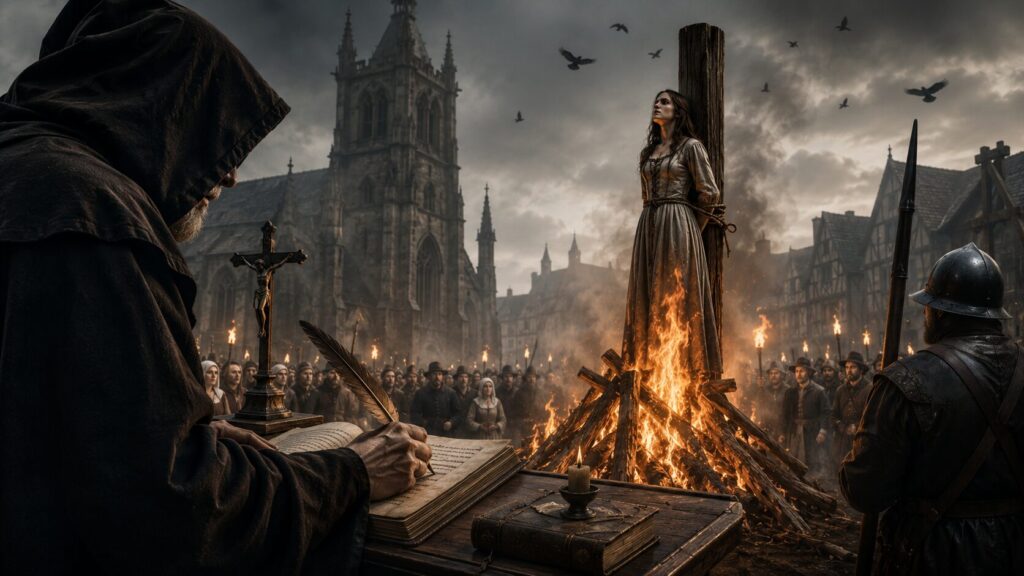
One of the most notorious sections of the Malleus Maleficarum focuses specifically on women.
Kramer argued that women were naturally more susceptible to temptation, emotionally weaker, spiritually unstable, and therefore far more likely to become servants of Satan.
Today such claims are recognized as deeply misogynistic.
Yet in the late fifteenth century they resonated with many educated Europeans because they reflected a mixture of classical philosophy, medieval medicine, and long-established religious stereotypes.
As a result, women became the overwhelming majority of those accused during the European witch hunts.
Men were certainly prosecuted as witches as well, but they represented only a minority of the victims.
Printing Changed Everything
The timing of the Malleus Maleficarum‘s publication proved extraordinarily important.
Only a few decades earlier, Johannes Gutenberg had revolutionized Europe through the invention of movable-type printing.
Before printing presses, a work like the Hammer of Witches could exist only in a handful of handwritten manuscripts.
Now it could be reproduced rapidly and distributed across the continent.
During the sixteenth century, new editions appeared again and again. Universities, courts, monasteries, and legal libraries acquired copies.
In many respects, the Malleus Maleficarum became one of Europe’s first true bestsellers.
Its ideas spread faster than any previous treatise on witchcraft ever could.
Did This Book Really Kill Tens of Thousands?
This is where history becomes more complicated than popular culture often suggests.
Movies, novels, and documentaries frequently portray the Hammer of Witches as the single cause of Europe’s witch hunts.
Professional historians are far more cautious.
The book undoubtedly influenced legal thinking about witchcraft and served as a reference for numerous judges and inquisitors.
However, it never became official canon law for the Catholic Church.
In fact, even shortly after its publication, many theologians criticized it for its extreme conclusions and weak legal reasoning.
The largest wave of witch trials did not occur immediately after the book appeared.
Instead, the most intense persecutions took place during the sixteenth and seventeenth centuries, when Europe was suffering from religious wars, epidemics, climate deterioration during the Little Ice Age, repeated crop failures, economic crises, and widespread political instability.
Under such conditions, societies often searched desperately for someone to blame.
The Malleus Maleficarum offered ready-made answers.
The End of the Age of Witch Hunts
Gradually, belief in organized conspiracies of witches began to fade.
Scientific discoveries, advances in medicine, improvements in legal systems, and the growth of rational inquiry slowly undermined many of the assumptions upon which witch trials had depended.
By the eighteenth century, prosecutions for witchcraft had virtually disappeared throughout most of Europe.
The Hammer of Witches ceased to function as a legal handbook and instead became a historical document.
Today it is studied not because it tells us anything truthful about witches.
Rather, it reveals how dangerous fear can become when it replaces evidence, and how prejudice can be transformed into law.
The Legacy of the Malleus Maleficarum
The history of the Hammer of Witches is not really a story about magic.
It is a story about human psychology.
Whenever societies experience prolonged fear and uncertainty, they often seek someone to blame. Sometimes that target is a foreign enemy. Sometimes it is a religious minority. Sometimes it is a political opponent.
In Europe between the fifteenth and seventeenth centuries, that role increasingly fell upon alleged witches.
That is why the Malleus Maleficarum remains relevant more than five hundred years after its publication.
Not because it teaches us anything about witchcraft—but because it demonstrates how even educated people can come to accept extraordinary claims as unquestionable truth when those claims reinforce existing fears.
It is more than one of the most infamous books of the Middle Ages.
It is one of history’s clearest reminders that ideas can shape civilizations—and sometimes destroy lives far more effectively than armies or kings ever could.