Mirror Armor: How an Eastern Breastplate Became the Symbol of the Russian Warrior


Some pieces of armor are instantly recognizable, even to people with little interest in history. Gothic plate armor immediately evokes images of fifteenth-century European knights, the Japanese ō-yoroi is inseparable from the samurai, and the Roman lorica segmentata has become one of the enduring symbols of the ancient world. Yet one remarkable type of armor remains largely forgotten despite protecting Russian noble cavalrymen and commanders for nearly two centuries. This was mirror armor—a distinctive combination of chainmail and large polished steel plates that gleamed brilliantly in the sunlight.
Many people assume mirror armor was invented in Russia. Museum displays certainly reinforce that impression: a Russian cavalryman wearing a tall eastern-style helmet, a long mail shirt, and a massive polished breastplate fixed over his chest has become one of the iconic images of Muscovite warfare. In reality, however, the story of mirror armor begins far from Moscow. To understand why Russian warriors of the sixteenth and seventeenth centuries wore what appeared to be a metal “mirror” on their chest, we must travel thousands of kilometers south to Persia.
It was there, among the flourishing cities and renowned armor workshops of the Iranian world, that an idea emerged which would eventually spread through Central Asia, the Timurid Empire, the Ottoman Empire, the steppe khanates, and finally into Muscovy, where it evolved into one of the defining symbols of the Russian mounted warrior. Even more fascinating is the fact that, at precisely the same time, European armorers were solving the same problem in an entirely different way.
The history of mirror armor is therefore much more than the story of another medieval cuirass. It is the story of two military civilizations responding to the same challenge: how to improve protection when traditional mail armor could no longer keep pace with increasingly powerful weapons.
Why Was It Called “Mirror Armor”?
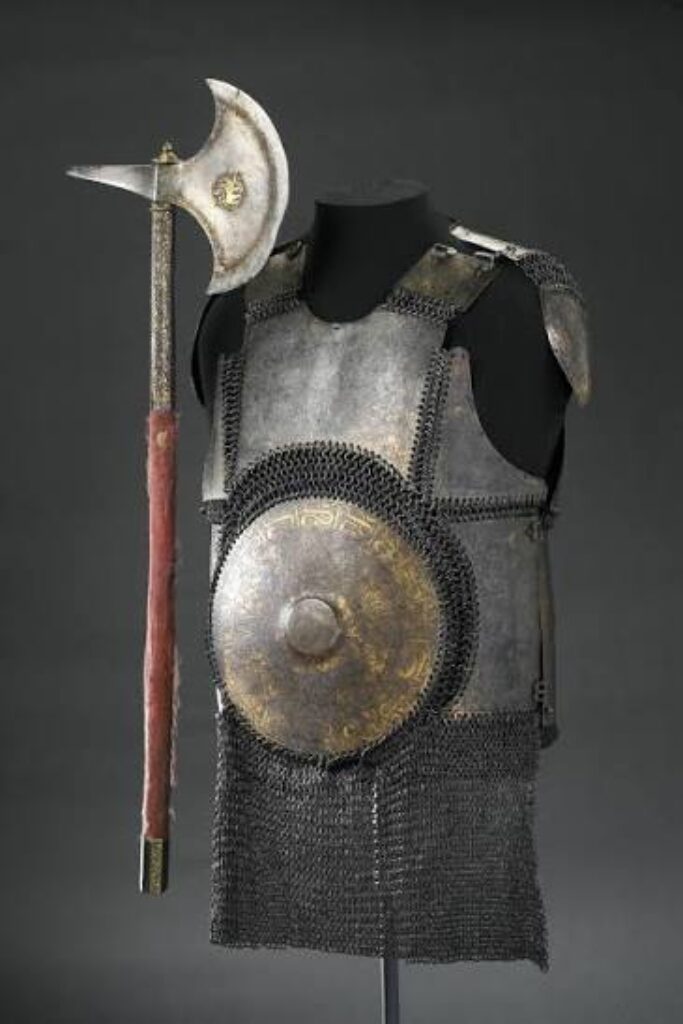
The name itself seems unusual to modern readers. Why would armor be associated with a mirror?
The answer lies in language. In Old Russian, the word zercalo originally referred not only to a mirror but to any carefully polished reflective metal surface. Before glass mirrors became common, polished bronze or steel served exactly that purpose. The large breastplates of this armor fit that definition perfectly.
These plates were painstakingly polished until they shone like mirrors. Many were decorated with silver inlay, gold damascening, engraved floral motifs, or religious symbols. Under bright sunlight they reflected light so intensely that the comparison became obvious.
In the cultures of the medieval East, these polished plates also carried symbolic meaning. Warriors believed that reflective metal could repel evil spirits, ward off misfortune, and protect the wearer from the “evil eye.” Armor was never merely functional—it also served as a talisman.
For that reason, mirror plates were rarely left plain. Persian examples often carried Quranic inscriptions or elaborate geometric decoration. When the design reached Muscovy, eastern inscriptions gradually gave way to Orthodox crosses, double-headed eagles, and Slavic ornamentation, yet the underlying concept remained unchanged: the mirror protected both the body and the spirit while displaying the owner’s status.
The Persian Origins: “Four Mirrors”
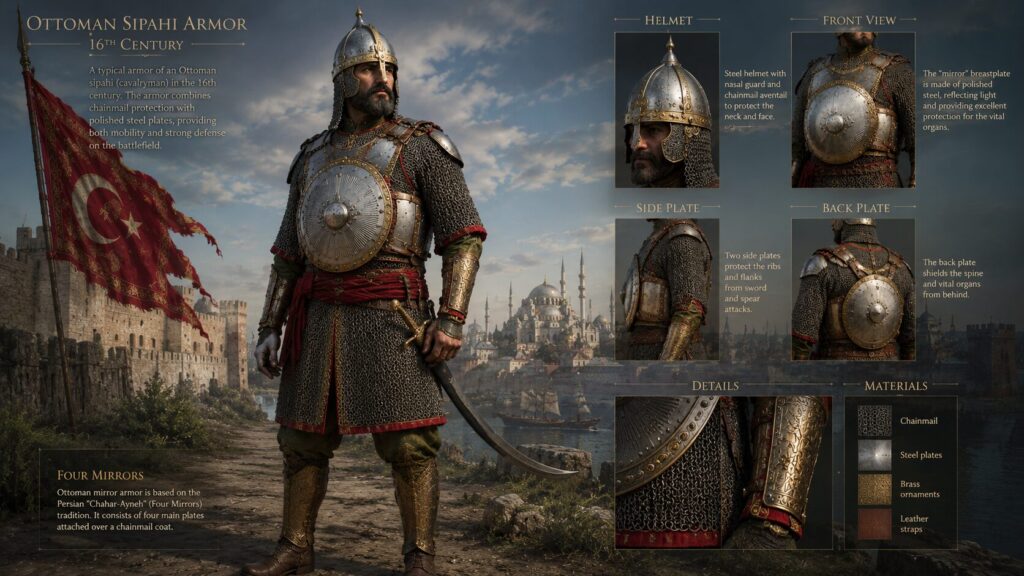
Contrary to popular belief, mirror armor did not begin as an entirely new form of armor. Instead, it was developed to improve an older one.
By the fourteenth and fifteenth centuries, Persian armorers realized that chainmail remained excellent protection against cuts but was increasingly vulnerable to powerful arrows, heavy lances, and crushing weapons. Rather than abandoning mail altogether, they reinforced its weakest areas with several large steel plates covering the chest, back, and sides.
This remarkably practical solution became known as Chahar-Ayneh, meaning “Four Mirrors.”
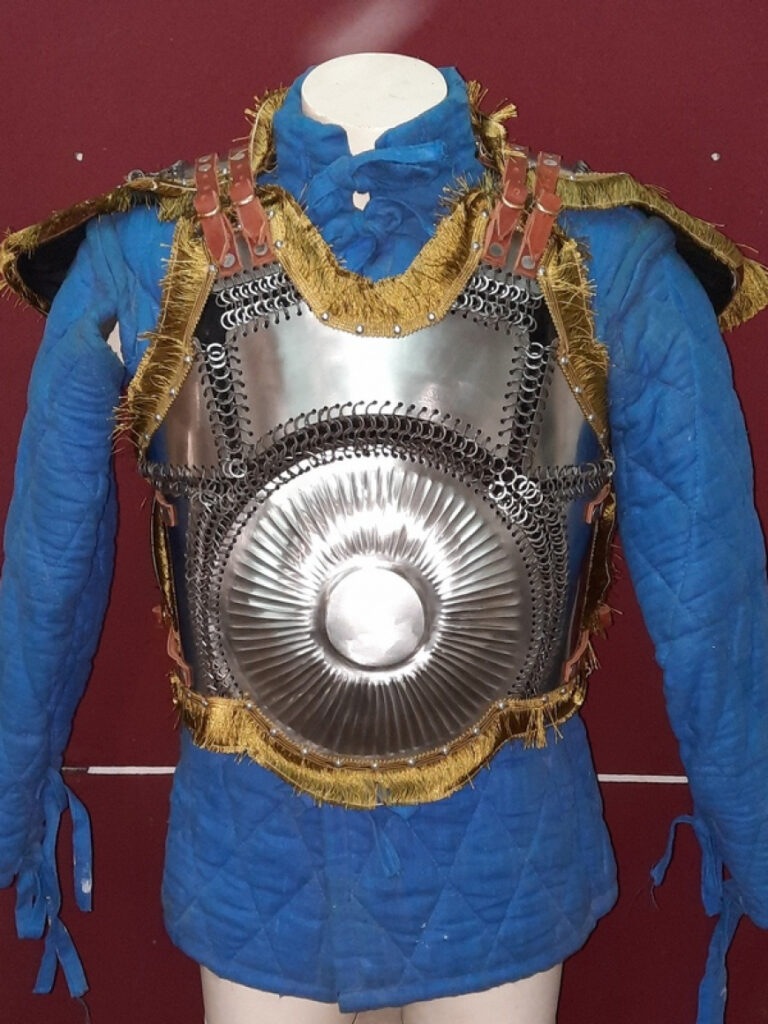
The name was entirely literal. A standard Persian set consisted of four large plates—a breastplate, a backplate, and two side plates—connected by straps or hinges and worn directly over a mail shirt.
The design proved extraordinarily successful. It preserved the flexibility of chainmail while dramatically increasing protection where it mattered most. Unlike a solid European cuirass, the four-plate system was relatively simple to manufacture, easier to repair, and adaptable to different body sizes.
From Persia the concept spread rapidly. It was adopted by the Timurids, Safavids, and Ottoman Turks, where it became popular among heavily armed cavalry. Through trade, diplomacy, and warfare, it eventually reached the Crimean Khanate and the lands bordering Muscovy.
There, the story entered a completely new chapter.
How Mirror Armor Reached Russia
Russia’s encounter with eastern military technology began long before the sixteenth century. Following the Mongol conquest, the Russian principalities spent more than two centuries in close contact with the Golden Horde. Alongside merchants, diplomats, and craftsmen came new weapons, military techniques, and armor designs.
Sabers gradually replaced straight swords. Composite bows became common among cavalry. Eastern helmets appeared beside traditional mail shirts. Mirror armor was simply another step in this long process of technological exchange.
Its widespread adoption, however, dates primarily to the late fifteenth and early sixteenth centuries, when Muscovy expanded rapidly while confronting the Crimean Khanate, Kazan, and the Ottoman Empire. Captured armor, imported equipment, and foreign craftsmen introduced Muscovite armorers to the eastern design.
Russian masters quickly recognized its advantages.
Unlike full European plate armor, mirror armor did not require the complex forging of large, anatomically shaped breastplates. Local workshops could produce it using existing chainmail as the foundation while adding several heavy steel plates over vital organs.
For a state whose military relied heavily on mounted noble cavalry rather than armored knights, it was an almost perfect solution.
Why Russia Did Not Adopt Full European Plate Armor
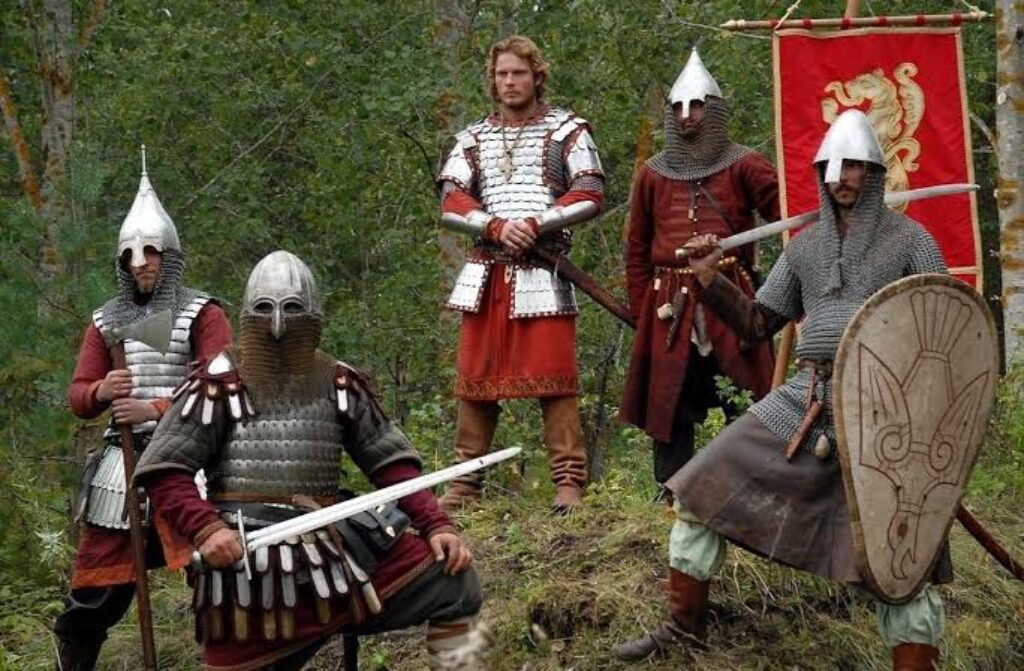
A common question naturally follows: if magnificent Gothic plate armor already existed in Western Europe, why did Russian cavalry continue wearing chainmail reinforced with mirror plates?
The answer lies not in technology but in warfare.
European full plate armor was designed for the battlefields of France, Burgundy, northern Italy, and the Holy Roman Empire. There, heavily armored knights fought in disciplined formations with long lances, relying on shock charges delivered by compact cavalry units.
The wars fought by Muscovy looked very different.
Its principal enemies were the Crimean Tatars, the Kazan Khanate, the Nogai Horde, the Grand Duchy of Lithuania, and later the Ottoman Empire. Fighting across the vast plains of Eastern Europe emphasized mobility, reconnaissance, mounted archery, raids, and rapid maneuver rather than direct clashes between heavily armored cavalry.
A Russian noble cavalryman often rode dozens of kilometers in a single day, crossed rivers, pursued raiding parties, and fought in constantly changing conditions.
Under such circumstances, the heaviest European tournament-style armor offered limited advantages.
Mirror armor represented a better balance between mobility and protection. Chainmail protected the limbs and allowed freedom of movement, while the steel mirrors safeguarded the chest and back against the most dangerous blows.
Rather than copying Western Europe, Muscovy developed its own military solution.
Armor Between East and West
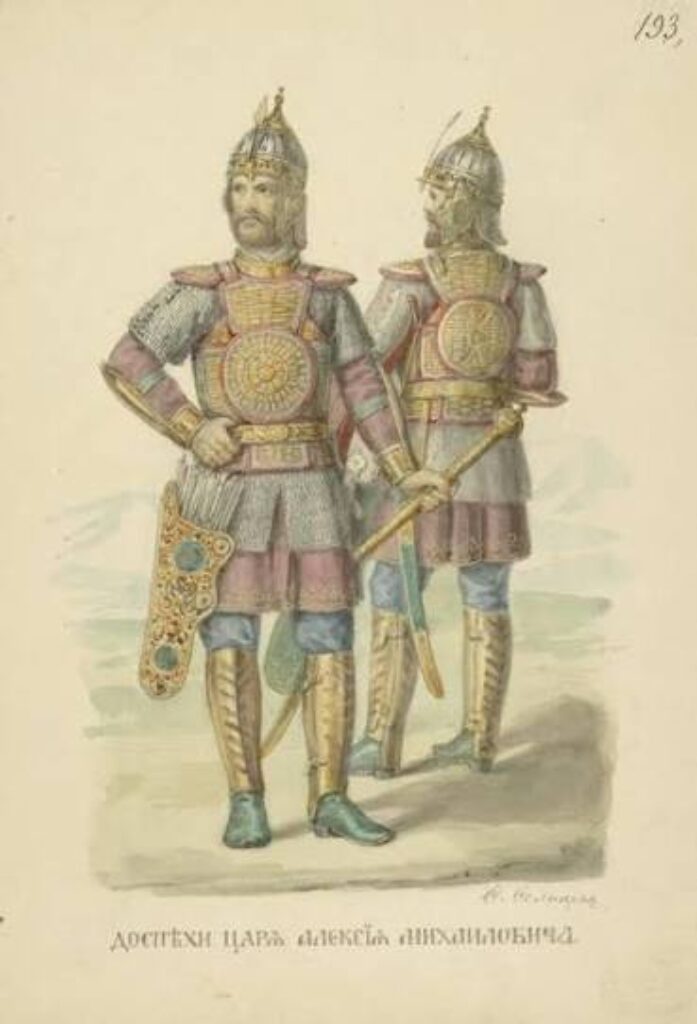
Mirror armor perfectly illustrates Russia’s unique position between two military worlds.
From the West came German and Polish armor, heavy cavalry tactics, and crossbows.
From the East came sabers, composite bows, lamellar armor, and eastern helmets.
Russian equipment combined both traditions into something entirely distinctive. A Muscovite cavalryman might wear a Persian-style helmet, a Russian mail shirt, a Turkish saber, a Tatar composite bow, and Persian-inspired mirror plates—all within a single armor set.
Foreign visitors frequently remarked that Russian cavalry looked unlike either European knights or Ottoman sipahis.
Mirror armor became one of the clearest symbols of this cultural and military fusion.
Who Wore Mirror Armor?
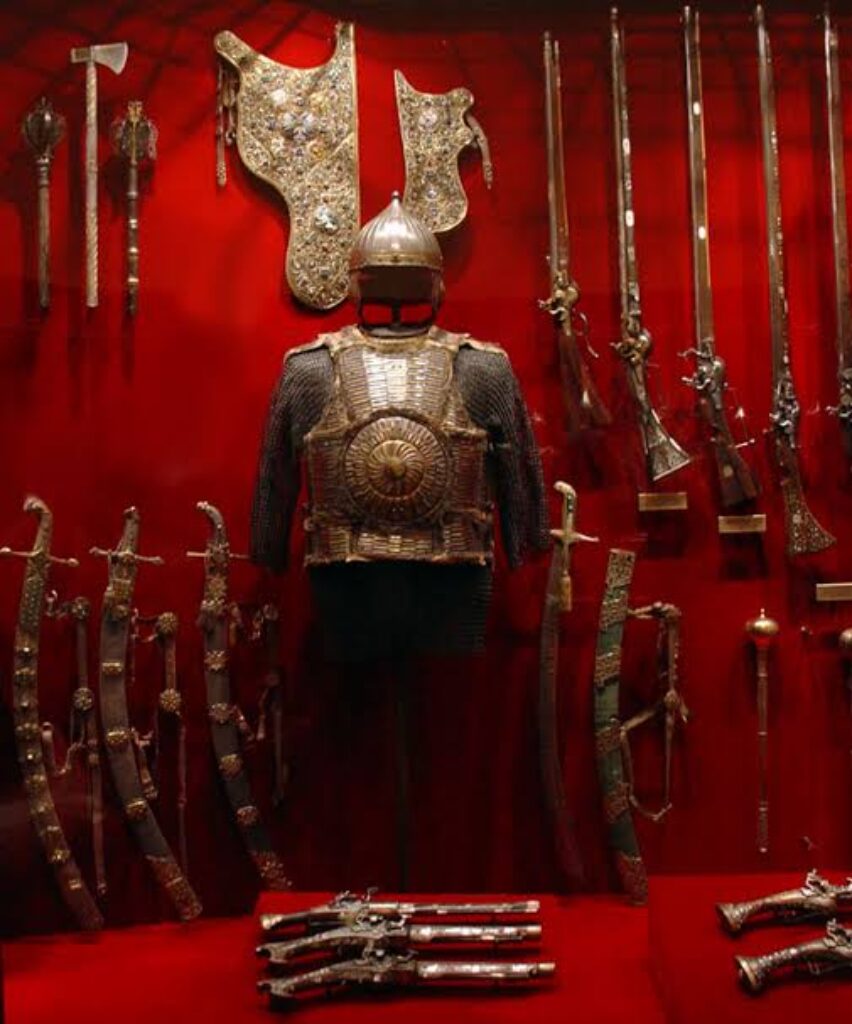
Although simpler than full European plate, mirror armor was never inexpensive.
High-quality steel, skilled forging, and elaborate decoration ensured that it remained the equipment of wealthier warriors.
It was primarily worn by members of the Muscovite service nobility, cavalry officers, governors, and high-ranking commanders. Particularly ornate examples featured gold damascening, silver inlay, engraved floral motifs, Orthodox crosses, and the double-headed eagle of the Russian state.
Several magnificent examples survive today in the collection of the Kremlin Armoury. Some are associated with the reign of Ivan IV (“Ivan the Terrible”) and the early Romanov dynasty.
These are no longer merely military artifacts—they are masterpieces of decorative metalwork.
The Final Century of Mirror Armor
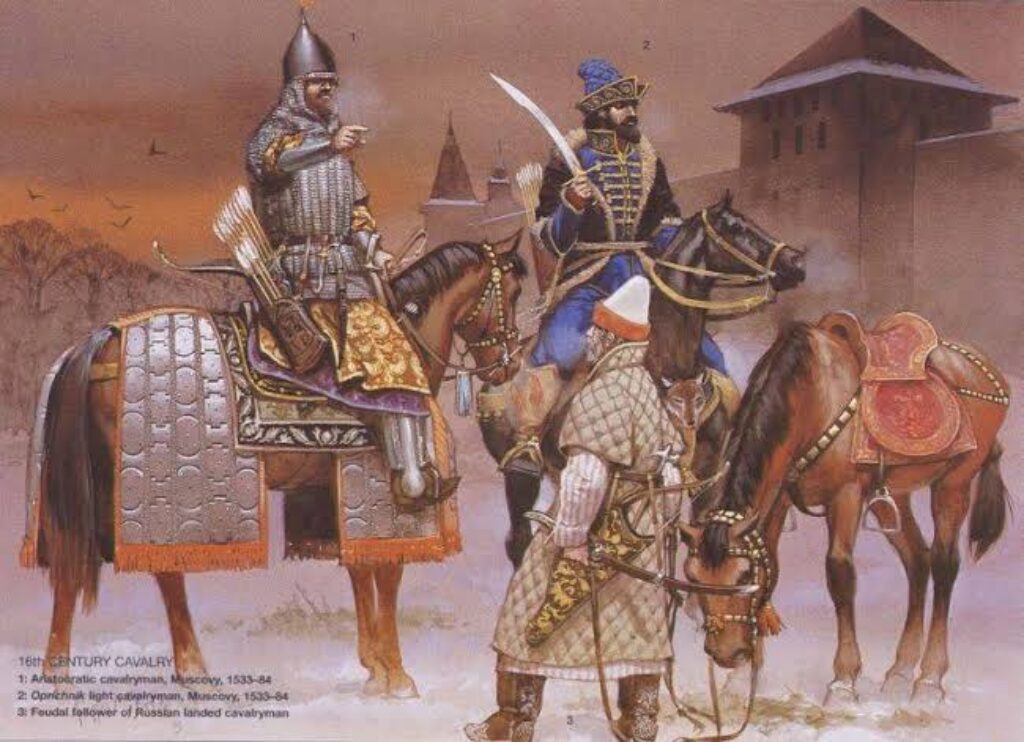
Like most forms of protective equipment, mirror armor did not disappear overnight.
It remained in active use during the Time of Troubles in the early seventeenth century and continued serving alongside traditional mail during the first decades of Romanov rule.
Its decline came with the rapid improvement of firearms.
As muskets became increasingly powerful throughout the seventeenth century, even thick steel plates could no longer guarantee protection. At the same time, Muscovy began adopting Western-style infantry formations and modernized cavalry units, gradually replacing older military traditions.
Mirror armor survived for a time as ceremonial equipment and a symbol of noble status before finally disappearing from active service.
A Symbol of an Entire Civilization
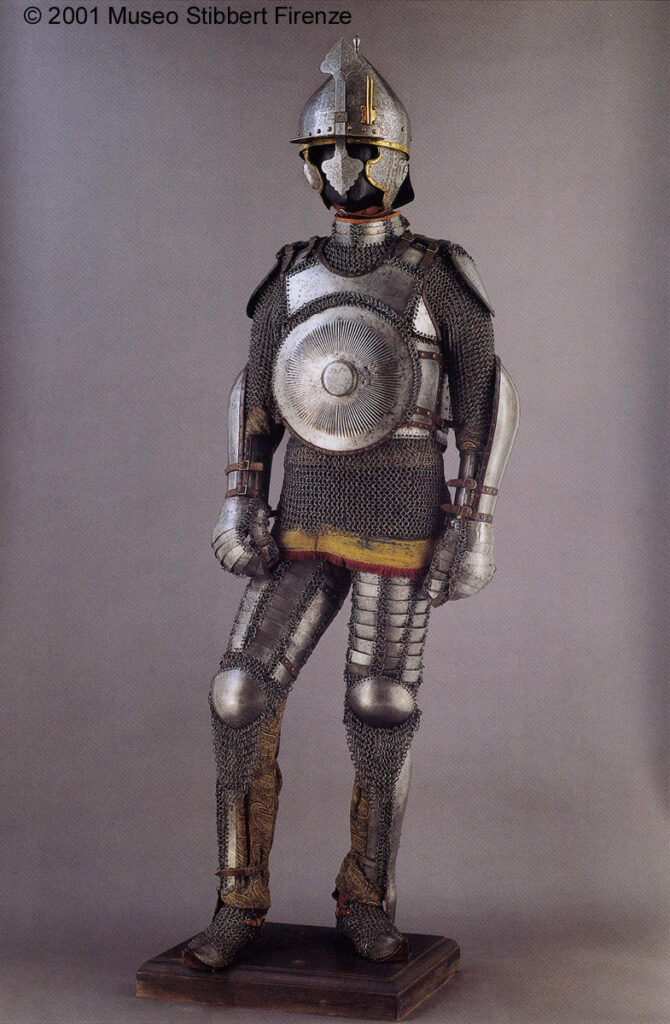
турецкий доспех
The story of mirror armor is remarkable because it is not the story of a single nation.
It is the story of an idea.
Born in the workshops of Persia, refined across Central Asia, adopted by Ottoman cavalry, carried through the steppe world, and ultimately transformed within Muscovy, mirror armor became one of the most distinctive expressions of Russian military culture.
While Europe perfected the full steel harness of the knight, the East continued refining the elegant simplicity of the “Four Mirrors.” Russia stood between those worlds, borrowing from both while creating something uniquely its own.
That is why mirror armor deserves to be remembered not simply as another type of medieval protection, but as one of history’s most fascinating examples of military innovation shaped by geography, culture, and centuries of conflict.