
A Weapon That Turns Off the Lights Instead of Destroying Cities
Modern warfare increasingly revolves not around the destruction of armies alone, but around attacks on infrastructure.
Electricity has become the bloodstream of industrial civilization. Without it, communication systems collapse, transportation stops, water supply systems fail, and modern economies begin to shut down almost immediately.
This is exactly the logic behind graphite bombs.
Unlike conventional bombs, their primary purpose is not massive physical destruction. Instead, they are designed to disable electrical infrastructure — power stations, substations, transformers, and transmission lines — often without directly demolishing the facilities themselves.
For this reason, graphite bombs are sometimes called “soft bombs” or “blackout bombs.”
How a Graphite Bomb Works
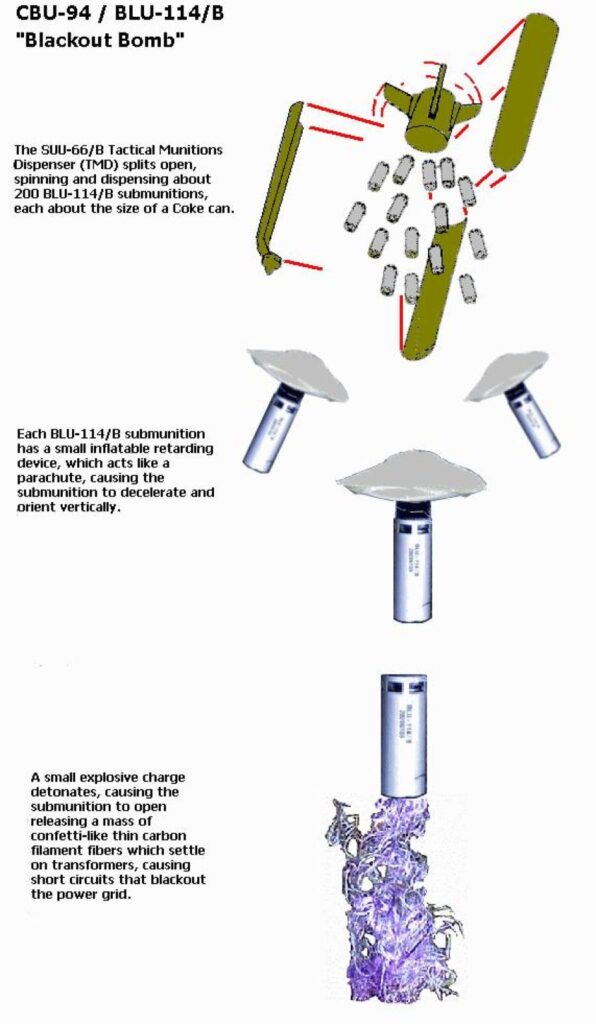
The principle behind the weapon is surprisingly simple.
A graphite bomb disperses enormous quantities of extremely thin conductive carbon filaments over electrical infrastructure. These fibers settle across transformers, switchyards, and high-voltage lines, creating short circuits.
The result is not a giant explosion.
Instead, electrical systems begin failing almost instantly.
Protective systems trip, substations shut down, transformers overload, and large sections of the grid can lose power simultaneously. Because modern electrical grids are deeply interconnected, failures in one area can cascade into much larger blackouts.
In some cases, the physical structures survive almost intact.
But the country still goes dark.
The American “Blackout Bomb”

The most famous graphite bomb developed by the United States was the BLU-114/B, used as part of the CBU-94 “Blackout Bomb.”
The system worked through cluster submunitions. After deployment, dozens or even hundreds of small canisters spread carbon filaments across electrical infrastructure.
The weapon saw combat use during several major conflicts.
During the Gulf War in 1991, U.S. forces reportedly used graphite-based weapons against Iraq, temporarily disabling around 85% of the country’s electrical supply.
Similar weapons were later used during NATO operations against Yugoslavia in 1999 and again during the Iraq War in 2003.
The effect was dramatic: cities suddenly plunged into darkness without the kind of large-scale physical devastation associated with conventional bombing campaigns.
A Weapon of Modern Infrastructure Warfare

Graphite bombs reveal an important shift in military thinking.
Traditional strategic bombing focused on physically destroying factories, bridges, and industrial centers. Graphite weapons instead attack the systems that allow modern society to function.
The target is not the building.
The target is connectivity.
Modern states depend on uninterrupted electricity for almost everything:
- communications;
- banking systems;
- transportation;
- hospitals;
- water treatment;
- military command systems.
A successful blackout can create national paralysis even when much of the infrastructure remains structurally intact.
Why They Are Considered “Humane” — and Why That’s Debatable
Graphite bombs are often described as relatively “humane” weapons because they usually cause limited immediate blast damage and lower direct civilian casualties compared to conventional bombing.
But this description is highly controversial.
Modern societies cannot function without electricity. Long-term blackouts affect hospitals, sanitation systems, refrigeration, communications, and water supply. Even if the bomb itself does not directly kill civilians, the indirect consequences can become severe.
In this sense, graphite bombs belong to a category of weapons designed not merely to destroy targets, but to destabilize entire systems.
The Return of the Blackout Weapon
In recent years, interest in graphite weapons appears to be growing again.
China publicly showcased a graphite-based “blackout bomb” concept in 2025, presenting it as a weapon capable of disabling large sections of electrical infrastructure.
South Korea has also reportedly worked on similar systems intended for use against North Korean infrastructure.
And during recent conflicts, reports periodically emerge about alleged graphite-based attacks on power systems, though such claims are often difficult to verify independently.
What is clear, however, is that modern warfare increasingly treats electrical infrastructure as one of the most critical targets on the battlefield.
The Invisible Strike
Perhaps the most unsettling aspect of graphite bombs is psychological.
A city hit by conventional bombing understands what happened immediately. Smoke, explosions, destruction — the attack is visible.
A graphite strike can feel different.
The lights simply go out.
Transportation stops. Phones die. Water systems fail. Entire cities suddenly lose the invisible systems that sustain modern life. And often, the infrastructure itself still appears physically intact.
This creates a strange form of warfare — one where the objective is not spectacle, but paralysis.
The Future of Infrastructure Warfare
Graphite bombs represent only one branch of a much broader evolution.
Modern militaries are increasingly exploring ways to disable infrastructure through cyberattacks, electromagnetic weapons, directed energy systems, and electronic warfare.
In this environment, the classic image of strategic bombing — cities reduced to rubble — may no longer be the only model of industrial war.
The wars of the future may focus less on destroying physical structures… and more on switching entire systems off.
And graphite bombs were one of the first weapons built specifically for that purpose.